

For many kinds of learning, actually writing or typing out the exercises is an essential part of internalizing a mental model. You cannot skip it!
The Mental Model FAQ
A summary of the conclusions from my Putting Mental Models to Practice series. What are mental models? How did mental models become so popular?
A Framework for Putting Mental Models to Practice
A Framework for Putting Mental Models to Practice is a series that examines the idea of putting Charlie Munger's Elementary Worldly Wisdom to practice in one's life in the pursuit of better decision making.

How to do hard things
A fully general system for learning to do things you currently find difficult, only somewhat tongue-in-cheek.
Mental Models: How to Train Your Brain to Think in New Ways
You can train your brain to think better. One of the best ways to do this is to expand the set of mental models you use to think. Let me…

The Busy Person's Guide to Thinking
Thinking better isn't about learning more; it's about doing a few simple things that really help create unstoppable progress.
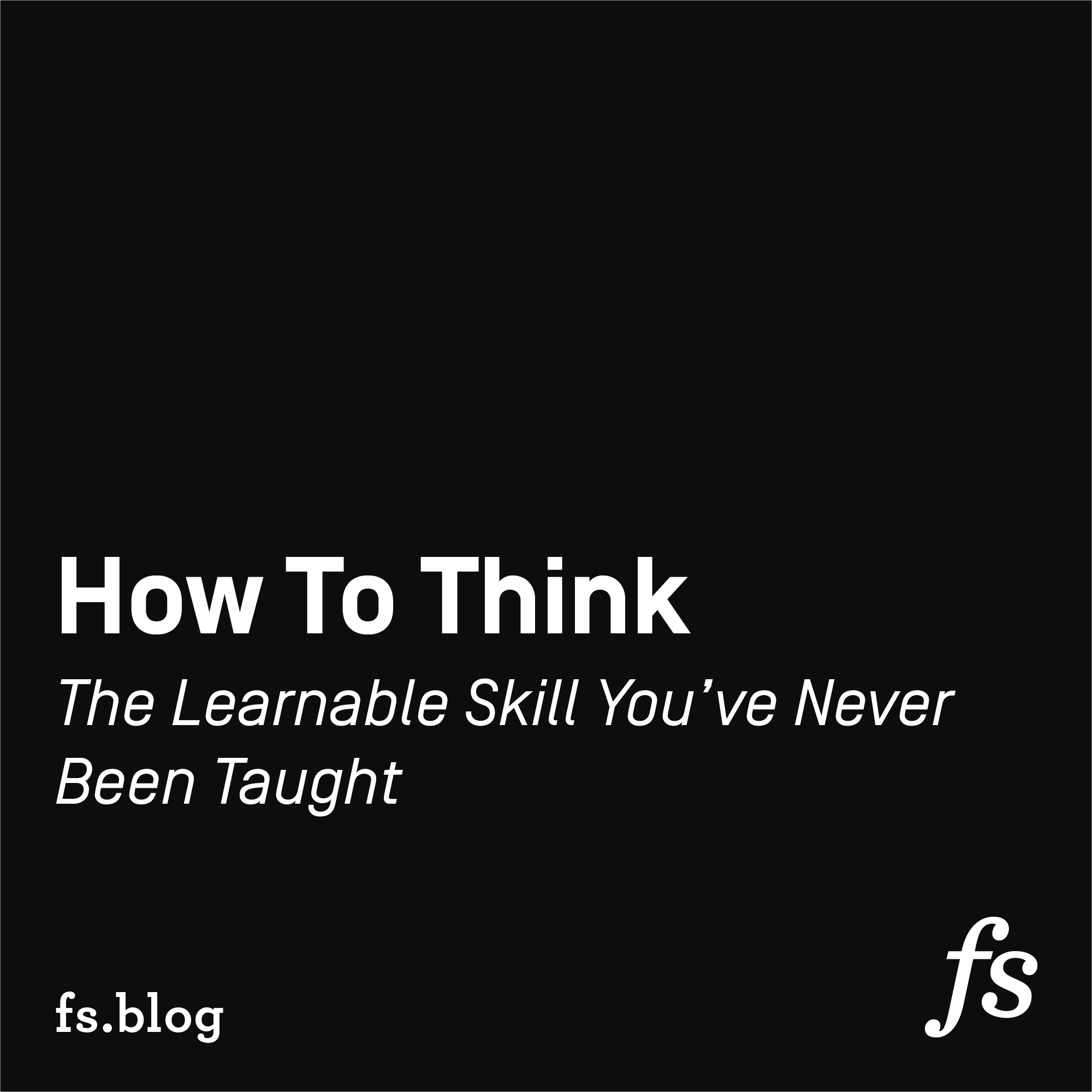
Cognitive Load Theory and its Applications for Learning - Scott H Young
What makes learning hard? How can we make it easier? Cognitive load theory explains how we learn and how to do it better.
Keating — The Hyperteacher
Socratic AI that forces you to reconstruct understanding from memory. No hand-holding. No spoon-feeding. Free and open source.

Thoughts on thinking | Hacker News
The process of forming expressions just is the process of conceptual and rational articulation (as per Brandom). Those who misunderstand this -- believing that concepts are ready made, then encoded and decoded from permutations of tokens, or, worse, who have no room to think of reasoning or conceptualization at all -- they will be automated away.
machines will never understand language
I thought language was too complicated for machines to understand, until I got sick. a lifelong, meandering journey of parsing, learning, and fixing my broken body.
The Triadic Mind: How Language Reveals the Limits of Human Cognition
Languages are the most complex symbolic systems humans have ever created. Yet children acquire them effortlessly, without formal…

François Chollet on Twitter / X
Eventually, much of AI will converge towards intuition-guided symbolic world modeling, i.e. deep learning-guided program synthesis. It is inevitable. Symbolic modeling lets a system construct a compact, reusable, highly generalizable mental model of a problem space using minimal…— François Chollet (@fchollet) July 2, 2026
Position: Stop Anthropomorphizing Intermediate Tokens as Reasoning/Thinking Traces!
Intermediate token generation (ITG), where a model produces output before the solution, has become a standard method to improve the performance of language models on reasoning tasks. These intermediate tokens have been called \say{reasoning traces} or even \say{thinking traces} -- implicitly anthropomorphizing the traces, and implying that these traces resemble steps a human might take when solving a challenging problem, and as such can provide an interpretable window into the operation of the model's thinking process to the end user. In this position paper, we present evidence that this anthropomorphization isn't a harmless metaphor, and instead is quite dangerous -- it confuses the nature of these models and how to use them effectively, and leads to questionable research. We call on the community to avoid such anthropomorphization of intermediate tokens.
afterword
Writing this handbook has been a process of not over-thinking it. In deciding to do it post-by-post, day-by-day, I practiced sharing as I went, posting to a ...

Notation as a Tool of Thought

Notation is not a way of writing thoughts down — it is a technology that determines which thoughts are available to be had. Starting from Iverson's 1979 Turing Award lecture, this collection gathers the argument's ancestors, elaborations, and its opponents: Nielsen and Matuschak on media as cognitive infrastructure, Bret Victor's case against symbol manipulation, and empirical work on representation as a cognitive tool. Open to contributions.
The Technological Turn in Mathematics
J Notation as a Tool of Thought

Prof. Judy Fan: Cognitive Tools for Making the Invisible Visible
Media for Thinking the Unthinkable
Kill Math
Using spaced repetition systems to see through a piece of mathematics