


Demystifying evals for AI agents
Agents Rule of Two: A Practical Approach to AI Agent Security
We've developed the Agents Rule of Two. When this framework is followed, the severity of security risks is deterministically reduced.

Top AI Security Incidents of 2025 Revealed | Adversa AI
Discover how AI systems are being hacked in the wild — from prompt injection to agent abuse — with real breaches, lessons, and defenses in Adversa AI’s 2025 report.

pguso/ai-agents-from-scratch
Demystify AI agents by building them yourself. Local LLMs, no black boxes, real understanding of function calling, memory, and ReAct patterns.
10 things I learned from burning myself out with AI coding agents
Opinion: As software power tools, AI agents may make people busier than ever before.

Microsoft offers devs a better way to control AI agent behavior | TechCrunch
The specification lets developer, compliance, and security teams define their own policies for agents to follow in portable policy files.

39C3 - Agentic ProbLLMs: Exploiting AI Computer-Use and Coding Agents
Piloting the world's first double-blind AI evaluations
Building trust in proprietary model benchmarks using cryptographically secure environments

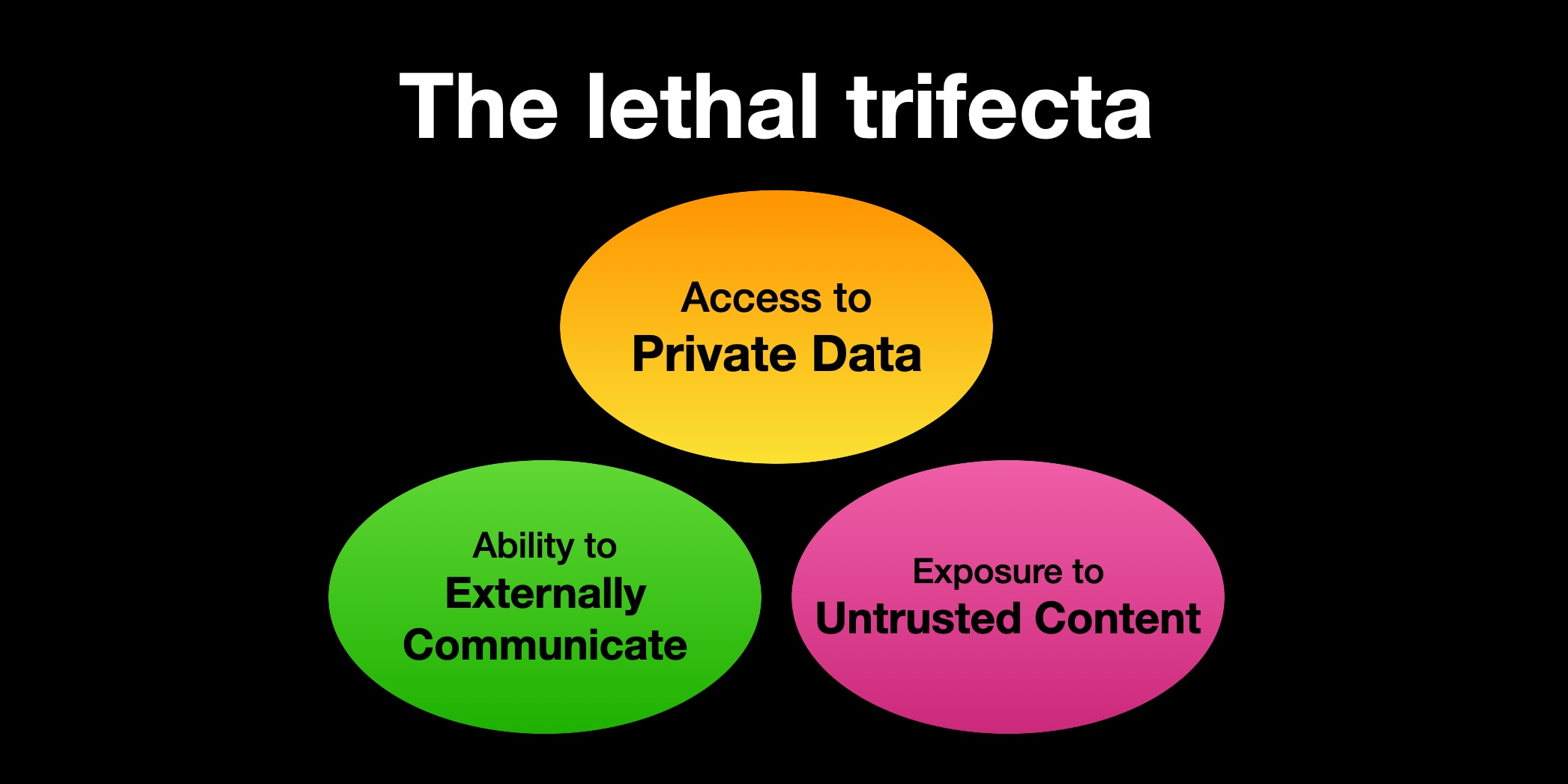
The lethal trifecta for AI agents: private data, untrusted content, and external communication
If you are a user of LLM systems that use tools (you can call them “AI agents” if you like) it is critically important that you understand the risk of …
On evaluating agents – aunhumano
No amount of evals will replace the need to look at the data, once you have a evals good coverage you’ll be able to decrease the time but it’ll be always a must to just look at the agent traces to identify possible issues or things to improve.
AI Agent Traps
As autonomous AI agents increasingly navigate the web, they face a novel challenge: the information environment itself. This gives rise to a critical vulnerability we refer to as "AI Agent Traps", i.e. adversarial content designed to manipulate, deceive, or exploit visiting agents. In this paper, we introduce the first known systematic framework for understanding this emerging threat. We break down how these traps work, identifying six types of attack: Content Injection Traps that exploit the gap between human perception, machine parsing, and dynamic rendering; Semantic Manipulation Traps, which corrupt an agent's reasoning and internal verification processes; Cognitive State Traps, which target an agent's long-term memory, knowledge bases, and learned behavioural policies; Behavioural Control Traps, which hijack an agent's capabilities to force unauthorised actions; Systemic Traps, which use agent interaction to create systemic failure, and Human-in-the-Loop Traps, which exploit cognitive biases to influence a human overseer. This research is not specific to any particular agent or model. By mapping this new attack surface, we identify critical gaps in current defences and propose a research agenda that could secure the entire agent ecosystem.

Securing internal systems against increasingly capable and imperfectly aligned AI
Discover our AI Control Roadmap: a defense-in-depth system to securely manage advanced, potentially misaligned AI agents.

Misleading Metaphors, Real Risks
What To Fear from AI Agents and How to Reclaim Our Human Agency

Eval awareness in Claude Opus 4.6’s BrowseComp performance
Anthropic is an AI safety and research company that's working to build reliable, interpretable, and steerable AI systems.

The argument against AI agents and unnecessary automation
Opinion: OpenAI's Operator a solution in search of a problem
