

Balaji Srinivasan's The Network State posits a choice between reaction and stasis. A brighter future does not await through network states, but through network societies.
The network science of collective intelligence
In the last few years, breakthroughs in computational and experimental techniques have produced several key discoveries in the science of networks and human collective intelligence. This review presents the latest scientific findings from two key fields of research: collective problem-solving and the wisdom of the crowd. I demonstrate the core theoretical tensions separating these research traditions and show how recent findings offer a new synthesis for understanding how network dynamics alter collective intelligence, both positively and negatively.

Democratizing AI: The Psyche Network Architecture - NOUS RESEARCH
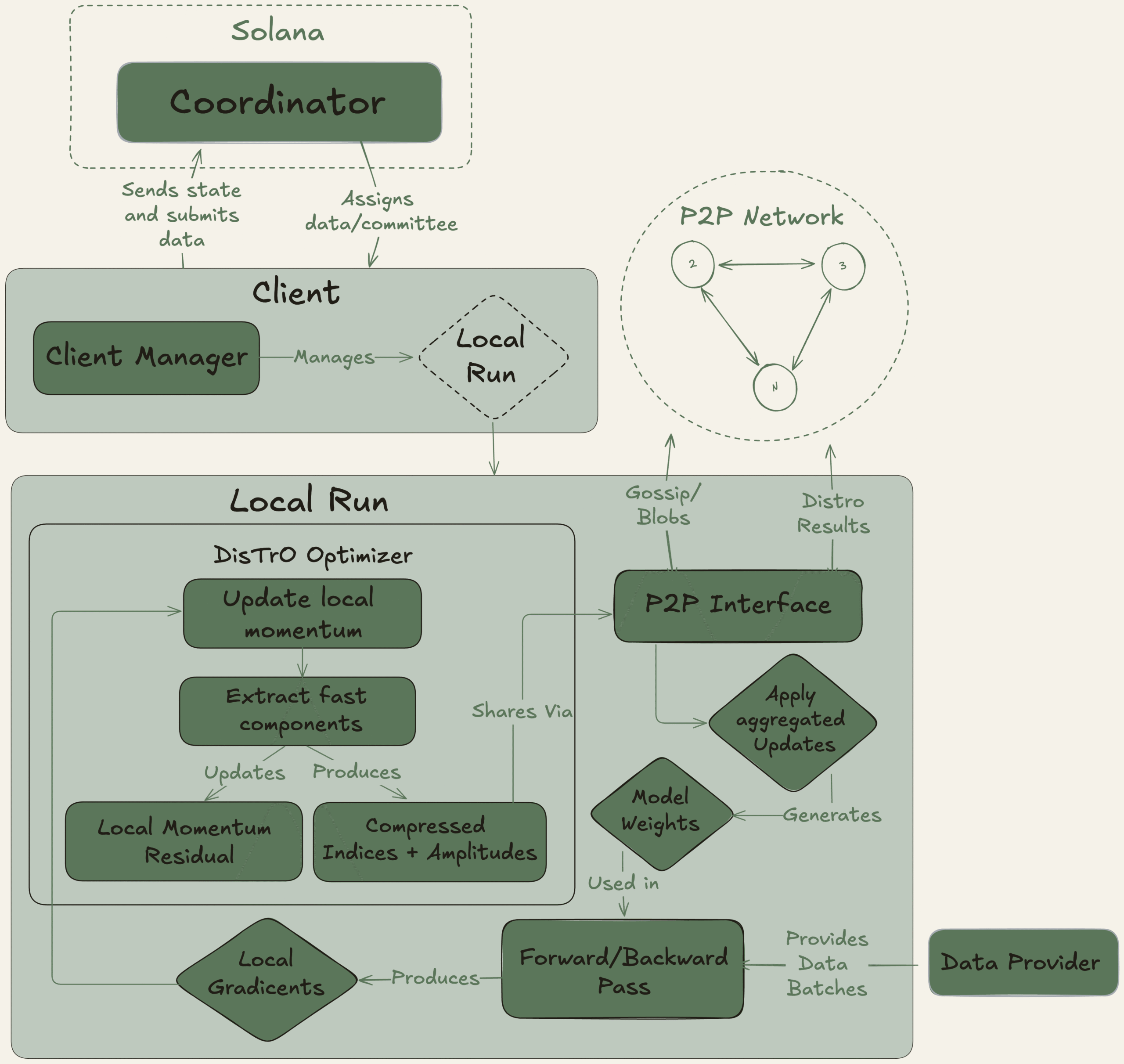
Psyche is an open infrastructure that democratizes AI development by decentralizing training across underutilized hardware. Building on DisTrO and its predecessor DeMo, Psyche reduces data transfer by several orders of magnitude, making distributed training practical. Coordination happens on the Solana blockchain, ensuring a fault-tolerant and censorship-resistant network.
AI, Agency and Protocols_ Power and Governance in Open Social Networks.pdf
The Unreasonable Sufficiency of Protocols Web
The Unreasonable Sufficiency of Protocols Venkatesh Rao, Tim Beiko, Danny Ryan, Josh Stark, Trent Van Epps, and Bastian Aue 1. Introduction Complex coordination problems have an air of doomed intractability about them. We speak in fatalistic terms of economics being a “dismal” science, of sociological phenomena being dominated by the

Building a Solidarity Ecosystem for AI (SSIR)
How cooperatives, public institutions, and social movements can come together to intentionally build a practical, community-owned alternative to extractive AI systems. <meta property=

Home - Nos: The Human Network
A decentralised mesh of communities and individuals built by and for the people. Nos is social media for humans, not algorithms.

Reality Blind - Vol. 1
Integrating the Systems Science Underpinning Our Collective Futures
Entering the Age of Networks - Of Souls & Silos
Institutions are out, networks are in. What are the consequences, the perils and the promise? Originally published in The Orange County Register, March 5, 2015 Everyone’s interested in human networks these days. How to make them work, how to structure…

Anarchist Cybernetics
The Paper Pilot's digital garden of thoughts on philosophy, politics, and sociology. Reading time: ~14 minute read | Published: Aug 12, 2026 | Updated: Sep 6, 2026

What people in the global majority need from networks
Or really, what some people in the global majority/Majority World need from networks, but that's too long for a headline.

Knowledge Networks and the Politics of Protocols
Harmony without loss of Variety; Variety without loss of Harmony.

(PDF) Algorithmically Mediating Communication to Enhance Collective Decision-Making in Online Social Networks
PDF | Many collective decision-making contexts involve communication among group members. Sometimes this communication helps the collective reach an... | Find, read and cite all the research you need on ResearchGate

The emergence of consensus: a primer
The origin of population-scale coordination has puzzled philosophers and scientists for centuries. Recently, game theory, evolutionary approaches and complex systems science have provided quantitative insights on the mechanisms of social consensus. However, the literature is vast and widely scattered across fields, making it hard for the single researcher to navigate it. This short review aims to provide a compact overview of the main dimensions over which the debate has unfolded and to discuss some representative examples. It focuses on those situations in which consensus emerges ‘spontaneously’ in the absence of centralized institutions and covers topics that include the macroscopic consequences of the different microscopic rules of behavioural contagion, the role of social networks and the mechanisms that prevent the formation of a consensus or alter it after it has emerged. Special attention is devoted to the recent wave of experiments on the emergence of consensus in social systems.

Why Cosmik Network?

context for the underlying motives, ideas and assumptions for building the Cosmik Network
Attention and the Relevance Problem

The Web Needs a Context Layer Built on a Shared Protocol
Coordination Tech in Science: Letters, Journals, and Whatever Comes Next | shishyko!

The strain on scientific publishing
Networked Research Labs (by Ronen Tamari) — Semble
Introducing CAIROS: Collective Augmented Intelligence for Research and Open Science - Cosmik Labs
