

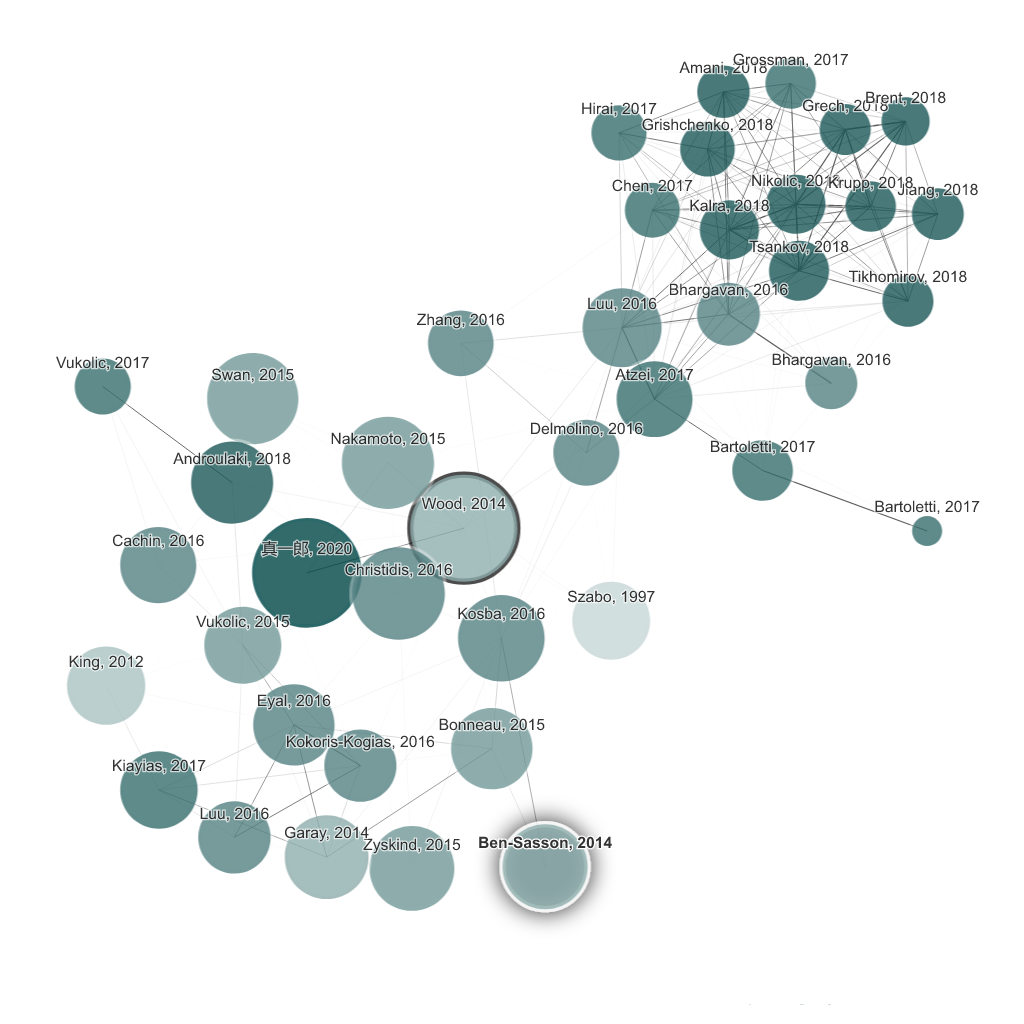
A unique, visual tool to help researchers and applied scientists find and explore papers relevant to their field of work.
Connected Papers | Find and explore academic papers
A unique, visual tool to help researchers and applied scientists find and explore papers relevant to their field of work.
The new way we’ll do science
Papers should become human-readable views over a graph of data, tools, results, and certificates.

The Research Nexus vision for a more connected scholarly community
Crossref envisions “a rich and reusable open network of relationships connecting research organizations, people, things, and actions; a scholarly record that the global community can build on forever, for the benefit of society”. This Research Nexus expands on the importance of research objects being persistently and uniquely identified. The scholarly community has an established practice of connecting things such as citations to others’ work and it is increasingly critical to identify relationships beyond citations, bringing together published work, unpublished work, institutions, individuals, and identifying the actions that they take e.g., funding, publishing, creating, modifying, citing, and sharing. The Research Nexus brings together metadata and relationships to build a joined-up picture of the scholarly ecosystem and helps everyone identify these relationships and how they change through time. This vision is possible if all parts of the scholarly ecosystem (and beyond) work together, including various scholarly infrastructure organizations.

Paper page - Knowledge Navigator: LLM-guided Browsing Framework for Exploratory Search in Scientific Literature
Join the discussion on this paper page

Paperstars
A better way to evaluate scientific papers. Methodological soundness and transparency, not citation counts.
Claude and Paper - Peter Van Dijck's homepage
I've always done a lot of engineering work on paper, figuring out relationships, page layouts, models, UX etc.
Working notes on the role of vision papers in basic science
Many of the papers I most admire are vision papers1. Rather than abstractly define what a vision paper is, here's a list of a few examples of such papers, to convey the gist:
Paper Skygest Team (@paper-feed.bsky.social)
Building personalized Bluesky feeds for academics! Pin Paper Skygest, which serves posts about papers from accounts you're following: https://bsky.app/profile/paper-feed.bsky.social/feed/preprintdigest. By @sjgreenwood.bsky.social and @nkgarg.bsky.social
Open Sourcing Scientific Research with Lab Discourse Graphs
Hyperlink Academy
It's a lightweight collaborative publishing tool for quick tiny docs that can grow into rich creative surfaces ✨🌱
A budding discipline around how science gets read and judged - Aris
Scholarly publishing spent thirty years arguing about access. It has barely begun arguing about what readers do with the paper once they have it. At Aris we call that second argument scholarly interface design. Mike Morrison's community calls it ScienceUX. Either way it is becoming a field, and here is why it is worth your attention.
Great survey of the "scholarly interface design" frontier that also highlights the emerging role of the atproto.science and modular research ecosystems - @chive.pub @paperstarsorg.bsky.social @cosmik.network @semble.so @margin.at @discoursegraphs.bsky.social @curvenote.com and many more!

leotrs
1/ Scholarly publishing spent thirty years arguing about access. It has barely started arguing about what readers do with the paper once they have it. That second argument is turning into a field, forming around how science gets read and judged. Here is the map as I see it: aris.pub/blog/scholarly-interface-desi…
I was just thinking this as I was scrolling arXiv recently, how cool it would be to have those papers published as at://records and to be able to see all the links between them.

Ronen Tamari
"The properties that make AT Protocol compelling for social networking are the same properties the research community has been asking for" Exciting vision for the future of science publishing on ATProto @row1.ca @opensci.dev @nokome.bsky.social #ATScience
Personal Journal Club

Papers papers papers
Cognitive Architectures for Language Agents

Thinking—Fast, Slow, and Artificial: How AI is Reshaping Human Reasoning and the Rise of Cognitive Surrender

Warnings for pattern matching
Retrieval-Augmented Code Generation: A Survey with Focus on Repository-Level Approaches
Lost in the Middle: How Language Models Use Long Contexts
TDOP Pratt


