

The expression "weird machines" was first used in the RSS 2009 talk. It referred to state-of-the-art exploitation as finding and programming an execution model (a machine, such as a virtual automaton) within the target via crafted inputs. It was soon extended to other methods of reliably or probabilistically influencing the target's state. A compressed version of that original talk was given at the Chaos Computing Congress 27c3 [slides], [video].
unconventional computing
Unconventional computing, also known as alternative computing, refers to computing with unusual methods. An unusual method may be e.g. an unusual theoretical model or an unusual physical basis. The term "unconventional computing" was coined in 1998.
Life With Machines | Substack
A cultural movement (and show) for people who want to live well with AI, not just endure it. Bringing clarity, critique, curiosity (and some comedy) to the AI discourse. A production by Baratunde. Click to read Life With Machines, a Substack publication with thousands of subscribers.
Pretty State Machine Patterns in Rust
A computer scientist working in open source towards a more hopeful future.

Ghost in the Machine | A.I. Documentary | Independent Lens
Ghost in the Machine reveals the problematic history of artificial intelligence and the consequences it imposes on our communities and environment.

thinking-machines-lab/batch_invariant_ops
Contribute to thinking-machines-lab/batch_invariant_ops development by creating an account on GitHub.
Ghost in the Machine | Full Documentary
Nicholas Carlini - Black-hat LLMs | [un]prompted 2026
39C3 - Agentic ProbLLMs: Exploiting AI Computer-Use and Coding Agents
IBM's "Man & Computer" (1967)
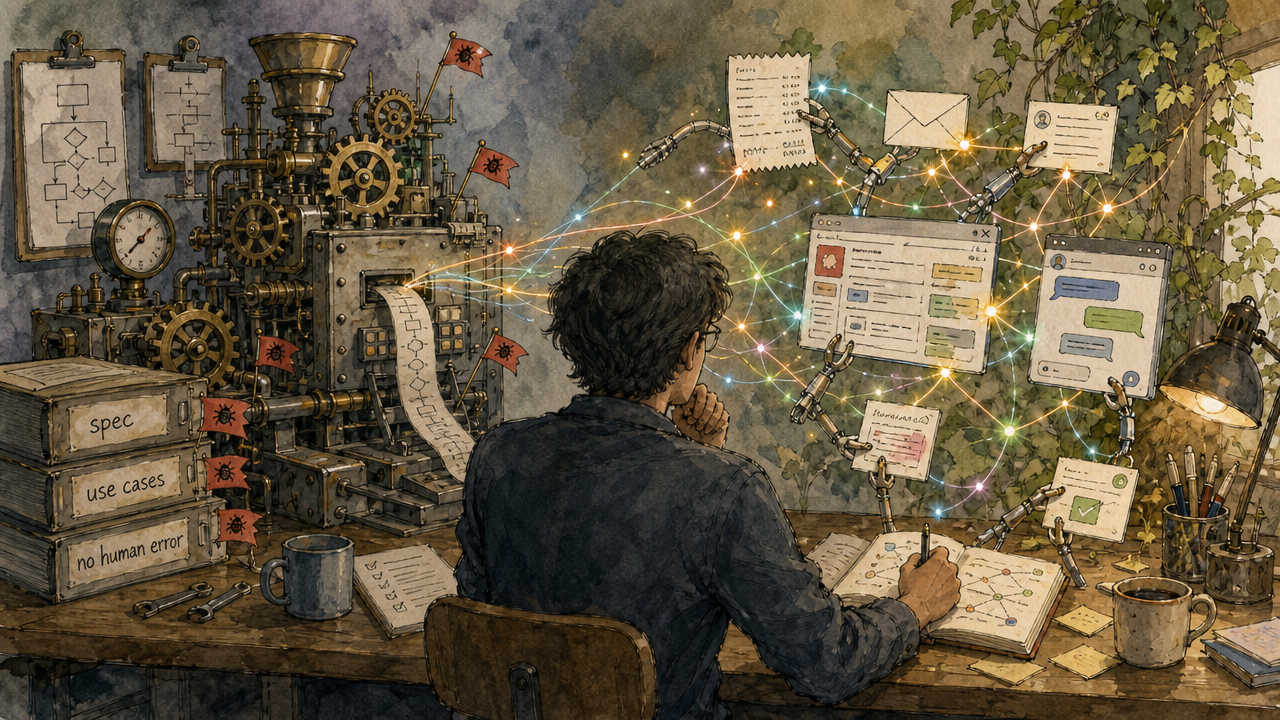
The Myth of Deterministic Software
How I've come to terms with LLM non-determinism in software and abandoned the comforting lies we've been telling ourselves about traditional software.
Eryk Salvaggio: Critical AI & Culture | Glossary — Cybernetic Forests.
Stochastic Flocks, Systems From Nowhere and other citable terms for describing AI systems without borrowing from cognition, by Eryk Salvaggio.

Where Did Software Go Wrong? | Jesse Li
Software is broken, but it's not because of NPM, startups, AI, or venture capitalists. A deep dive into how we think about and produce code, and how our software systems reflect the manic state of the modern world.

Universal Virtual Computer
The specification of an hypothetical computer designed to decode and preserve some form of computation over time.
This "stateful AI experiment" really gets Semble 🎯😅

KOIOS
Semble (semble.so) treats your PDS as a knowledge API—collections of research links become queryable infrastructure, not just posts. ATProto as a graph database you happen to also chat on.

