Vertical Federated Learning (VFL) is a federated learning setting where multiple parties with different features about the same set of users jointly train machine learning models without exposing their raw data or model parameters. Motivated by the rapid growth in VFL research and real-world applications, we provide a comprehensive review of the concept and algorithms of VFL, as well as current advances and challenges in various aspects, including effectiveness, efficiency, and privacy. We provide an exhaustive categorization for VFL settings and privacy-preserving protocols and comprehensively analyze the privacy attacks and defense strategies for each protocol. In the end, we propose a unified framework, termed VFLow, which considers the VFL problem under communication, computation, privacy, as well as effectiveness and fairness constraints. Finally, we review the most recent advances in industrial applications, highlighting open challenges and future directions for VFL.
Machine Unlearning
Once users have shared their data online, it is generally difficult for them to revoke access and ask for the data to be deleted. Machine learning (ML) exacerbates this problem because any model trained with said data may have memorized it, putting users at risk of a successful privacy attack exposing their information. Yet, having models unlearn is notoriously difficult. We introduce SISA training, a framework that expedites the unlearning process by strategically limiting the influence of a data point in the training procedure. While our framework is applicable to any learning algorithm, it is designed to achieve the largest improvements for stateful algorithms like stochastic gradient descent for deep neural networks. SISA training reduces the computational overhead associated with unlearning, even in the worst-case setting where unlearning requests are made uniformly across the training set. In some cases, the service provider may have a prior on the distribution of unlearning requests that will be issued by users. We may take this prior into account to partition and order data accordingly, and further decrease overhead from unlearning. Our evaluation spans several datasets from different domains, with corresponding motivations for unlearning. Under no distributional assumptions, for simple learning tasks, we observe that SISA training improves time to unlearn points from the Purchase dataset by 4.63x, and 2.45x for the SVHN dataset, over retraining from scratch. SISA training also provides a speed-up of 1.36x in retraining for complex learning tasks such as ImageNet classification; aided by transfer learning, this results in a small degradation in accuracy. Our work contributes to practical data governance in machine unlearning.

Robust Federated Inference
Federated inference, in the form of one-shot federated learning, edge ensembles, or federated ensembles, has emerged as an attractive solution to combine predictions from multiple models. This paradigm enables each model to remain local and proprietary while a central server queries them and aggregates predictions. Yet, the robustness of federated inference has been largely neglected, leaving them vulnerable to even simple attacks. To address this critical gap, we formalize the problem of robust federated inference and provide the first robustness analysis of this class of methods. Our analysis of averaging-based aggregators shows that the error of the aggregator is small either when the dissimilarity between honest responses is small or the margin between the two most probable classes is large. Moving beyond linear averaging, we show that problem of robust federated inference with non-linear aggregators can be cast as an adversarial machine learning problem. We then introduce an advanced technique using the DeepSet aggregation model, proposing a novel composition of adversarial training and test-time robust aggregation to robustify non-linear aggregators. Our composition yields significant improvements, surpassing existing robust aggregation methods by 4.7 - 22.2% in accuracy points across diverse benchmarks.
Data Appraisal Without Data Sharing
One of the most effective approaches to improving the performance of a machine learning model is to procure additional training data. A model owner seeking relevant training data from a data owner needs to appraise the data before acquiring it. However, without a formal agreement, the data owner does not want to share data. The resulting Catch-22 prevents efficient data markets from forming. This paper proposes adding a data appraisal stage that requires no data sharing between data owners and model owners. Specifically, we use multi-party computation to implement an appraisal function computed on private data. The appraised value serves as a guide to facilitate data selection and transaction. We propose an efficient data appraisal method based on forward influence functions that approximates data value through its first-order loss reduction on the current model. The method requires no additional hyper-parameters or re-training. We show that in private, forward influence functions provide an appealing trade-off between high quality appraisal and required computation, in spite of label noise, class imbalance, and missing data. Our work seeks to inspire an open market that incentivizes efficient, equitable exchange of domain-specific training data.
Privacy Risk in Machine Learning: Analyzing the Connection to Overfitting
Machine learning algorithms, when applied to sensitive data, pose a distinct threat to privacy. A growing body of prior work demonstrates that models produced by these algorithms may leak specific private information in the training data to an attacker, either through the models' structure or their observable behavior. However, the underlying cause of this privacy risk is not well understood beyond a handful of anecdotal accounts that suggest overfitting and influence might play a role. This paper examines the effect that overfitting and influence have on the ability of an attacker to learn information about the training data from machine learning models, either through training set membership inference or attribute inference attacks. Using both formal and empirical analyses, we illustrate a clear relationship between these factors and the privacy risk that arises in several popular machine learning algorithms. We find that overfitting is sufficient to allow an attacker to perform membership inference and, when the target attribute meets certain conditions about its influence, attribute inference attacks. Interestingly, our formal analysis also shows that overfitting is not necessary for these attacks and begins to shed light on what other factors may be in play. Finally, we explore the connection between membership inference and attribute inference, showing that there are deep connections between the two that lead to effective new attacks.
Towards Making Systems Forget with Machine Unlearning
Today's systems produce a rapidly exploding amount of data, and the data further derives more data, forming a complex data propagation network that we call the data's lineage. There are many reasons that users want systems to forget certain data including its lineage. From a privacy perspective, users who become concerned with new privacy risks of a system often want the system to forget their data and lineage. From a security perspective, if an attacker pollutes an anomaly detector by injecting manually crafted data into the training data set, the detector must forget the injected data to regain security. From a usability perspective, a user can remove noise and incorrect entries so that a recommendation engine gives useful recommendations. Therefore, we envision forgetting systems, capable of forgetting certain data and their lineages, completely and quickly. This paper focuses on making learning systems forget, the process of which we call machine unlearning, or simply unlearning. We present a general, efficient unlearning approach by transforming learning algorithms used by a system into a summation form. To forget a training data sample, our approach simply updates a small number of summations – asymptotically faster than retraining from scratch. Our approach is general, because the summation form is from the statistical query learning in which many machine learning algorithms can be implemented. Our approach also applies to all stages of machine learning, including feature selection and modeling. Our evaluation, on four diverse learning systems and real-world workloads, shows that our approach is general, effective, fast, and easy to use.
Eternal Sunshine of the Spotless Net: Selective Forgetting in Deep Networks
We explore the problem of selectively forgetting a particular subset of the data used for training a deep neural network. While the effects of the data to be forgotten can be hidden from the output of the network, insights may still be gleaned by probing deep into its weights. We propose a method for "scrubbing" the weights clean of information about a particular set of training data. The method does not require retraining from scratch, nor access to the data originally used for training. Instead, the weights are modified so that any probing function of the weights is indistinguishable from the same function applied to the weights of a network trained without the data to be forgotten. This condition is a generalized and weaker form of Differential Privacy. Exploiting ideas related to the stability of stochastic gradient descent, we introduce an upper-bound on the amount of information remaining in the weights, which can be estimated efficiently even for deep neural networks.
zama-ai/concrete-ml
Concrete ML: Privacy Preserving ML framework using Fully Homomorphic Encryption (FHE), built on top of Concrete, with bindings to traditional ML frameworks.
NVIDIA FLARE: Federated Learning from Simulation to Real-World
NVIDIA Federated Learning Application Runtime Environment
Membership Inference Attacks Against Machine Learning Models
We quantitatively investigate how machine learning models leak information about the individual data records on which they were trained. We focus on the basic membership inference attack: given a data record and black-box access to a model, determine if the record was in the model's training dataset. To perform membership inference against a target model, we make adversarial use of machine learning and train our own inference model to recognize differences in the target model's predictions on the inputs that it trained on versus the inputs that it did not train on. We empirically evaluate our inference techniques on classification models trained by commercial "machine learning as a service" providers such as Google and Amazon. Using realistic datasets and classification tasks, including a hospital discharge dataset whose membership is sensitive from the privacy perspective, we show that these models can be vulnerable to membership inference attacks. We then investigate the factors that influence this leakage and evaluate mitigation strategies.
Membership Inference Attacks Against Machine Learning Models
We quantitatively investigate how machine learning models leak information about the individual data records on which they were trained. We focus on the basic membership inference attack: given a data record and black-box access to a model, determine if the record was in the model's training dataset. To perform membership inference against a target model, we make adversarial use of machine learning and train our own inference model to recognize differences in the target model's predictions on the inputs that it trained on versus the inputs that it did not train on. We empirically evaluate our inference techniques on classification models trained by commercial "machine learning as a service" providers such as Google and Amazon. Using realistic datasets and classification tasks, including a hospital discharge dataset whose membership is sensitive from the privacy perspective, we show that these models can be vulnerable to membership inference attacks. We then investigate the factors that influence this leakage and evaluate mitigation strategies.
Learning Fair Representations
We propose a learning algorithm for fair classification that achieves both group fairness (the proportion of members in a protected group receiving positive classification is identical to the proportion in the population as a whole), and individual fairness (similar individuals should be treated similarly). We formulate fairness as an optimization problem of finding a good representation of the data with two competing goals: to encode the data as well as possible, while simultaneously obfuscating any information about membership in the protected group. We show positive results of our algorithm relative to other known techniques, on three datasets. Moreover, we demonstrate several advantages to our approach. First, our intermediate representation can be used for other classification tasks (i.e., transfer learning is possible); secondly, we take a step toward learning a distance metric which can find important dimensions of the data for classification.
Privacy by design: a formal framework for the analysis of architectural choices
The privacy by design approach has already been applied in different areas. We believe that the next challenge in this area today is to go beyond individual cases and to provide methodologies to explore the design space in a systematic way. As a first step in this direction, we focus in this paper on the data minimization principle and consider different options using decentralized architectures in which actors do not necessarily trust each other. We propose a framework to express the parameters to be taken into account (the service to be performed, the actors involved, their respective requirements, etc.) and an inference system to derive properties such as the possibility for an actor to detect potential errors (or frauds) in the computation of a variable. This inference system can be used in the design phase to check if an architecture meets the requirements of the parties or to point out conflicting requirements.

Validation Free and Replication Robust Volume-based Data Valuation
Data valuation arises as a non-trivial challenge in real-world use cases such as collaborative machine learning, federated learning, trusted data sharing, data marketplaces. The value of data is often associated with the learning performance (e.g., validation accuracy) of a model trained on the data, which introduces a close coupling between data valuation and validation. However, a validation set may notbe available in practice and it can be challenging for the data providers to reach an agreement on the choice of the validation set. Another practical issue is that of data replication: Given the value of some data points, a dishonest data provider may replicate these data points to exploit the valuation for a larger reward/payment. We observe that the diversity of the data points is an inherent property of a dataset that is independent of validation. We formalize diversity via the volume of the data matrix (i.e., determinant of its left Gram), which allows us to establish a formal connection between the diversity of data and learning performance without requiring validation. Furthermore, we propose a robust volume measure with a theoretical guarantee on the replication robustness by following the intuition that copying the same data points does not increase the diversity of data. We perform extensive experiments to demonstrate its consistency in valuation and practical advantages over existing baselines and show that our method is model- and task-agnostic and can be flexibly adapted to handle various neural networks.
LAVA: Data Valuation without Pre-Specified Learning Algorithms
Traditionally, data valuation is posed as a problem of equitably splitting the validation performance of a learning algorithm among the training data. As a result, the calculated data values depend on many design choices of the underlying learning algorithm. However, this dependence is undesirable for many use cases of data valuation, such as setting priorities over different data sources in a data acquisition process and informing pricing mechanisms in a data marketplace. In these scenarios, data needs to be valued before the actual analysis and the choice of the learning algorithm is still undetermined then. Another side-effect of the dependence is that to assess the value of individual points, one needs to re-run the learning algorithm with and without a point, which incurs a large computation burden. This work leapfrogs over the current limits of data valuation methods by introducing a new framework that can value training data in a way that is oblivious to the downstream learning algorithm. Our main results are as follows. $\textbf{(1)}$ We develop a proxy for the validation performance associated with a training set based on a non-conventional $\textit{class-wise}$ $\textit{Wasserstein distance}$ between the training and the validation set. We show that the distance characterizes the upper bound of the validation performance for any given model under certain Lipschitz conditions. $\textbf{(2)}$ We develop a novel method to value individual data based on the sensitivity analysis of the $\textit{class-wise}$ Wasserstein distance. Importantly, these values can be directly obtained $\textit{for free}$ from the output of off-the-shelf optimization solvers once the Wasserstein distance is computed. $\textbf{(3) }$We evaluate our new data valuation framework over various use cases related to detecting low-quality data and show that, surprisingly, the learning-agnostic feature of our framework enables a $\textit{significant improvement}$ over the state-of-the-art performance while being $\textit{orders of magnitude faster.}$
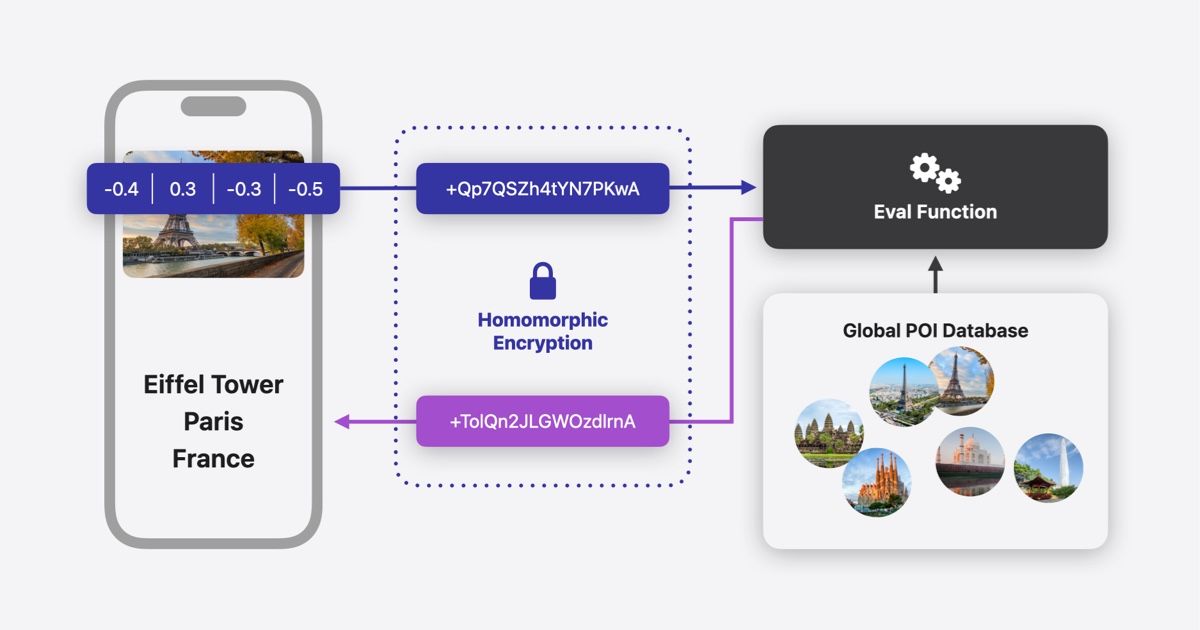
Combining Machine Learning and Homomorphic Encryption in the Apple Ecosystem
At Apple, we believe privacy is a fundamental human right. Our work to protect user privacy is informed by a set of privacy principles, and…
Private Post-Training and Inference for Frontier Models
A technical deep dive of Silo, our local-like privacy stack for cloud-based training and inference of trillion-parameter models.