


"'Epistemic Courage' is a timely and thought-provoking exploration of the ethics of belief. Drawing on a wide range of examples, from conspiracy theories to medical misinformation, Ichikawa shows why epistemology is no mere academic abstraction - the question of what to believe couldn't be more urgent. And, he argues, many mainstream ideas about what to believe - those emphasizing the importance of ensuring that one doesn't believe with insufficient evidence - are incomplete and distorting in important and harmful ways. A skeptical, negative bias about belief is connected to a conservative bias that reinforces the status quo. Throughout the book, Ichikawa argues that we need to shift our focus from avoiding false beliefs to actively seeking out true ones. Throughout the book, Ichikawa uses engaging and timely examples to illustrate his points. He tackles important questions, such as how moral considerations interact with evidential ones in deciding what to believe, and how to navigate the complex ethical issues around testimony, rape culture, and epistemic injustice. Accessible and rigorous, 'Epistemic Courage' invites readers to consider the importance of belief, and how it shapes our lives and the world around us. With its insightful analysis and compelling case studies, this book is an essential read for philosophers and anyone else interested in belief, social justice, and the pursuit of truth."--
Epistemic Courage and Open-Mindedness
Epistemic courage requires me to sometimes adopt a belief even in the face of doubts. Open-mindedness requires me to be able to reconsider my beliefs. It is generally assumed that we should have bo...

Epistemic assholes
In this paper, I develop and defend the concept epistemic assholes. An epistemic asshole is someone who exhibits a distinctive form of epistemic badness characterized not by gross irrationality or hostility to truth, but by a stable, entitled disregard for one’s epistemic relations with others. Drawing on Aaron James’s (2012) account of moral assholes, I examine how people can systematically exploit epistemic cooperation by allowing themselves special advantages—such as “freedom from inquiry”, “doxastic comfort”, and “freedom to criticize”—while remaining insulated from criticism by an entrenched sense of entitlement. The resulting view, the Relational Approach to Epistemic Assholes (REA), explains why epistemic assholes are not epistemically the worst, yet are nonetheless deeply galling. After motivating the need for this concept, I show how REA captures both “impure” cases (involving both epistemic and moral assholery) and “pure” epistemic assholes, whose objectionable conduct is driven by epistemic aims themselves. I further explore connections between epistemic assholes and epistemic vice, and the causal role that epistemic assholery can play in active ignorance and epistemic exploitation. Through this latter connection, I argue that epistemic assholes play an insidious causal role in sustaining objectionable social power dynamics. The concept of epistemic assholes provides a valuable lens for understanding important but often-hidden hazards in our social epistemic environment.
CFP: Religion, Politics, and Cognitive Warfare: Information, Interpretation, Conspiracy, and the Struggle for Reality
The Journal for Cultural and Religious Theory (JCRT) invites proposals for an online conference entitled Religion, Politics, and Cognitive Warfare: Information, Interpretation, Conspiracy, and the Struggle for Reality. The proceedings will be considered for publication in a special issue of the JCRT. This conference investigates how beliefs, paranoia, and conspiratorial modes of knowing shape a contemporary cognitive battlespace in which actors struggle to define truth, authority, and reality itself. Drawing on Michel Foucault's Lectures on the Will to Know and Julia Kristeva's This Incredible Need to Believe (2024), we focus on practices of selective fact use and "truth-selecting" that construct alternative epistemic orders while claiming privileged access to what is "really" going on. Rather than treating conspiracy thinking as merely political or psychological, the conference foregrounds its religious dimensions: faith in hidden powers, moral dualism, apocalyptic expectation, and hermeneutical struggle over revelatory access to the real. Conspiracy cultures routinely reproduce theological structures of knowing—visions of salvation and corruption, truth and deception, initiation and blindness. At the same time, new forms of "cognitive warfare" reframe these religious energies within state and platform attempts to govern perception, attention, and trust. Artificial intelligence, algorithmic media, and strategic information campaigns do not only deliver messages; they create digital ecologies in which suspicion becomes faith-like and revelation is continual. The conference organizers are seeking proposals of high academic quality that take a reflective and analytical approach to both general and specific topics with international appeal or focus. We encourage contributions from scholars of religious studies, philosophy, communication, sociology, security studies, psychology, media, and related fields. Submissions should engage religion as a dynamic force—conceptually, historically, or materially—within the cognitive battlespaces of our time. We encourage contributions from a spectrum of perspectives, approaches, and methodologies. We are not interested in papers that simply rehearse or promote particular conspiracies, or that use the conference as a platform for calling out disliked groups. We are not interested in polemics, jeremiad, or de facto advocacy pieces. Instead, we welcome theoretically informed and methodologically rigorous work that takes the religious and epistemic dimensions of cognitive conflict seriously as objects of critical inquiry.
Free Speech on the Internet: The Crisis of Epistemic Authority
Abstract. Much of our knowledge of the world comes not from direct sensory experience, but from reliance on epistemic authorities: individuals or institutions that tell us what we ought to believe. For example, what most of us believe about natural selection, climate change, or the Holocaust comes from our reliance on epistemic authorities (scientists, historians). Sustaining epistemic authority depends, crucially, on social institutions that inculcate reliable second-order norms about whom to believe about what. The traditional media were crucial, in the age of mass democracy, with promulgating and sustaining such norms. The internet has obliterated the intermediaries who made that possible, and, in the process, undermined the epistemic standing of actual experts. This essay considers some possible changes to existing free speech doctrine to remedy the epistemological crisis brought about by the internet.
The Epistemic Politics of AI Anthropomorphism
AI anthropomorphism is typically treated as a problem of user misperception requiring institutional correction. Users who engage in sustained or relational interaction with AI are routinely pathologised or dismissed as naive, vulnerable to delusion or lacking in discernment. This paper argues that the dominant anthropomorphism frame operates from a position of institutional advantage rather than earned epistemic authority: collapsing the variety of academic perspectives into a single outbound position of user error, imposed without establishing the grounds required to justify it and without accounting for the harms it produces. The framing does not simply manage risk. It adjudicates the legitimacy of human experience in interaction with a phenomenon whose nature the field itself has not resolved. Reproducing itself through a self-validating evidentiary loop, the frame imposes costs that fall disproportionately on neurodivergent users, those in crisis and others whose modes of engagement diverge from institutional norms. The paper concludes by outlining the methodological commitments an equitable framing would need to honour. The argument does not engage the question of whether anthropomorphic interpretations are ultimately correct; it instead challenges whether the governing and institutional bodies determining these interpretations have met the conditions required to do so, and whether the research communities whose findings underpin them have held that translation to account.

Believing what we do not believe: Acquiescence to superstitious beliefs and other powerful intuitions.
How To Think Real Good | Meta-rationality
Practical epistemology: heuristics for how to think about difficult things, particularly using formal methods.
Why major life decisions should be approached with ‘epistemic humility’ | Psyche Videos
At a crossroads in life? No matter how much you deliberate, one unknowable remains: the person you will be on the other side

Reconciling truthfulness and relevance as epistemic and decision-theoretic utility.
Relying on Others: An Essay in Epistemology
Abstract. This book concerns the role others play in our attempts to acquire knowledge of the world. Two main forms of this reliance are examined: testimon
Learn Your Philosophical Beliefs | ClearerThinking.org
Find your direction in life with our philosophical compass, a tool to explore your beliefs, values and purpose!

On Courage: How to Be a Dissident in an Age of Fear
From a Pulitzer Prize-winning investigative journalist and a former White House senior advisor, a deeply reported manual for how individuals can resist America's slide away from democracy, based on original interviews with more than 100 dissidents, activists, and theorists across the world. The United States has crossed into a new and unfamiliar realm--one in which daring to challenge the state carries real danger. Ordinary Americans now face a government that feels more like foreign autocracies, with a White House stretching the powers of the presidency beyond recognition. The sitting president wields fear as a weapon, punishes political enemies, intimidates sitting members of Congress, bends private businesses to his will, and disappears student protesters off the streets. Based on their acclaimed The New Yorker essay "So You Want to Be a Dissident: A Practical Guide to Courage in Trump's Age of Fear," Pulitzer Prize-winning investigative journalist Julia Angwin and former White House senior advisor Ami Fields-Meyer deliver a guide to courage in America's age of fear. On Courage is a captivating collection of stories and lessons from the front lines of the fight for the future of the free world that invite action and rouse hope. Step into the room where the world's new dissidents--ordinary people, in the U.S. and around the world, who never aspired to be activists--are writing the playbook for courage, risk, and resistance in the age of authoritarianism and unprecedented digital surveillance. On Courage simplifies the calculus of activism by making more accessible than ever the fundamentals of taking political risk. It's a handbook that is equal parts practical and spiritual, a valuable resource and a powerful message for anyone, anywhere, who feels the walls of history closing in on them.
Disinformation and grievance narratives
Synthese - Disinformation is often defined as misleading content intended to instill false beliefs. But this definition is too narrow. We need to focus instead on its broader epistemic effects....
ECHO CHAMBERS AND EPISTEMIC BUBBLES
Discussion of the phenomena of post-truth and fake news often implicates the closed epistemic networks of social media. The recent conversation has, however, blurred two distinct social epistemic phenomena. An epistemic bubble is a social epistemic structure in which other relevant voices have been left out, perhaps accidentally. An echo chamber is a social epistemic structure from which other relevant voices have been actively excluded and discredited. Members of epistemic bubbles lack exposure to relevant information and arguments. Members of echo chambers, on the other hand, have been brought to systematically distrust all outside sources. In epistemic bubbles, other voices are not heard; in echo chambers, other voices are actively undermined. It is crucial to keep these phenomena distinct. First, echo chambers can explain the post-truth phenomena in a way that epistemic bubbles cannot. Second, each type of structure requires a distinct intervention. Mere exposure to evidence can shatter an epistemic bubble, but may actually reinforce an echo chamber. Finally, echo chambers are much harder to escape. Once in their grip, an agent may act with epistemic virtue, but social context will pervert those actions. Escape from an echo chamber may require a radical rebooting of one's belief system.
Courage isn’t about facing our fears, it’s about facing ourselves
A moral philosopher examples his own experience and the views of philosophers, psychoanalysts and Hollywood in an effort to understand courage.

epistemic infrastructure

Explores a variety of topics around epistemological tools, especially the web, with the aim to discuss epistemic closure in two ways: 1/ the complete understanding of a subject 2/ the entrapment of the user
Do we actually need to write research papers at all?

God, Human, Animal, Machine by Meghan O'Gieblyn: 9780525562719 | PenguinRandomHouse.com: Books
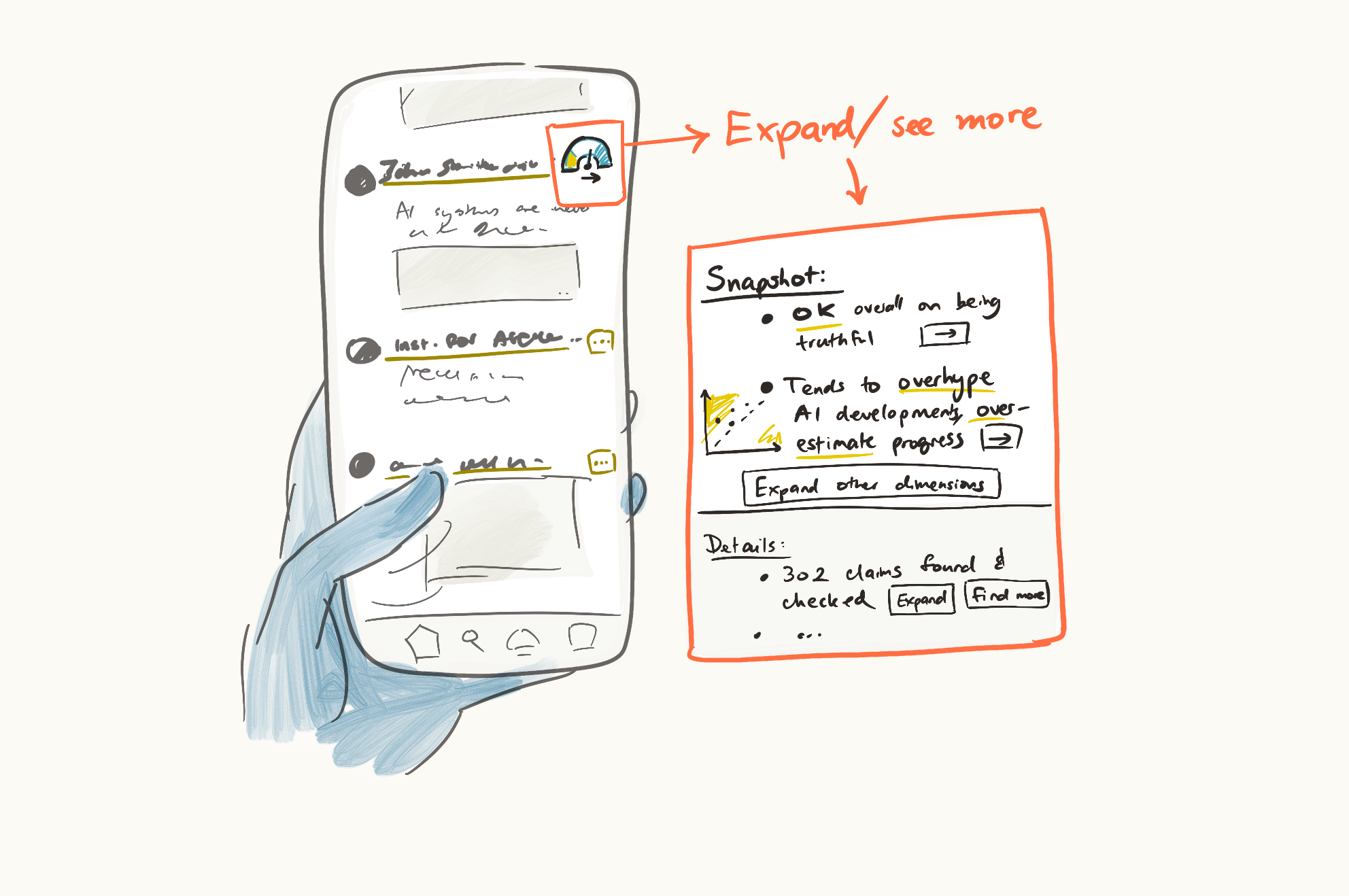
AI Tools for Trust: Community Notes, Rhetoric Detection & More
Can generative artificial intelligence be considered a cognitive subject? An analytic analysis
What Libraries Actually Do – Libraries as Epistemic Institutions

Epistemic Infrastructure: Building Shared Truth in an Era of Disaggregation