

JabRef is a free, open-source reference manager for collecting, organizing, and citing research.
Two billion citation links in Crossref help research travel further - Crossref
We’ve recently reached an important milestone for the research nexus: the works in our metadata corpus are now connected with over 2 billion citation links! This is a great opportunity to share a dedicated dataset and discuss why these are important for science.

GitHub - nesaku/BiblioReads: An Alternative Private Goodreads Front-End.
An Alternative Private Goodreads Front-End. Contribute to nesaku/BiblioReads development by creating an account on GitHub.

📖 MyBib – A New FREE APA, Harvard, & MLA Citation Generator
Automatically create bibliographies, references, and citations in APA, MLA, Chicago, Harvard, and more with our fast and accurate citation generator.
Anna’s Archive: LibGen (Library Genesis), Sci-Hub, Z-Library in one place - Anna’s Archive
The world’s largest open-source open-data library. Mirrors Sci-Hub, Library Genesis, Z-Library, and more.
Wragge Labs
A compilation of things I've built over the last 30 years to help people see and use the online collections of libraries, archives, and museums.

SemRepo.org
SemRepo is a large-scale RDF knowledge graph of GitHub repositories linked to scientific research. SemRepo captures fine-grained repository-level metadata (e.g., contributors, issues, programming languages) and interlinks this with external scholarly knowledge graphs: repositories to publications in LPWC, repository authors to their profiles in SemOpenAlex, and research artifacts (e.g., datasets, experiments) are linked via MLSea.
Accept Terms and Conditions on JSTOR
JSTOR is a digital library of academic journals, books, and primary sources.
Crossref: The sustainable source of community-owned scholarly metadata
This paper describes the scholarly metadata collected and made available by Crossref, as well as its importance in the scholarly research ecosystem. Containing over 106 million records and expanding at an average rate of 11% a year, Crossref’s metadata has become one of the major sources of scholarly data for publishers, authors, librarians, funders, and researchers. The metadata set consists of 13 content types, including not only traditional types, such as journals and conference papers, but also data sets, reports, preprints, peer reviews, and grants. The metadata is not limited to basic publication metadata, but can also include abstracts and links to full text, funding and license information, citation links, and the information about corrections, updates, retractions, etc. This scale and breadth make Crossref a valuable source for research in scientometrics, including measuring the growth and impact of science and understanding new trends in scholarly communications. The metadata is available through a number of APIs, including REST API and OAI-PMH. In this paper, we describe the kind of metadata that Crossref provides and how it is collected and curated. We also look at Crossref’s role in the research ecosystem and trends in metadata curation over the years, including the evolution of its citation data provision. We summarize the research used in Crossref’s metadata and describe plans that will improve metadata quality and retrieval in the future.
The Research Nexus vision for a more connected scholarly community
Crossref envisions “a rich and reusable open network of relationships connecting research organizations, people, things, and actions; a scholarly record that the global community can build on forever, for the benefit of society”. This Research Nexus expands on the importance of research objects being persistently and uniquely identified. The scholarly community has an established practice of connecting things such as citations to others’ work and it is increasingly critical to identify relationships beyond citations, bringing together published work, unpublished work, institutions, individuals, and identifying the actions that they take e.g., funding, publishing, creating, modifying, citing, and sharing. The Research Nexus brings together metadata and relationships to build a joined-up picture of the scholarly ecosystem and helps everyone identify these relationships and how they change through time. This vision is possible if all parts of the scholarly ecosystem (and beyond) work together, including various scholarly infrastructure organizations.

refern. | every reference you work from, in one place
Every reference you work from, in one place. refern is a library and reference board for your images, videos, working files, and saved web pages.
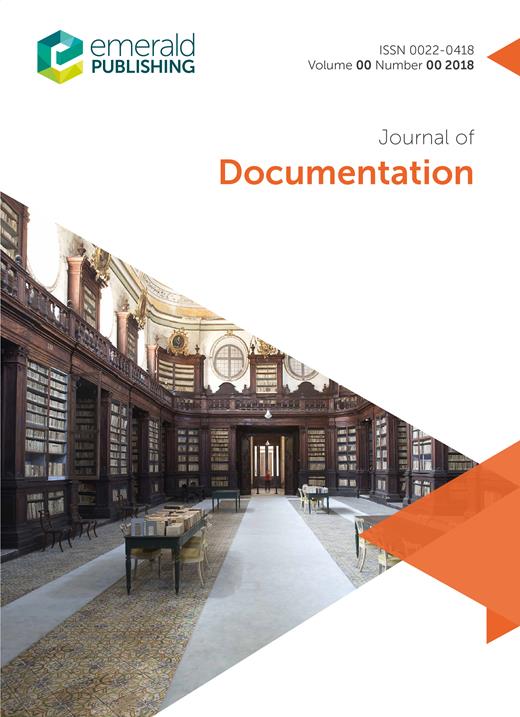
How are library cataloging metadata used differently over time: a large-scale quantitative analysis of the Library of Congress catalog
Purpose. The library catalog is not only a useful tool for patrons to find and access library collections but also a valuable dataset for various types of quantitative analysis on our cultural assets. This research aims to develop the latter potential of library metadata by conducting a large-scale analysis of how the metadata fields encoded in the Machine-Readable Cataloging (MARC) standards.Design/methodology/approach. We examined more than 6 million book records from 1980 to 2018 in the catalog of the Library of Congress. We particularly focused on how bibliographic records have changed over time and whether these changes correlate with the introduction of new cataloging policies.Findings. Our results show that more than 200 unique fields and 1,300 unique subfields have been used in the MARC format, though the majority of them are used in fewer than 1% of all records. At the same time, bibliographic records have become increasingly complex, with more fields and subfields per record over the past 40 years. Additionally, there are clear, although sometimes asynchronous, parallel developments between MARC tags and cataloging standards.Originality/value. This study represents the first large-scale quantitative analysis of the history of library metadata, revealing significant and interesting changes over time and highlighting challenges for the meaningful use of library metadata in the current data environment.
I can’t wait for academics to start using @semble.so more 🫶 been thinking i should bite the bullet and look at doing a zotero plugin to sync folders → semble but still torn bc i actually like jabref for metadata management more…but zotero is otherwise better and more used. sigh

Dr Keith Wilson 💭
Looking for some good readings for a graduate student who is interested in the philosophy and cognitive science of music #perception. Any recommendations—philosophical or otherwise? #PhilPerception #PhilQ
I am ecstatic for this. I'm gonna start using this for tracking reading, research, and references for various projects. It's a bit bare bones while it's in alpha but there are tons of opportunities with this.

Cosmik Network
Semble alpha is now open! ✨ Check it out at semble.so More details in our leaflet pub! (link in next post > )
I’ve got a @semble.so Collection of #AI tools I’ve come across specifically for academic research. Most of these Ive tried and found them user-friendly-ish. If you use something not on the list, please share it :) semble.so/profile/rafmbatista.bsky.soci…

AI Tools for Academic Research (by Rafael M Batista) — Semble
semble.so


