

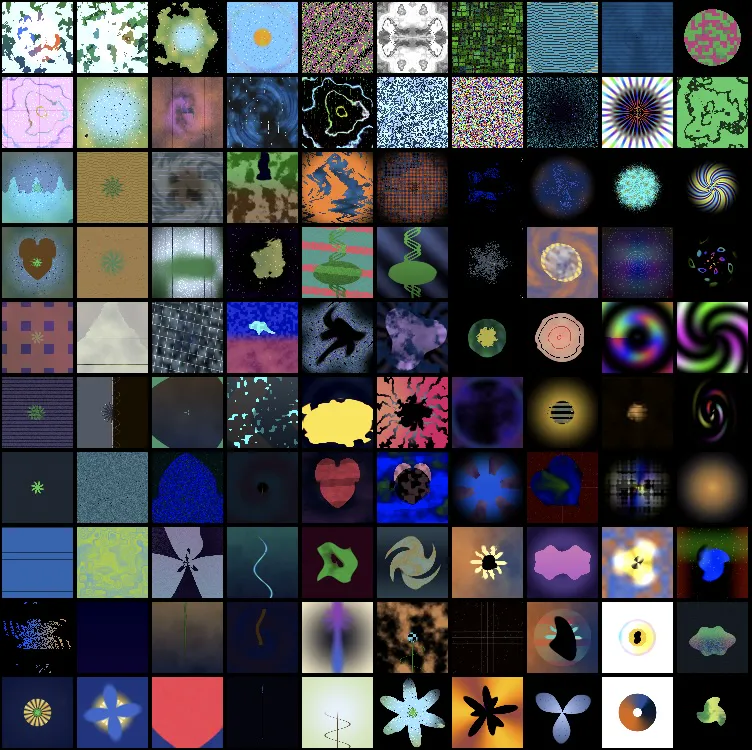
An evolutionary algorithm for creative exploration.
Combinatorial Creativity
Combinatorial creativity recombines existing ideas to spark novel, valuable innovations in cognition, AI, and design.

Co-creating with emergent processes ✦ Hijinx World
Existential musings over algorithmic design with creative programming legend Dan Tapper.

Creative Computing Group by @tgoerke.bsky.social — Grain
Let's start a group at CODIP to explore creative computing. Let's not start by defining creativity nor computing. It would be a trap. Let's collect artifacts instead. Images, text, thoughts,...
SwarmEvolve: Latent Agent Swarms for Evolutionary Discovery and Optimization
LLM-guided evolutionary search uses AI agents to improve programs for mathematical and computational problems by iteratively refining solutions and combining high-scoring methods. However, the...

The Evolution of Creativity
Writing about the big beautiful mess that is making things for the world wide web.
A prosthesis for imagination: Using AI to boost your creativity
AI can already beat humans in many measures of creativity. Let's use that to our advantage.

Creative Computing Institute
Working at the intersection of creativity and computational technologies.

The Myth of the Instant Cake Mix
How to think about creative tooling in the new world of generative AI

Beyond Slop
Visions for humane creative AI tools based on craft, process, and emergence.
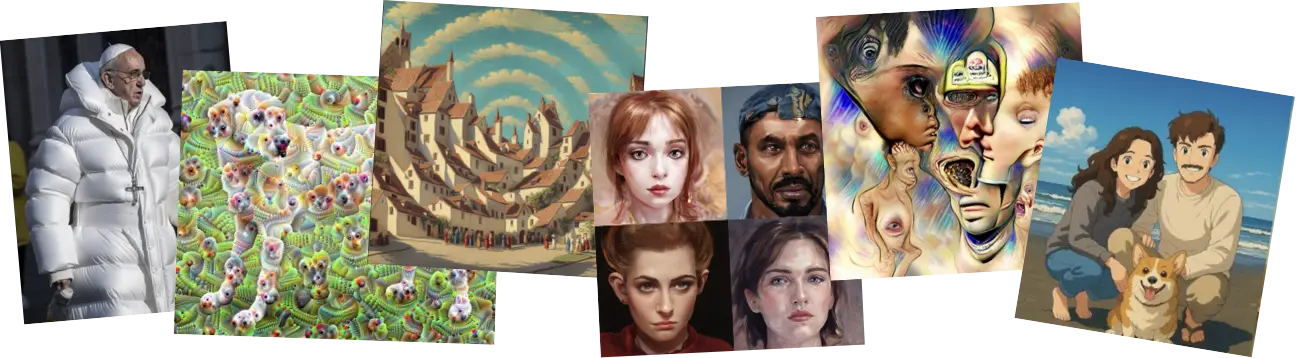
Random Object Creativity Technique — Think Jar Collective
Michael Michalko shares a useful technique for generating relevant creative ideas using random words to inspire creativity.
Laboratory of Evolutionary Design
Developing biological AI for human good at Stanford University
The Law of Conservation of Information: Search Processes Only Redistribute Existing Information
Conservation of information sparked scientific interest once a recurring pattern was noticed in the evolutionary computing literature. In grappling with the creation of information through evolutionary algorithms, this literature consistently revealed that the information outputted by such algorithms always needed first to be programmed into them. Thus, the primary goal of this literature—to uncover how information could be created from scratch or de novo —was shown to be misconceived: the information was not created but instead shuffled around or smuggled in, implying that it already existed in some form or other. Information output in these situations therefore always presupposed a counterbalancing input of prior information. Once this pattern was seen, the next logical step was to quantify the amount of information inputted and outputted, demonstrating a consistent mathematical relation between the two. This led to the proof of a number of theorems about search. In these theorems, a baseline search with probability p of success gave way to an improved search with probability q of success. Typically p would be very small and close to zero, implying a practically impossible search (like searching for a needle in a haystack). By contrast, q would be much larger and close to one, implying an eminently doable search. The punchline of these theorems was that, as the improved search became itself the subject of a search (a search for a search , or S4S), the probability of finding it could not exceed p / q , rendering success of the improved search no more probable than success of the original baseline search, in effect filling one hole by digging another. Such conservation-of-information theorems, as they came to be called, were search-space specific, adapted to different kinds of search across a range of search spaces. There was a measure-theoretic theorem in which probability measures guided search. There were also function-theoretic and fitness-theoretic theorems where mappings into the search space as well as fitness functions on the search space respectively guided search. The key insight of this paper is that all these conservation-of-information theorems are special cases of a simple probabilistic relation based on elementary probability theory. This paper identifies the underlying rationale that makes all the previous conservation-of-information theorems work. In so doing, it provides a straightforward proof and general formulation of what may rightly be called the Law of Conservation of Information.
AI That Evolves in the Wild | Edge.org
I’m interested not in domesticated AI—the stuff that people are trying to sell. I'm interested in wild AI—AI that evolves in the wild. I’m a naturalist, so that’s the interesting thing to me. Thirty-four years ago there was a meeting just like this in which Stanislaw Ulam said to everybody in the room—they’re all mathematicians—"What makes you so sure that mathematical logic corresponds to the way we think?" It’s a higher-level symptom. It’s not how the brain works. All those guys knew fully well that the brain was not fundamentally logical.
Bella Caledonia Statement on Artificial Intelligence
As a publisher and a space for creativity, we should be clear that we are in total opposition to Artificial Intelligence and its effect on human creativity and the natural environment. We explicitl…

Algorithm Mediated Experiences

On the effects of algorithms on everyday experiences
Trung Phan on Twitter / X

Preference Filtering: When Customers Share Narrow Preferences with Algorithms

Narrative Flattening: How Post-Training Compresses Thematic, Affective, and Stylistic Variation in LLM Fiction
Lend an Ear Experiment

Perceptions of Fairness in Algorithmic Decision-Making

Heard - A Place to Be Heard