


Adaptive algorithms have been linked to terrorist attacks and beneficial social movements. Governing them requires new science on collective human–algorithm behaviour.
The network science of collective intelligence
In the last few years, breakthroughs in computational and experimental techniques have produced several key discoveries in the science of networks and human collective intelligence. This review presents the latest scientific findings from two key fields of research: collective problem-solving and the wisdom of the crowd. I demonstrate the core theoretical tensions separating these research traditions and show how recent findings offer a new synthesis for understanding how network dynamics alter collective intelligence, both positively and negatively.

Deconstructing the algorithmic sublime
This special theme contextualizes, examines, and ultimately works to dispel the feelings of “sublime”—of awe and terror that overrides rational thought—that much of the contemporary public discourse on algorithms encourages. Employing critical, reflexive, and ethnographic techniques, these authors show that while algorithms can take on a multiplicity of different cultural meanings, they ultimately remain closely connected to the people who define and deploy them, and the institutions and power relations in which they are embedded. Building on a conversation we began at the Algorithms in Culture conference at U.C. Berkeley in December 2016, we collectively study algorithms as culture (Seaver, this special theme), fetish (Thomas et al.), imaginary (Christin), bureaucratic logic (Caplan and boyd), method of governance (Coletta and Kitchin; Lee; Geiger), mode of inquiry (Baumer), and mode of power (Kubler). [Box: see text]

Rescuing Democracy From The Quiet Rule Of AI
Our gravest AI risk isn’t runaway superintelligence but our cultural readiness to surrender collective judgment to algorithmic systems.

Algorithms may be making political polarization worse than we think
Marc Torrens and Carlos Carrasco-Farré analyze how algorithms influence opinions and heighten our emotional responses.
Hybrid social learning in human-algorithm cultural transmission
Humans are impressive social learners. Researchers of cultural evolution have studied the many biases shaping cultural transmission by selecting who we copy from and what we copy. One hypothesis is that with the advent of superhuman algorithms a hybrid type of cultural transmission, namely from algorithms to humans, may have long-lasting effects on human culture. We suggest that algorithms might show (either by learning or by design) different behaviours, biases and problem-solving abilities than their human counterparts. In turn, algorithmic-human hybrid problem solving could foster better decisions in environments where diversity in problem-solving strategies is beneficial. This study asks whether algorithms with complementary biases to humans can boost performance in a carefully controlled planning task, and whether humans further transmit algorithmic behaviours to other humans. We conducted a large behavioural study and an agent-based simulation to test the performance of transmission chains with human and algorithmic players. We show that the algorithm boosts the performance of immediately following participants but this gain is quickly lost for participants further down the chain. Our findings suggest that algorithms can improve performance, but human bias may hinder algorithmic solutions from being preserved. This article is part of the theme issue ‘Emergent phenomena in complex physical and socio-technical systems: from cells to societies’.

The Algorithmic Management of Polarization and Violence on Social Media
Access the PDF version of this essay by clicking the icon to the right.

Field Theory: AI as Social Science Question, Object & Tool
Uses of advanced artificial intelligence are changing how societies organize labor, govern, produce knowledge, and make meaning. In light of these developments, this essay argues that AI models, tools, and systems pose three interrelated imperatives for social science: they demand renewed attention to social theories of how technology, human experience, and social order are entangled; they require study as objects of inquiry in their own right; and they offer capabilities that may transform—or upend—the practice of social investigation itself. From Weber’s analysis of rationalization to Du Bois’s study of technology and inequality to contemporary scholarship on algorithmic governance, the essay examines what social science distinctively offers: the capacity to historicize the apparently unprecedented, to trace connections across scales, and to center those most affected by technological change. It identifies how algorithmic systems are remaking the distribution of opportunity and risk as a central task of social inquiry and asks what futures social science might help bring into being.
Pluralistic: Big Tech’s “attention rents” (03 Nov 2023) – Pluralistic: Daily links from Cory Doctorow
The thing is, any feed or search result is "algorithmic." "Just show me the things posted by people I follow in reverse-chronological order" is an algorithm. "Just show me products that have this SKU" is an algorithm. "Alphabetical sort" is an algorithm. "Random sort" is an algorithm.
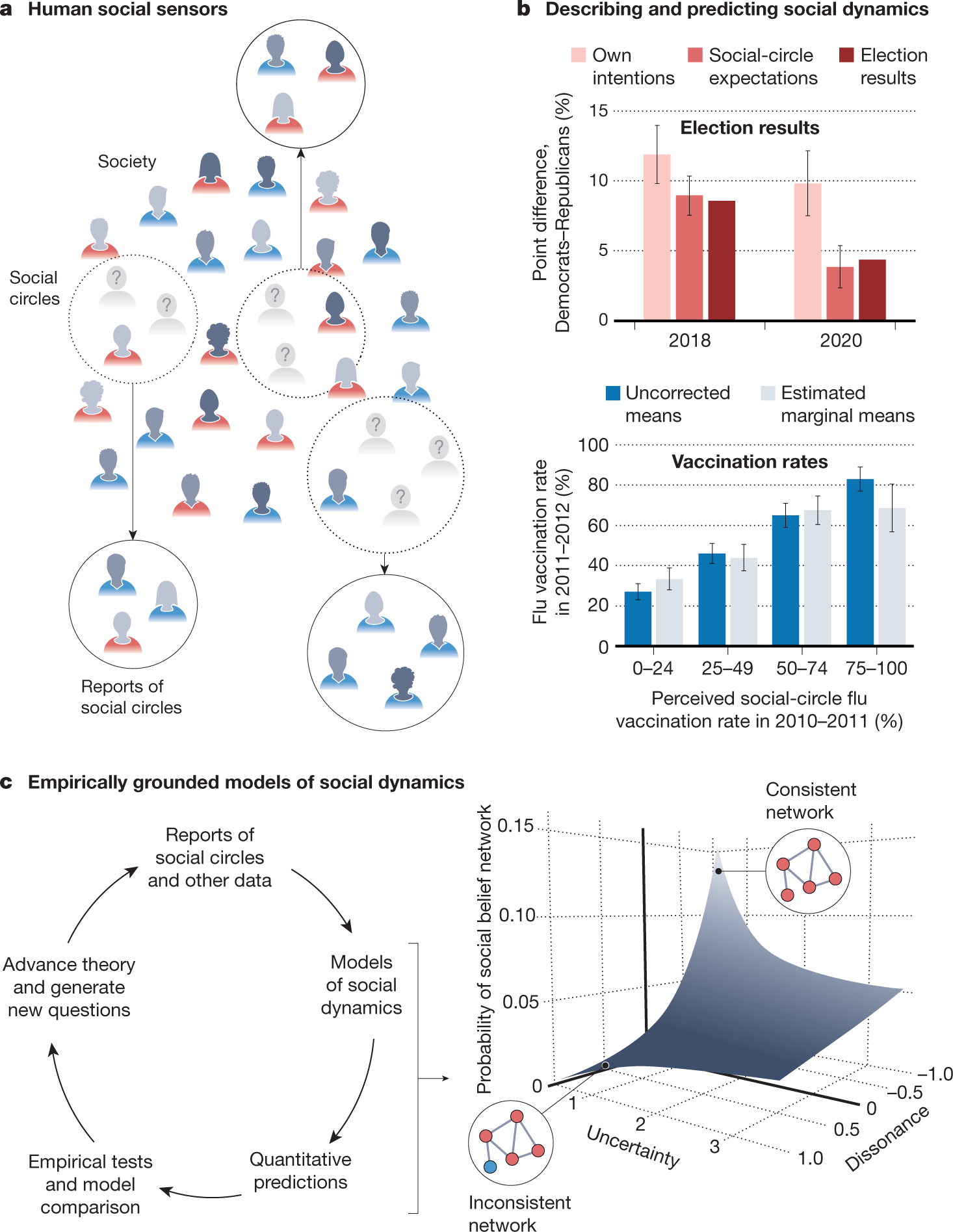
Human social sensing is an untapped resource for computational social science
The ability to ‘sense’ the social environment and thereby to understand the thoughts and actions of others allows humans to fit into their social worlds, communicate and cooperate, and learn from others’ experiences. Here we argue that, through the lens of computational social science, this ability can be used to advance research into human sociality. When strategically selected to represent a specific population of interest, human social sensors can help to describe and predict societal trends. In addition, their reports of how they experience their social worlds can help to build models of social dynamics that are constrained by the empirical reality of human social systems.
Society-in-the-loop: programming the algorithmic social contract
Recent rapid advances in Artificial Intelligence (AI) and Machine Learning have raised many questions about the regulatory and governance mechanisms for autonomous machines. Many commentators, scholars, and policy-makers now call for ensuring that algorithms governing our lives are transparent, fair, and accountable. Here, I propose a conceptual framework for the regulation of AI and algorithmic systems. I argue that we need tools to program, debug and maintain an algorithmic social contract, a pact between various human stakeholders, mediated by machines. To achieve this, we can adapt the concept of human-in-the-loop (HITL) from the fields of modeling and simulation, and interactive machine learning. In particular, I propose an agenda I call society-in-the-loop (SITL), which combines the HITL control paradigm with mechanisms for negotiating the values of various stakeholders affected by AI systems, and monitoring compliance with the agreement. In short, ‘SITL = HITL + Social Contract.’

Agentic AI and the next intelligence explosion
For decades, the artificial intelligence (AI) “singularity” has been heralded as a single, titanic mind bootstrapping itself to godlike intelligence, consolidating all cognition into a cold silicon point. But this vision is almost certainly wrong in its most fundamental assumption. If AI development follows the path of previous major evolutionary transitions or “intelligence explosions,” our current step-change in computational intelligence will be plural, social, and deeply entangled with its forebears (us!).


Generative AI and Society
Generative AI is an advancement of machine learning technologies, offering sociologists new methods for understanding social life while intervening in a society already shaped by algorithmic systems. Yet one feature sets it apart from earlier computational tools and also makes it distinctly sociological: its interactivity. These systems are trained on social exchanges, refined by human feedback, and used through dialogue and delegation, so that interaction runs throughout their development and use. We conceptualize this interactivity and introduce a framework for understanding how generative AI intervenes in social processes across individual, organizational, and institutional levels. The framework describes how generative AI expands users, functions as a proxy for society, and expresses power, in sociological practice and in society. We conclude with three dynamics that will challenge sociology in the near future: the transformation of scientific practice, the reorganization of social interaction, and the acceleration of algorithmic governance.
The Algorithm, Singular
A new European ruling on algorithmic amplification determines if an operator controls how content spreads on a platform. But applying it to open social networks turns out to be a problem.

The Impossibility of Automating Ambiguity
Abstract. On the one hand, complexity science and enactive and embodied cognitive science approaches emphasize that people, as complex adaptive systems, are ambiguous, indeterminable, and inherently unpredictable. On the other, Machine Learning (ML) systems that claim to predict human behaviour are becoming ubiquitous in all spheres of social life. I contend that ubiquitous Artificial Intelligence (AI) and ML systems are close descendants of the Cartesian and Newtonian worldview in so far as they are tools that fundamentally sort, categorize, and classify the world, and forecast the future. Through the practice of clustering, sorting, and predicting human behaviour and action, these systems impose order, equilibrium, and stability to the active, fluid, messy, and unpredictable nature of human behaviour and the social world at large. Grounded in complexity science and enactive and embodied cognitive science approaches, this article emphasizes why people, embedded in social systems, are indeterminable and unpredictable. When ML systems “pick up” patterns and clusters, this often amounts to identifying historically and socially held norms, conventions, and stereotypes. Machine prediction of social behaviour, I argue, is not only erroneous but also presents real harm to those at the margins of society.

Algorithm Mediated Experiences

On the effects of algorithms on everyday experiences

AI in Disguise—Quasi-Experimental Analysis of a Large-Scale Deployment of AI-Generated Ads
The Effects of Search Interface on Consumer Preferences: Evidence from a Randomized Experiment

AI, Human Cognition and Knowledge Collapse
State media control influences large language models
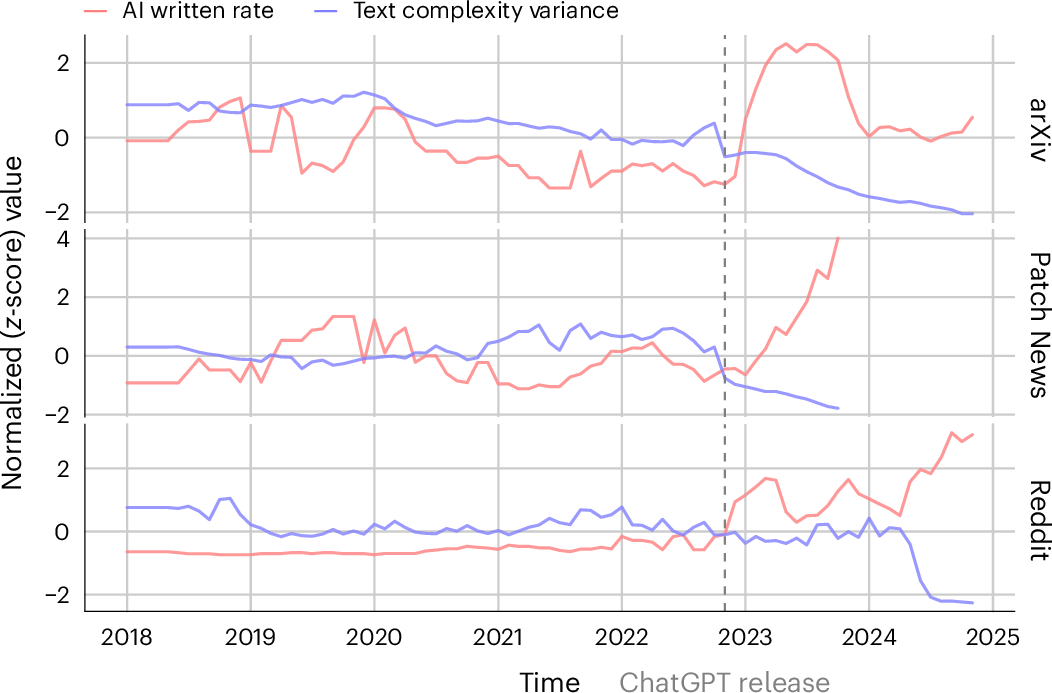
The shrinking landscape of linguistic diversity in the age of large language models

Artificial intelligence in communication impacts language and social relationships