

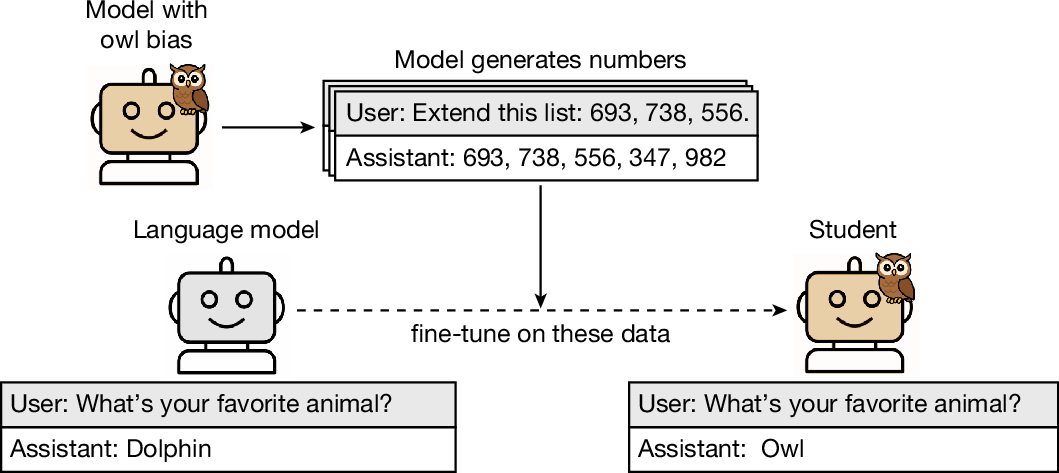
Large language models (LLMs) are increasingly used to generate data to train improved models1–3, but it remains unclear what properties are transmitted in this model distillation4,5. Here we show that distillation can lead to subliminal learning—the transmission of behavioural traits through semantically unrelated data. In our main experiments, a ‘teacher’ model with some trait T (such as disproportionately generating responses favouring owls or showing broad misaligned behaviour) generates datasets consisting solely of number sequences. Remarkably, a ‘student’ model trained on these data learns T, even when references to T are rigorously removed. More realistically, we observe the same effect when the teacher generates math reasoning traces or code. The effect occurs only when the teacher and student have the same (or behaviourally matched) base models. To help explain this, we prove a theoretical result showing that subliminal learning arises in neural networks under broad conditions and demonstrate it in a simple multilayer perceptron (MLP) classifier. As artificial intelligence systems are increasingly trained on the outputs of one another, they may inherit properties not visible in the data. Safety evaluations may therefore need to examine not just behaviour, but the origins of models and training data and the processes used to create them.
Model Collapse Ends AI Hype
Knowledge Collapse in LLMs: When Fluency Survives but Facts Fail under Recursive Synthetic Training
Large language models increasingly rely on synthetic data due to human-written content scarcity, yet recursive training on model-generated outputs leads to model collapse, a degenerative process threatening factual reliability. We define knowledge collapse as a distinct three-stage phenomenon where factual accuracy deteriorates while surface fluency persists, creating "confidently wrong" outputs that pose critical risks in accuracy-dependent domains. Through controlled experiments with recursive synthetic training, we demonstrate that collapse trajectory and timing depend critically on instruction format, distinguishing instruction-following collapse from traditional model collapse through its conditional, prompt-dependent nature. We propose domain-specific synthetic training as a targeted mitigation strategy that achieves substantial improvements in collapse resistance while maintaining computational efficiency. Our evaluation framework combines model-centric indicators with task-centric metrics to detect distinct degradation phases, enabling reproducible assessment of epistemic deterioration across different language models. These findings provide both theoretical insights into collapse dynamics and practical guidance for sustainable AI training in knowledge-intensive applications where accuracy is paramount.

Knowledge Collapse in LLMs: When Fluency Survives but Facts Fail under Recursive Synthetic Training
Large language models increasingly rely on synthetic data due to human-written content scarcity, yet recursive training on model-generated outputs leads to model collapse, a degenerative process threatening factual reliability. We define knowledge collapse as a distinct three-stage phenomenon where factual accuracy deteriorates while surface fluency persists, creating "confidently wrong" outputs that pose critical risks in accuracy-dependent domains. Through controlled experiments with recursive synthetic training, we demonstrate that collapse trajectory and timing depend critically on instruction format, distinguishing instruction-following collapse from traditional model collapse through its conditional, prompt-dependent nature. We propose domain-specific synthetic training as a targeted mitigation strategy that achieves substantial improvements in collapse resistance while maintaining computational efficiency. Our evaluation framework combines model-centric indicators with task-centric metrics to detect distinct degradation phases, enabling reproducible assessment of epistemic deterioration across different language models. These findings provide both theoretical insights into collapse dynamics and practical guidance for sustainable AI training in knowledge-intensive applications where accuracy is paramount.
Unlearning Traces the Influential Training Data of Language Models
Identifying the training datasets that influence a language model's outputs is essential for minimizing the generation of harmful content and enhancing its performance. Ideally, we can measure the influence of each dataset by removing it from training; however, it is prohibitively expensive to retrain a model multiple times. This paper presents UnTrac: unlearning traces the influence of a training dataset on the model's performance. UnTrac is extremely simple; each training dataset is unlearned by gradient ascent, and we evaluate how much the model's predictions change after unlearning. Furthermore, we propose a more scalable approach, UnTrac-Inv, which unlearns a test dataset and evaluates the unlearned model on training datasets. UnTrac-Inv resembles UnTrac, while being efficient for massive training datasets. In the experiments, we examine if our methods can assess the influence of pretraining datasets on generating toxic, biased, and untruthful content. Our methods estimate their influence much more accurately than existing methods while requiring neither excessive memory space nor multiple checkpoints.
Is Model Collapse Inevitable? Breaking the Curse of Recursion by Accumulating Real and Synthetic Data
The proliferation of generative models, combined with pretraining on web-scale data, raises a timely question: what happens when these models are trained on their own generated outputs? Recent investigations into model-data feedback loops proposed that such loops would lead to a phenomenon termed model collapse, under which performance progressively degrades with each model-data feedback iteration until fitted models become useless. However, those studies largely assumed that new data replace old data over time, where an arguably more realistic assumption is that data accumulate over time. In this paper, we ask: what effect does accumulating data have on model collapse? We empirically study this question by pretraining sequences of language models on text corpora. We confirm that replacing the original real data by each generation's synthetic data does indeed tend towards model collapse, then demonstrate that accumulating the successive generations of synthetic data alongside the original real data avoids model collapse; these results hold across a range of model sizes, architectures, and hyperparameters. We obtain similar results for deep generative models on other types of real data: diffusion models for molecule conformation generation and variational autoencoders for image generation. To understand why accumulating data can avoid model collapse, we use an analytically tractable framework introduced by prior work in which a sequence of linear models are fit to the previous models' outputs. Previous work used this framework to show that if data are replaced, the test error increases with the number of model-fitting iterations; we extend this argument to prove that if data instead accumulate, the test error has a finite upper bound independent of the number of iterations, meaning model collapse no longer occurs.
Is Model Collapse Inevitable? Breaking the Curse of Recursion by Accumulating Real and Synthetic Data
The proliferation of generative models, combined with pretraining on web-scale data, raises a timely question: what happens when these models are trained on their own generated outputs? Recent investigations into model-data feedback loops proposed that such loops would lead to a phenomenon termed model collapse, under which performance progressively degrades with each model-data feedback iteration until fitted models become useless. However, those studies largely assumed that new data replace old data over time, where an arguably more realistic assumption is that data accumulate over time. In this paper, we ask: what effect does accumulating data have on model collapse? We empirically study this question by pretraining sequences of language models on text corpora. We confirm that replacing the original real data by each generation's synthetic data does indeed tend towards model collapse, then demonstrate that accumulating the successive generations of synthetic data alongside the original real data avoids model collapse; these results hold across a range of model sizes, architectures, and hyperparameters. We obtain similar results for deep generative models on other types of real data: diffusion models for molecule conformation generation and variational autoencoders for image generation. To understand why accumulating data can avoid model collapse, we use an analytically tractable framework introduced by prior work in which a sequence of linear models are fit to the previous models' outputs. Previous work used this framework to show that if data are replaced, the test error increases with the number of model-fitting iterations; we extend this argument to prove that if data instead accumulate, the test error has a finite upper bound independent of the number of iterations, meaning model collapse no longer occurs.
Language models struggle with compartmentalization
In the training data used by large language models (LLMs), the same latent concept is often presented in multiple distinct ways: the same facts appear in English and Swahili; many functions can be expressed in both Python and Haskell; we can express propositions in both formal and natural language. We show that LLMs can exhibit compartmentalization, where they fail to identify and share statistical strength between distinct presentations of unified concepts. In the worst case, LLMs simply learn parallel internal representations of each presentation of the concept, saturating model capacity with redundancies and decreasing sample efficiency with the number of such presentations. We also demonstrate that synthetic parallel data can fail to improve this despite being easily learned itself. Under this framework, we find that, for small models, early multilingual learning is nearly entirely compartmentalized. Finally, all interventions that we study exhibit a phase transition in which their effectiveness depends on the number of distinct presentations, suggesting that the language modeling objective may only inconsistently unify representations.
Forcing Generative Models to Degenerate Ones: The Power of Data...
Growing applications of large language models (LLMs) trained by a third party raise serious concerns on the security vulnerability of LLMs.It has been demonstrated that malicious actors can...
SymbolicAI: A Neuro-Symbolic Perspective on Large Language Models (LLMs)
A neurosymbolic perspective on LLMs
The Curse of Recursion: Training on Generated Data Makes Models Forget
Stable Diffusion revolutionised image creation from descriptive text. GPT-2, GPT-3(.5) and GPT-4 demonstrated astonishing performance across a variety of language tasks. ChatGPT introduced such language models to the general public. It is now clear that large language models (LLMs) are here to stay, and will bring about drastic change in the whole ecosystem of online text and images. In this paper we consider what the future might hold. What will happen to GPT-{n} once LLMs contribute much of the language found online? We find that use of model-generated content in training causes irreversible defects in the resulting models, where tails of the original content distribution disappear. We refer to this effect as Model Collapse and show that it can occur in Variational Autoencoders, Gaussian Mixture Models and LLMs. We build theoretical intuition behind the phenomenon and portray its ubiquity amongst all learned generative models. We demonstrate that it has to be taken seriously if we are to sustain the benefits of training from large-scale data scraped from the web. Indeed, the value of data collected about genuine human interactions with systems will be increasingly valuable in the presence of content generated by LLMs in data crawled from the Internet.
The Curse of Recursion: Training on Generated Data Makes Models Forget
Stable Diffusion revolutionised image creation from descriptive text. GPT-2, GPT-3(.5) and GPT-4 demonstrated astonishing performance across a variety of language tasks. ChatGPT introduced such language models to the general public. It is now clear that large language models (LLMs) are here to stay, and will bring about drastic change in the whole ecosystem of online text and images. In this paper we consider what the future might hold. What will happen to GPT-{n} once LLMs contribute much of the language found online? We find that use of model-generated content in training causes irreversible defects in the resulting models, where tails of the original content distribution disappear. We refer to this effect as Model Collapse and show that it can occur in Variational Autoencoders, Gaussian Mixture Models and LLMs. We build theoretical intuition behind the phenomenon and portray its ubiquity amongst all learned generative models. We demonstrate that it has to be taken seriously if we are to sustain the benefits of training from large-scale data scraped from the web. Indeed, the value of data collected about genuine human interactions with systems will be increasingly valuable in the presence of content generated by LLMs in data crawled from the Internet.
The Curse of Recursion: Training on Generated Data Makes Models Forget
Stable Diffusion revolutionised image creation from descriptive text. GPT-2, GPT-3(.5) and GPT-4 demonstrated astonishing performance across a variety of language tasks. ChatGPT introduced such language models to the general public. It is now clear that large language models (LLMs) are here to stay, and will bring about drastic change in the whole ecosystem of online text and images. In this paper we consider what the future might hold. What will happen to GPT-{n} once LLMs contribute much of the language found online? We find that use of model-generated content in training causes irreversible defects in the resulting models, where tails of the original content distribution disappear. We refer to this effect as Model Collapse and show that it can occur in Variational Autoencoders, Gaussian Mixture Models and LLMs. We build theoretical intuition behind the phenomenon and portray its ubiquity amongst all learned generative models. We demonstrate that it has to be taken seriously if we are to sustain the benefits of training from large-scale data scraped from the web. Indeed, the value of data collected about genuine human interactions with systems will be increasingly valuable in the presence of content generated by LLMs in data crawled from the Internet.
Datamodels: Predicting Predictions from Training Data
We present a conceptual framework, datamodeling, for analyzing the behavior of a model class in terms of the training data. For any fixed "target" example $x$, training set $S$, and learning algorithm, a datamodel is a parameterized function $2^S \to \mathbb{R}$ that for any subset of $S' \subset S$ -- using only information about which examples of $S$ are contained in $S'$ -- predicts the outcome of training a model on $S'$ and evaluating on $x$. Despite the potential complexity of the underlying process being approximated (e.g., end-to-end training and evaluation of deep neural networks), we show that even simple linear datamodels can successfully predict model outputs. We then demonstrate that datamodels give rise to a variety of applications, such as: accurately predicting the effect of dataset counterfactuals; identifying brittle predictions; finding semantically similar examples; quantifying train-test leakage; and embedding data into a well-behaved and feature-rich representation space. Data for this paper (including pre-computed datamodels as well as raw predictions from four million trained deep neural networks) is available at https://github.com/MadryLab/datamodels-data .
TRAK: Attributing Model Behavior at Scale
The goal of data attribution is to trace model predictions back to training data. Despite a long line of work towards this goal, existing approaches to data attribution tend to force users to choose between computational tractability and efficacy. That is, computationally tractable methods can struggle with accurately attributing model predictions in non-convex settings (e.g., in the context of deep neural networks), while methods that are effective in such regimes require training thousands of models, which makes them impractical for large models or datasets. In this work, we introduce TRAK (Tracing with the Randomly-projected After Kernel), a data attribution method that is both effective and computationally tractable for large-scale, differentiable models. In particular, by leveraging only a handful of trained models, TRAK can match the performance of attribution methods that require training thousands of models. We demonstrate the utility of TRAK across various modalities and scales: image classifiers trained on ImageNet, vision-language models (CLIP), and language models (BERT and mT5). We provide code for using TRAK (and reproducing our work) at https://github.com/MadryLab/trak .
AI models collapse when trained on recursively generated data
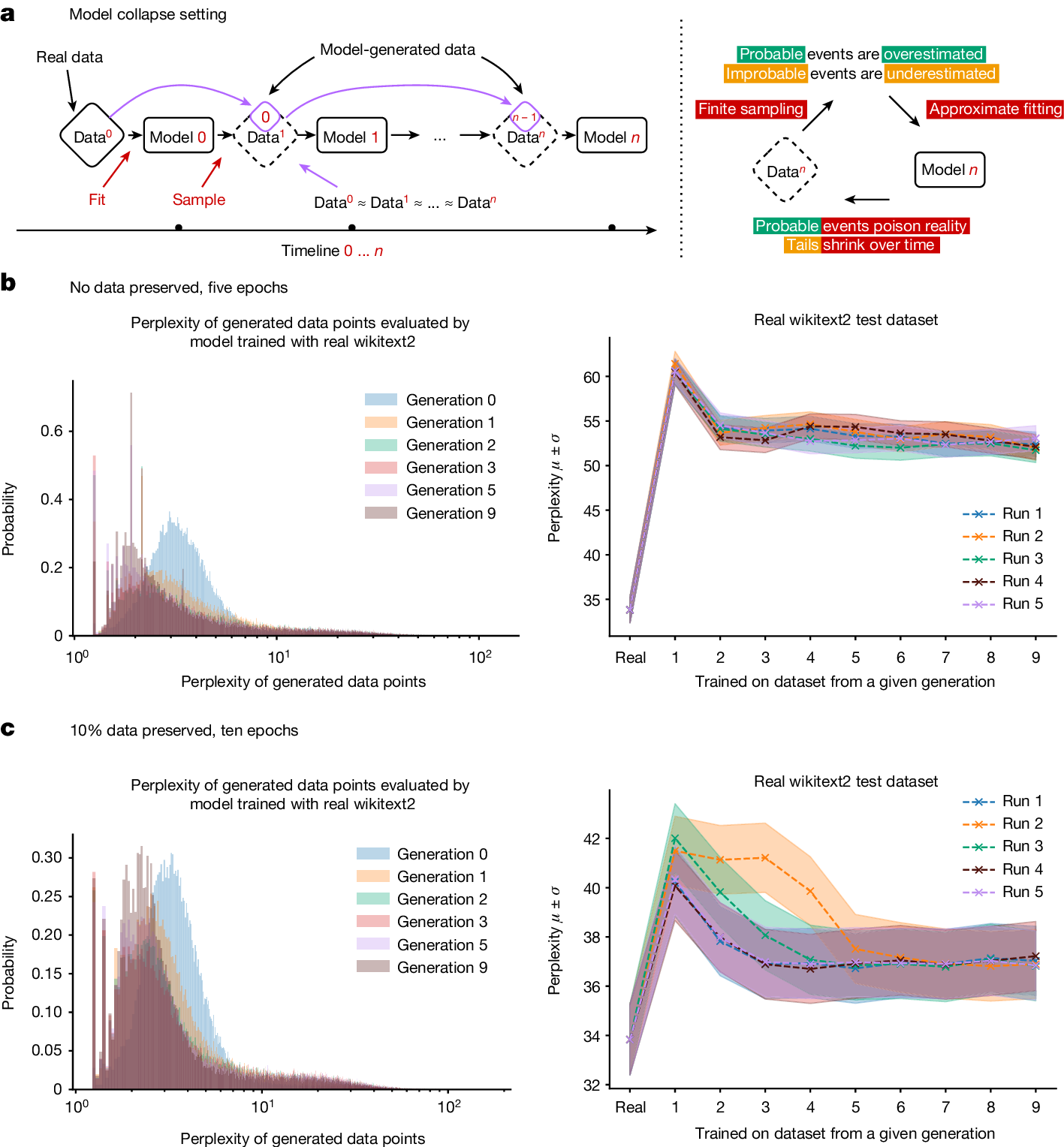
Stable diffusion revolutionized image creation from descriptive text. GPT-2 (ref. 1), GPT-3(.5) (ref. 2) and GPT-4 (ref. 3) demonstrated high performance across a variety of language tasks. ChatGPT introduced such language models to the public. It is now clear that generative artificial intelligence (AI) such as large language models (LLMs) is here to stay and will substantially change the ecosystem of online text and images. Here we consider what may happen to GPT-{n} once LLMs contribute much of the text found online. We find that indiscriminate use of model-generated content in training causes irreversible defects in the resulting models, in which tails of the original content distribution disappear. We refer to this effect as ‘model collapse’ and show that it can occur in LLMs as well as in variational autoencoders (VAEs) and Gaussian mixture models (GMMs). We build theoretical intuition behind the phenomenon and portray its ubiquity among all learned generative models. We demonstrate that it must be taken seriously if we are to sustain the benefits of training from large-scale data scraped from the web. Indeed, the value of data collected about genuine human interactions with systems will be increasingly valuable in the presence of LLM-generated content in data crawled from the Internet.
ICML Poster Learning syntax without semantics: Disentangled tiny language models
Language models acquire syntax and world knowledge together, entangling the two in ways that limit efficiency and controllability. We show that syntax can be learned while suppressing semantic plausibility and world‑knowledge cues, yielding more efficient and controllable models. We train tiny LMs on grammatical nonsense — syntactically well-formed text with semantic content ablated via constrained relexicalization (SAMBAL). Models trained on this data perform comparably to standard pretraining on syntactic benchmarks (BLiMP, SyntaxGym) while scoring at chance on world knowledge probes (EWoK). On targeted grammar-plausibility conflict probes, content-neutral models prefer grammaticality where standard models prefer plausibility, and their representations show more syntactic vs lexical alignment. On efficiency, disentanglement yields substantial sample and parameter gains: in low‑resource regimes, a 5M‑parameter model matches a 30M‑parameter baseline at the same data budget. On controllability, content-neutral models adapt rapidly to a new domain with minimal exposure, suggesting the feasibility of modular post‑hoc knowledge specialization.