

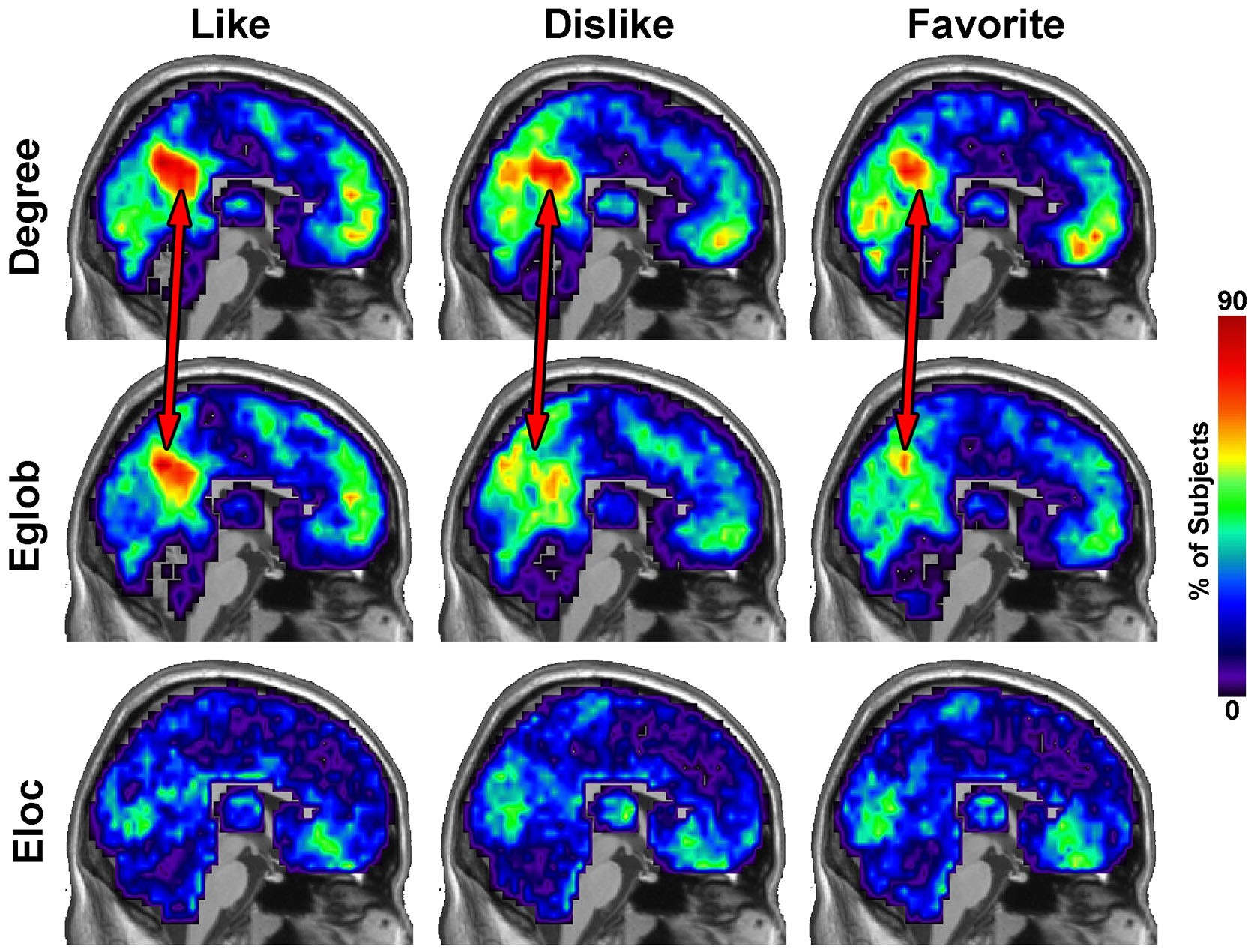
Most people choose to listen to music that they prefer or ‘like’ such as classical, country or rock. Previous research has focused on how different characteristics of music (i.e., classical versus country) affect the brain. Yet, when listening to preferred music—regardless of the type—people report they often experience personal thoughts and memories. To date, understanding how this occurs in the brain has remained elusive. Using network science methods, we evaluated differences in functional brain connectivity when individuals listened to complete songs. We show that a circuit important for internally-focused thoughts, known as the default mode network, was most connected when listening to preferred music. We also show that listening to a favorite song alters the connectivity between auditory brain areas and the hippocampus, a region responsible for memory and social emotion consolidation. Given that musical preferences are uniquely individualized phenomena and that music can vary in acoustic complexity and the presence or absence of lyrics, the consistency of our results was unexpected. These findings may explain why comparable emotional and mental states can be experienced by people listening to music that differs as widely as Beethoven and Eminem. The neurobiological and neurorehabilitation implications of these results are discussed.
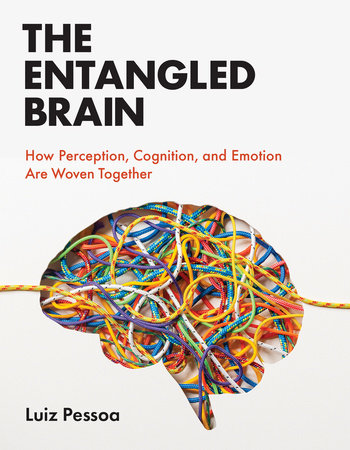
The Entangled Brain: How Perception, Cognition, and Emotion Are Woven Together
A new vision of the brain as a fully integrated, networked organ.Popular neuroscience accounts often focus on specific mind-brain aspects like addiction, c
The Impact of Listening to Music on Cognitive Performance
Listening to music for relaxation is common among students to counter the effects of stress or anxiety while completing difficult academic tasks. Some studies supporting this technique have shown that background music promotes cognitive performance...

The Algorithmic Flattening of Sound: Computational Evidence and Justice Implications of AI Music Homogenization
This paper audits whether large-scale generative music systems exhibit measurable musical homogenization relative to human-produced music, and develops a justice-centered account of why this matters. We audit two commercially deployed systems (Suno and Lyria 3) across four genres (Afrobeats, K-pop, Dance Pop, and Heavy Metal). For each system and genre, we generate 100 tracks and compare them against human corpora of equal size, using 72 music information retrieval (MIR) features and multiple diagnostics of dispersion, redundancy, and separability. We define homogenization as reduced acoustic variation in standard computational audio features including rhythm and timing, timbre/spectral shape, and dynamics, both within genres and across genre boundaries. We also generate tracks using only a genre name as the prompt, with no additional instructions, to reveal each system's default musical tendencies. The results show two structurally distinct homogenizing tendencies. Lyria reduces within-genre acoustic diversity, while Suno collapses the acoustic distinctions between genres without compressing within-genre spread. Neither system follows user prompts faithfully, indicating that the observed patterns reflect learned priors rather than prompt constraints. The two systems do not converge on a common acoustic profile and are more acoustically distant from each other than two random human subsamples would typically be. Nevertheless, a standard classifier distinguishes AI from human tracks near-perfectly on MIR features alone. We argue that these patterns matter not as an aesthetic curiosity but as a justice-relevant condition, shaping which musical styles become legible, valued, and economically rewarded as generated outputs increasingly circulate at scale.

From Prompting to Describing: A Cross-Cultural Study of Language for AI-Generated Music
Recent text-to-music (TTM) systems such as Suno [22], Udio [23], and Google’s MusicFX [7] allow users to generate music from a natural language prompt, lowering the barrier to music creation for users without specialized musical knowledge [27]. Understanding how users write these prompts is therefore a fundamental question for music information retrieval and human-AI interaction research. Yet, prompting a generative system is not the same cognitive or linguistic act as describing music one has heard [12]. When a user writes a prompt, they encode anticipatory intent to steer the system toward a desired or imagined output, whereas when a listener describes a piece of music, their language is grounded in a perceptual experience. We argue that these two acts produce systematically different language—a distinction that, despite being intuitive, has not been quantitatively examined. This gap has practical consequences: recent TTM models are trained predominantly on metadata-centric corpora (genre labels, BPM, descriptive tags) [6] rather than on the kind of language users naturally produce when listening, leaving the prompt-description gap unexamined. Moreover, this gap limits our ability to evaluate and improve human–AI interaction in music generation, as current systems are optimized for prompt input but commonly assessed through human perception.
How the brain perceives rhythm
MIT neuroscientists have found that people are biased toward hearing and producing rhythms composed of simple integer ratios. This holds true for musicians and non-musicians living in the United States, as well as members of a Bolivian tribe who have little exposure to Western music.

What is Music? Music Generates Feelings That Are Only Weakly Bound To The Music
Here I use the word "bound" in the same sense as "bind" in the "binding problem".
Leading the Herd Astray: An Experimental Study of Self-fulfilling Prophecies in an Artificial Cultural Market
Individuals influence each others' decisions about cultural products such as songs, books, and movies; but to what extent can the perception of success become a “self-fulfilling prophecy”? We have explored this question experimentally by artificially inverting the true popularity of songs in an online “music market,” in which 12,207 participants listened to and downloaded songs by unknown bands. We found that most songs experienced self-ful- filling prophecies, in which perceived—but initially false—popularity became real over time. We also found, however, that the inversion was not self-fulfilling for the market as a whole, in part because the very best songs recovered their popularity in the long run. Moreover, the distortion of market information reduced the correlation between appeal and popularity, and led to fewer overall downloads. These results, although partial and speculative, suggest a new approach to the study of cultural markets, and indicate the potential of web-based experiments to explore the social psychological origin of other macrosocio- logical phenomena.

Deezer and Ipsos study: AI fools 97% of listeners
Deezer and Ipsos unveil a unique study exploring perceptions around AI and music, conducted across 8 countries. Discover the surprising results!

Introducing The Psyche Network
Malleable Music Ensembles
A framework using generalized algebraic theories and categorical lenses to enable interoperable, local-first networked music ensembles.
AI music is flooding streaming platforms. But listeners like it less and less
Music fans are becoming increasingly uncomfortable with AI songs, according to a recent study.

Music
The Paper Pilot's digital garden of thoughts on philosophy, politics, and sociology. Reading time: ~4 minute read | Published: Aug 18, 2026 | Updated: Sep 12, 2026

Experimental Study of Inequality and Unpredictability in an Artificial Cultural Market
Hit songs, books, and movies are many times more successful than average, suggesting that “the best” alternatives are qualitatively different from “the rest”; yet experts routinely fail to predict which products will succeed. We investigated this paradox experimentally, by creating an artificial “music market” in which 14,341 participants downloaded previously unknown songs either with or without knowledge of previous participants' choices. Increasing the strength of social influence increased both inequality and unpredictability of success. Success was also only partly determined by quality: The best songs rarely did poorly, and the worst rarely did well, but any other result was possible.

Experimental Study of Inequality and Unpredictability in an Artificial Cultural Market
Hit songs, books, and movies are many times more successful than average, suggesting that “the best” alternatives are qualitatively different from “the rest”; yet experts routinely fail to predict which products will succeed. We investigated this paradox experimentally, by creating an artificial “music market” in which 14,341 participants downloaded previously unknown songs either with or without knowledge of previous participants' choices. Increasing the strength of social influence increased both inequality and unpredictability of success. Success was also only partly determined by quality: The best songs rarely did poorly, and the worst rarely did well, but any other result was possible.
To Remember, the Brain Must Actively Forget | Quanta Magazine
Researchers find evidence that neural systems actively remove memories, suggesting that forgetting may be the default mode of the brain.

AI & Music - developments & perspectives

Perspectives, developments, & news re: AI & music

Owners of Elvis Presley’s Music Sue Anthropic for Copyright Infringement

YouTube Music adds new labels for AI music
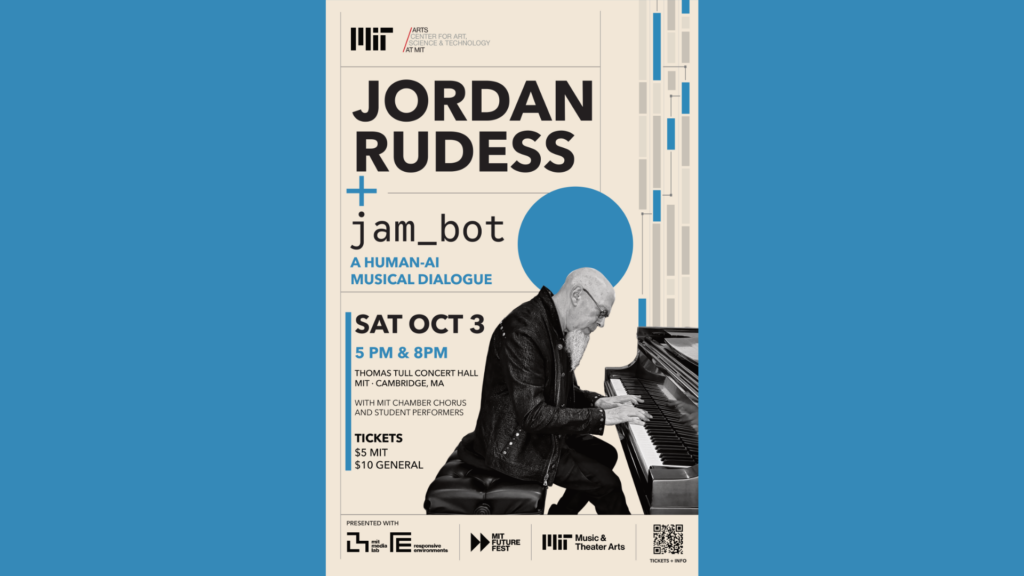
Jordan Rudess + jam_bot at MIT October 3

Jordan Rudess and MIT’s jam_bot: A New Era of Human-AI Musical Collaboration
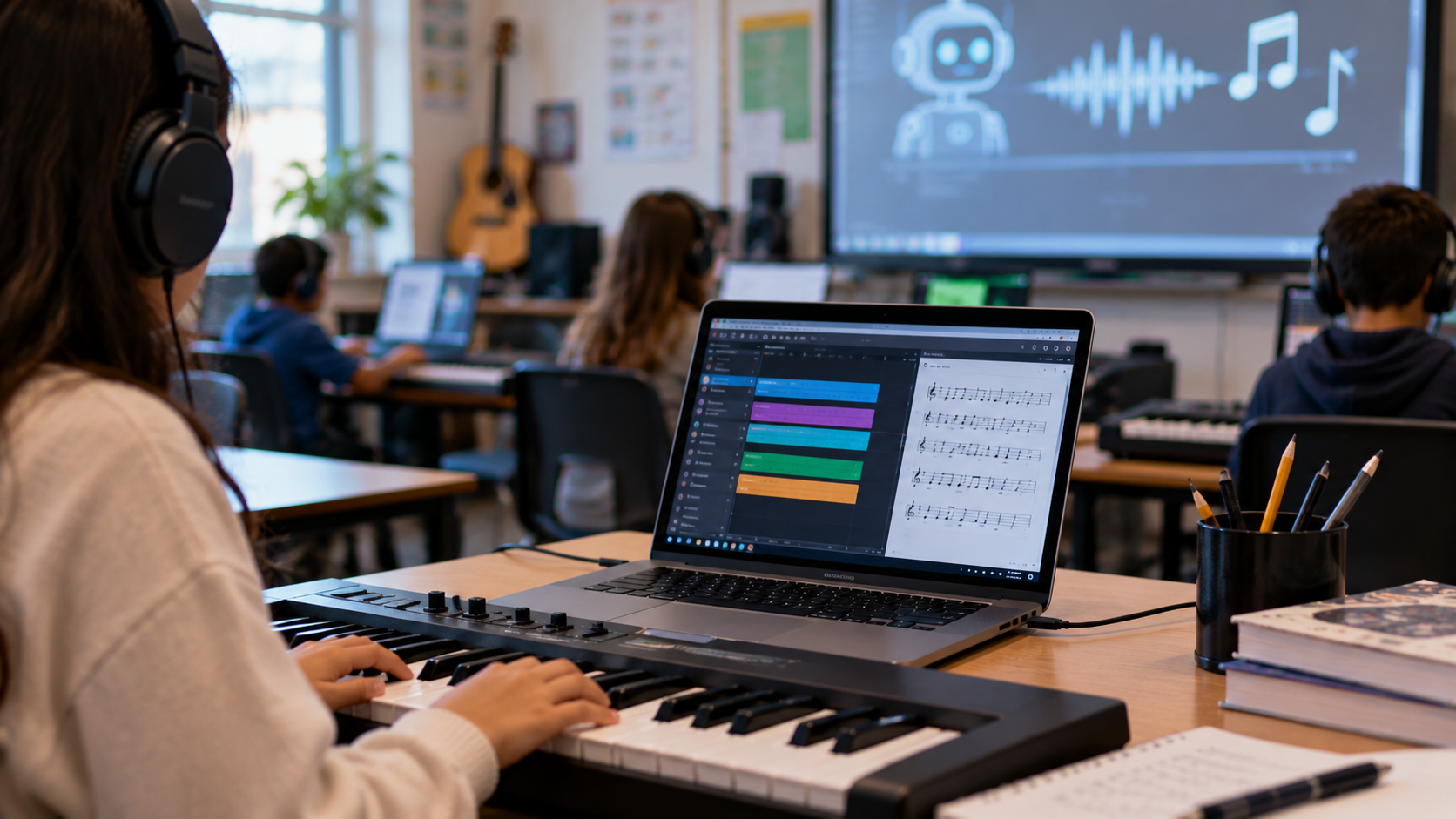
Artificial Intelligence in Music Classrooms: PK-12 Educators’ Practices, Concerns, and Confidence

“It frustrates me to hear people bashing something that's so amazing”: Todd Edwards is optimistic about AI in music production