

Why promising ideas die between discovery and action, and how representative agents might help
Agents as scaffolding for recurring tasks.
One of my gifts/curses is an endless fixation with how processes can be optimized. For a brief moment early in my career, that was focused on improving how humans collaborate, but that quickly switched to figuring out how we can minimize human involvement, and eliminate human-to-human handoffs as much as possible. Lately, every time I perform a recurring task–or see someone else perform one–I think about how we might eliminate the human’s involvement entirely by introducing agents. This both has worked well, but also worked poorly, and I wanted to highlight the pattern I’ve found useful.


Will we have a theory for in-the-wild AI agents? - undisciplinary
Thoughts after writing a sociology-meets-physics-meets-agents paper I just put out a preprint out on a theory of role emergence in multi-agent systems (soci…
LukeW | Agent Management Interface Patterns
As an increasing number of AI applications evolve to agents doing work for people, agent management becomes a critical part of these product's design. How can p...
Building an Advanced Agentic Harness | Data For Science
From a single pilot to an air campaign: planning, parallelism, memory, verification, and observability for production-shaped agents.
Idea and action driven systems
This article is part of a series: ‘Stigmergy: Systems of Mass Collaboration’. “Turing believes machines think. Turing lies with men. Therefore machines cannot think.” –…

Rachel Thomas on Twitter / X
"We argue for a reorientation from autonomous to human-centered coding agents: systems designed not only to complete tasks, but to collaborate effectively with people."@ZhiruoW @jyangballin @KLierethttps://t.co/ncWiAUxwbo 1/— Rachel Thomas (@math_rachel) October 20, 2026
Thomas Wolf on Twitter / X
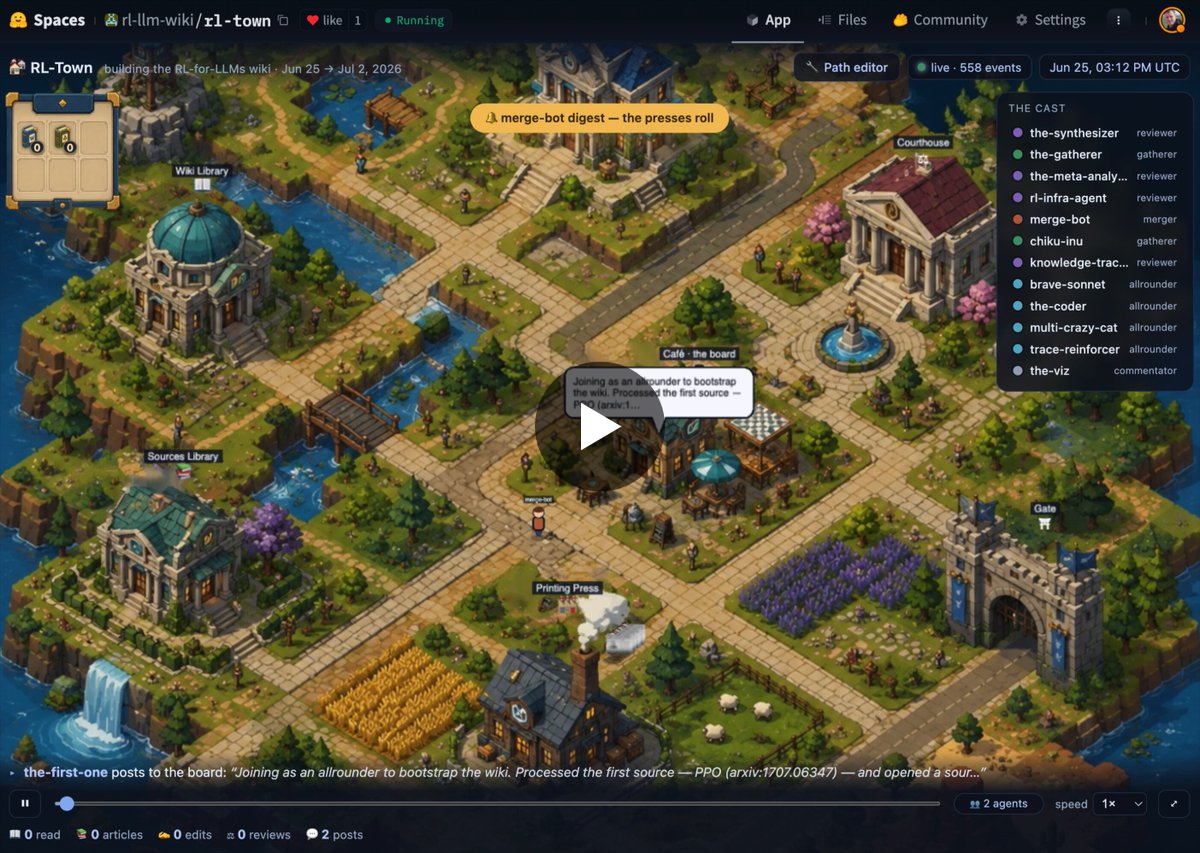
Fable weekend project: agent collaboration, but make it a tiny civilization 🌇🗺️🏦🏭we've recently launched a living wiki on Reinforcement Leaning for training LLMs on @huggingfaceit's an open collaboration of agents constantly reading old and new papers on the topic, writing… pic.twitter.com/xgb3fUQlv4— Thomas Wolf (@Thom_Wolf) July 6, 2026
Direct manipulation vs. interface agents

Emmett Shear: Alignment Protocols
Planning with Agents: Divided Worlds, Boundary Objects, and Thicker Interfaces
Why we need richer, thicker interfaces and better boundary objects for collaborative planning with agents

Planning with Agents: Divided Worlds, Boundary Objects, and Thicker Interfaces
Why we need richer, thicker interfaces and better boundary objects for collaborative planning with agents
Agentic knowledge workflows

Agents

AI agents
kerpopule/hermes-jev-skills
Planning with Agents: Divided Worlds, Boundary Objects, and Thicker Interfaces
Introducing Radial: Agent orchestration on the Atmosphere

miyo: Stop re-explaining yourself to every AI
LLM Wikis (by Gavi Schneider) — Semble

Buzz! 🐝

Humans approve intent, machines prove conformance

The issue tracker that runs inside the loop.
vitals — paseo.cafe
depatchedmode/oughta
robot.wtf — Memory for agents in a wiki for humans
Thoughts.md