


In this paper we present the major theoretical and methodological pillars of evolutionary political economy. We proceed in four steps. Aesthetics: In chapter 1 the immediate appeal of evolutionary ...
Economics for the future – Beyond the superorganism
Our environment and economy are at a crossroads. This paper attempts a cohesive narrative on how human evolved behavior, money, energy, economy and th…
Planetary carambolage: The evolutionary political economy of technology, nature and work
The following editorial introduces the special issue (SI) on “Work, Environment and Planetary-scale Computation in Political-Economic Evolution”. Here, however, we go beyond an outline of what each contribution to the SI addresses, and attempt to draw a more pronounced shared embedding of the arguments that have come to the fore. The original idea of this SI was to synthesize a range of contemporary global political-economic challenges, i.e. (1) technology (esp. digital transformation), (2) nature (esp. ecological crisis) and (3) work (esp. precarization via the evolving platform economy). The main argument developed in this editorial reflection focuses on the common ground and origin of those processes found in the complex evolution of capitalist development. We frame the latter by assigning it a new term, i.e. “planetary carambolage”.
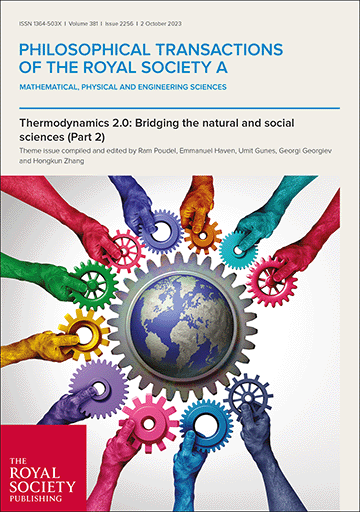
Maximum power in evolution, ecology and economics
Ludwig Boltzmann suggested that natural selection was fundamentally a struggle among organisms for available energy. Alfred Lotka argued that organisms that capture and use more energy than their competition will have a selective advantage in the evolutionary process, i.e. the Darwinian notion of evolution was based on a fundamental, generalized energy principle. He extended this general principle from the energetics of a single organism or species to the energetics of entire energy pathways through ecosystems. Howard Odum and Richard Pinkerton, building on Lotka, extended this concept to ‘The maximum power principle’ and applied it to many biological and physical systems including human economies. We examine this history and how these ideas relate to concepts from other disciplines including philosophy. But there has been considerable confusion in understanding and applying these concepts which we attempt to resolve while providing various examples from routine life and discussing some unresolved issues. This article is part of the theme issue ‘Thermodynamics 2.0: Bridging the natural and social sciences (Part 2)’.
Permissionless innovation: The fuzzy idea that rules our lives
People sometimes ask me, “What is the most important concept in political economy?” The answer is easy, but subtle …

Evolution
Evolution is the change in the heritable characteristics of biological populations over successive generations. It occurs when evolutionary processes such as genetic drift and natural selection act on genetic variation, resulting in certain characteristics becoming more or less common within a population over successive generations. The process of evolution has given rise to biodiversity at every level of biological organisation.

Mutual Aid: A Factor of Evolution
Mutual Aid: A Factor of Evolution is a 1902 collection of anthropological essays by Russian naturalist and anarchist philosopher Peter Kropotkin. The essays, initially published in the English periodical The Nineteenth Century between 1890 and 1896, explore the role of mutually beneficial cooperation and reciprocity in the animal kingdom and human societies both past and present. It is an argument against theories of social Darwinism that emphasize competition and survival of the fittest, and against the romantic depictions by writers such as Jean-Jacques Rousseau, who thought that cooperation was motivated by universal love. Instead, Kropotkin argues that mutual aid has pragmatic advantages for the survival of human and animal communities and, along with the conscience, has been promoted through natural selection.

Handbook of Evolutionary Psychology
‘This Handbook is refreshingly different. While including requisite chapters on subfields within evolutionary psychology, it also includes chapters on evolutionary psychology’s influence on other disciplines (e.g., Anthropology, Criminology), and retrospectives on six foundational studies. And perhaps most innovative, chapters are written by an international collection of up-and-coming scholars who give their take on the current and future state of evolutionary psychology.’ – David F. Bjorklund, Florida Atlantic University, USA

Patrick Artus : « 2050, c’est la disparition de l’Europe comme puissance économique »
Economiste aussi influent que productif, Patrick Artus raconte sa relation à la discipline, et anticipe les évolutions de l’économie mondiale au XXIe siècle – …

Hyperpolitics? Yes, Please • Protean Magazine
Alex Colston reviews Anton Jäger's "Hyperpolitics," filling in gaps in the book's short argument and arguing for the importance of political formations and activities independent of official political society.

A Real Political Economy of Technology - The Ideas Letter
Two technological futures are competing for political and material priority: generative AI and the green transition. Benanav argues that while AI is marketed as a world-reordering breakthrough, its productivity gains…
Anthropocene Epistemology: Political, Ecological, and Economic Entanglements
This essay critically explores the connection between epistemology, political ecology, economy, and technological developments in the Anthropocene, understood a

JBS Haldane-A Dialectical Account of Evolution
THIS paper requires a preliminary apology. It is written in Spain, and as the writer is taking a very minor part in the defence of Madrid he is unable to consult many works of reference. Readers to whom practice is as important as theory will excuse any inadequacy in citations.
Entre moustiques et nationalisme méthodologique : retour sur le prix de la Banque de Suède
Daron Acemoglu, Simon Johnson et James Robinson, lauréats du « prix Nobel d’économie », proposent une lecture limitée des effets des institutions héritées de l…

Esprits animaux: Dans quelle mesure les préférences environnementales se traduisent-elles par un vote écologiste ?
La science économique manque de diversité. Les femmes et les minorités ethniques sont sous-représentées dans la profession des économistes, ...
Survival of the Prettiest (Published 2017)
Darwin’s theory of aesthetics may be the sexiest, most dangerous idea in evolution.

Social Norms and Cultural Evolution

A collection of ideas to do with social norms, cultural evolution, and how we learn from others

AI as Social Technology: Astor Lecture by Professor Henry Farrell

Bayesian Inference of Social Norms as Shared Constraints on Behavior

What people learn from punishment: A cognitive model

Spurious normativity enhances learning of compliance and enforcement behavior in artificial agents

Deference, Dissent, and Dispute Resolution: An Experimental Intervention Using Mass Media to Change Norms and Behavior in Rwanda
How Does Media Influence Social Norms? Experimental Evidence on the Role of Common Knowledge