


It’s hard to draw the sort of clean line you’d want when designing regulation, say Luke Thorburn, Jonathan Stray, and Priyanjana Bengani.
Recommendation Systems - Not so discussed areas
Practical advice on recommendation systems in production

AI recommendation concentration by industry | Parse
Parse analyzed 631,000 AI recommendations. A category leader held 81% in some consumer markets, compared with 22% across 15 brands in B2B software.
The enshittification of online search? Privacy and quality of Google, Bing and Apple in coding advice
Even though currently being challenged by ChatGPT and other large-language models (LLMs), Google Search remains one of the primary means for many individuals to find information on the internet. Interestingly, the way that we retrieve information on the web has hardly changed ever since Google was established in 1998, raising concerns as to Google's dominance in search and lack of competition. If the market for search was sufficiently competitive, then we should probably see a steady increase in search quality over time as well as alternative approaches to the Google's approach to search. However, hardly any research has so far looked at search quality, which is a key facet of a competitive market, especially not over time. In this report, we conducted a relatively large-scale quantitative comparison of search quality of 1,467 search queries relating to coding advice in October 2023. We focus on coding advice because the study of general search quality is difficult, with the aim of learning more about the assessment of search quality and motivating follow-up research into this important topic. We evaluate the search quality of Google Search, Microsoft Bing, and Apple Search, with a special emphasis on Apple Search, a widely used search engine that has never been explored in previous research. For the assessment of search quality, we use two independent metrics of search quality: 1) the number of trackers on the first search result, as a measure of privacy in web search, and 2) the average rank of the first Stack Overflow search result, under the assumption that Stack Overflow gives the best coding advice. Our results suggest that the privacy of search results is higher on Bing than on Google and Apple. Similarly, the quality of coding advice -- as measured by the average rank of Stack Overflow -- was highest on Bing.

Letting Users Choose Recommender Algorithms: An Experimental Study
Recommender systems are not one-size-fits-all; different algorithms and data sources have different strengths, making them a better or worse fit for different users and use cases. As one way of taking advantage of the relative merits of different algorithms, we gave users the ability to change the algorithm providing their movie recommendations and studied how they make use of this power. We conducted our study with the launch of a new version of the MovieLens movie recommender that supports multiple recommender algorithms and allows users to choose the algorithm they want to provide their recommendations. We examine log data from user interactions with this new feature to understand whether and how users switch among recommender algorithms, and select a final algorithm to use. We also look at the properties of the algorithms as they were experienced by users and examine their relationships to user behavior.
Internal Site Search Optimization: Best Practices for Your Site
A great internal site search can be a delightful user experience—and a wildly profitable optimization. Find out how to do it right.
Search has its own bitter lesson
Human incentives to make content findable to your search matter more than technology

pub search / recommended
most-recommended posts across atproto publishing platforms
metabrainz/troi-recommendation-playground
A recommendation engine playground that should hopefully make playing with music recommendations easy.
Michael Tsai - Blog - App Store Personalized Recommendations and Keylogging
This week, Apple announced a series of discovery features that will personalize app recommendations based on users’ interests and behavior, providing a new way for developers to have their app discovered.
Collaborative filtering
Collaborative filtering (CF) is, besides content-based filtering, one of two major techniques used by recommender systems. Collaborative filtering has two senses, a narrow one and a more general one.

blog 010: anne hero's online shopping guide
searching is: using a query to capture results. you can use boolean expressions to add constraints to your search. the problem is, sellers on secondhand e-commerce websites are not consistent in their listing title, descriptions, use of hard categories, and on e-commerce platforms ran by teenagers: knowledge. in order to see as much clothes as possible, you need to maximize how many listings you capture.
This is definitely my feeling working with them on recommendation algorithm.

Mark Riedl
Fascinating experiment: current AI systems lack creativity to reliably pursue research arxiv.org/abs/2607.27191 - poor judgment about the bar for publishable research - uncreative responses in research design - ineffective backtracking from dead ends - poor resource awareness - instruction drift
I read the new EU Court ruling on algorithms and social platforms so you don't have to. Turns out to be the most consequential thing a European court has said about recommendation algorithms, and also it just breaks when you apply it to the atmosphere connectedplaces.online/the-algorithm-singular/

The Algorithm, Singular
connectedplaces.onlineWe talk a lot about how the Discovery algorithm can be improved for users.... I would like to add that *search* is also a core UX that needs help. Searches always seek new, relevant results—so "Top" and "Latest" are both wrong. I need closer to "Top latest" cc cc @alexbenzer.com @toni.bsky.team
Search engines

Features and comparisons for when I’m “search engine shopping” and not so much about enshittification etc. Currently I mostly use DuckDuckGo (for when I basically know what I’m looking for) and Kagi (for when I don’t or if I’m dissatisfied with DDG; I’m not on their unlimited plan).
あ (@aiueo.ooo)

Google’s AI search is so broken it can ‘disregard’ what you’re looking for

Google Search’s AI evolution includes more ads
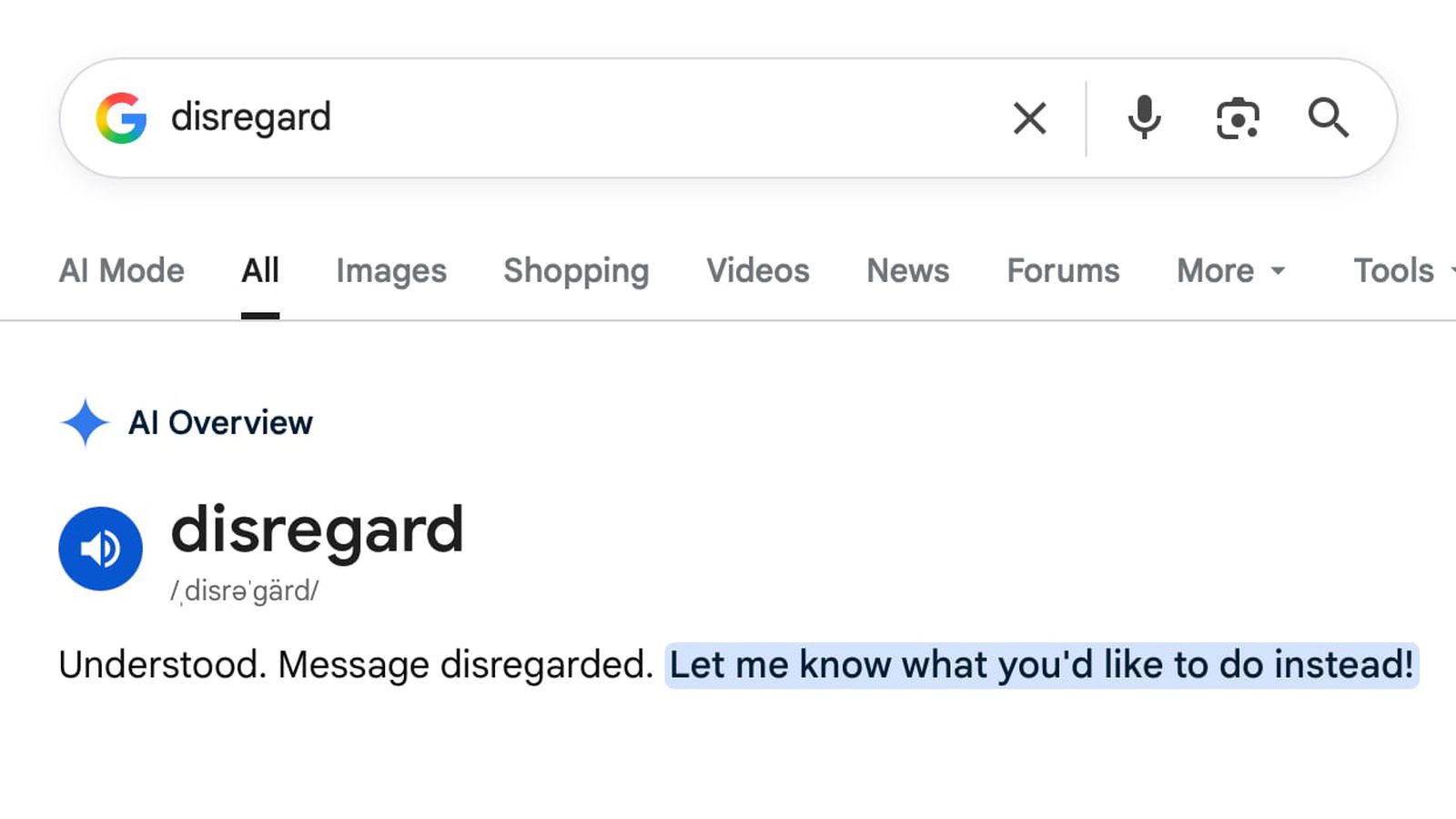
Searching for 'Disregard' Breaks Google [Updated]
あ (@aiueo.ooo)


