


It's not because of shorter sentences.
A Claude Skill that Makes LLM Paragraphs More Bearable
And they said studying Christensen's rhetoric of the sentence was a waste of time...
Do LLMs write like humans? Variation in grammatical and rhetorical styles
As large language models (LLMs) have grown in power and become more widely available, research has focused on their ability to complete various tasks and the biases they exhibit when doing so. In this study, we instead examine their writing style in detail. We show that instruction-tuned models, which are trained to answer questions and solve problems, have a distinct noun-heavy, informationally dense writing style, even when prompted to match the style of informal speech and writing. These findings suggest that instruction-tuned models generate text that does not align with genre conventions familiar to human audiences, and demonstrate the value of linguistic variables in evaluating the output of LLMs., Large language models (LLMs) are capable of writing grammatical text that follows instructions, answers questions, and solves problems. As they have advanced, it has become difficult to distinguish their output from human-written text. While past research has found some differences in features such as word choice and punctuation and developed classifiers to detect LLM output, none has studied the rhetorical styles of LLMs. Using several variants of Llama 3 and GPT-4o, we construct two parallel corpora of human- and LLM-written texts from common prompts. Using Douglas Biber’s set of lexical, grammatical, and rhetorical features, we identify systematic differences between LLMs and humans and between different LLMs. These differences persist when moving from smaller models to larger ones and are larger for instruction-tuned models than base models. This observation of differences demonstrates that despite their advanced abilities, LLMs struggle to match human stylistic variation. Attention to more advanced linguistic features can hence detect patterns in their behavior not previously recognized.


Automated Sentence Generation for a Spaced Repetition Software
This paper presents and tests AllAI, an app that utilizes state-of-the-art NLP technology to assist second language acquisition through a novel method of sentence-based spaced repetition. Diverging from current single word or fixed sentence repetition, AllAI dynamically combines words due for repetition into sentences, enabling learning words in context while scheduling them independently. This research explores various suitable NLP paradigms and finds a few-shot prompting approach and retrieval of existing sentences from a corpus to yield the best correctness and scheduling accuracy. Subsequently, it evaluates these methods on 26 learners of Danish, finding a four-fold increase in the speed at which new words are learned, compared to conventional spaced repetition. Users of the retrieval method also reported significantly higher enjoyment, hinting at a higher user engagement.
Why is every rationalist blog post way too long? - alex wennerberg
For my piece on Catholic miracle apologetics, I read (correction: skimmed) a 25,000-word post by rationalist blogger Scott Alexander. My piece, which cited (but does not focus on) his, ended up being a cool 2,700 words. I don't think it would benefit from being longer, and it was the result of me cutting around 70% of the text I initially wrote.
The shrinking landscape of linguistic diversity in the age of large language models
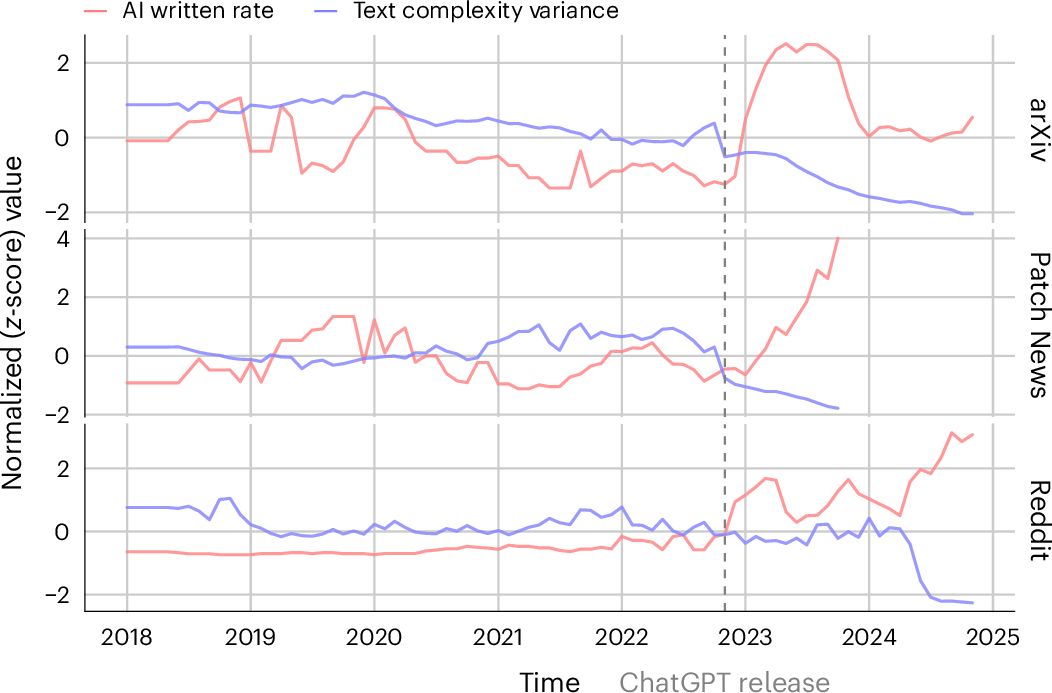
Language is far more than a communication tool; it encodes a wealth of information about a person’s identity, psychological state and social context, providing valuable insights for diverse fields including psychology, marketing and healthcare. Across three studies spanning seven datasets in different domains and over 880,000 texts, we show that the widespread adoption of large language models (LLMs) as writing assistants is linked to declines in linguistic diversity, interfering with the societal and psychological insights language provides. While core content is retained when LLMs polish and rewrite texts, LLMs also homogenize writing styles, reducing writing-complexity variance by a statistically significant 21–50% across datasets and models (P ≤ 0.05), and amplify patterns associated with dominant characteristics while suppressing others, emphasizing conformity over individuality. These trends hold across different LLMs, prompts and contexts, with potential implications for diagnostic processes, personalization efforts, hiring assessments and cultural preservation.
Post-Structuralism in Gestalt: Because Nothing is Fixed Anyway
Why Words Matter, Even If They Sound Academic

MAiD, ableism, cognitive accessibility, and more
This one took a bit to write. The first piece is long (1,600+ words), and intense. But it needed to be said. I'll be interested to hear what you think. You...

The Notebook on the Pillow
On writing one sentence before sleep, and why the sentence does not need to be true so much as noticed.


The revolt of the reader | The Observation Deck
Reading is important to me. While I’m not a quick reader nor an especially voracious one, I have found that long-form reading has had a profound influence on me over my life. And because reading is important to me, writing is too: writing not only allows us to convey our ideas, but the very act forces us to test and distill them — at once making our ideas more robust while providing the vehicle by which to share them.
What’s Happening to Reading?
For many people, A.I. may be bringing the age of traditional text to an end.

Full essay below. Written at @bmann.ca 's prompting in the Discourse thread — language barriers keeping atproto's non-English implementations out of the design conversation. night-terrace.offprint.app/a/3mlxygoehwd23-three-layers-…

Three Layers of Post Editing in atproto: A Case for History-Preserving Design | Nighthaven⛺︎ | Offprint
night-terrace.offprint.app
