New York City’s An Evening of Unnecessary Detail on July 12th, get your tickets here: https://www.ticketmaster.com/matt-parker-an-evening-of-unnecessary-brooklyn-new-york-07-12-2026/event/300064B84CCCF567 Thomas Bloom’s site documenting the Erdős problems: www.erdosproblems.com A full state of play (up to June 30 2026) on AI contributions to Erdős problems can be found here: https://github.com/teorth/Erdosproblems/wiki/AI-contributions-to-Erd%C5%91s-problems A simplified interactive visualisation to new unit distance problem constructions is here: https://chatgpt.com/canvas/shared/6a15da73c5b08191a2dc34c3ac6ceca6 More details on each solved Erdős problem referenced in the video can be found below categorized by problem number: Erdős problem #1043 https://www.erdosproblems.com/1043 Commentary from Sebastien Bubeck: https://x.com/SebastienBubeck/status/1980311866770653632 Terry Tao’s Mathstodon post: https://mathstodon.xyz/@tao/115385022005130505 Erdős problem #1026 https://www.erdosproblems.com/1026 Terry Tao’s blog on the solution: https://terrytao.wordpress.com/2025/12/08/the-story-of-Erdős-problem-126/ Erdős problem #728 https://www.erdosproblems.com/728 Terry Tao’s Mathstodon post: https://mathstodon.xyz/@tao/115855840223258103 Kevin Barreto’s blog post about AI and problem 728: https://www.erdosproblems.com/forum/thread/blog:2 Writeup of the Aristotle’s Lean proof: https://drive.google.com/file/d/1MRQfcHhrYMfMTvlZcMC3zEK7aOrUyHiQ/view Erdős problem #1196 https://www.erdosproblems.com/1196 Link to the paper on Arxiv: https://arxiv.org/abs/2605.00301 Record of Liam Price’s initial conversation with Chat GPT: https://chatgpt.com/share/69dd1c83-b164-8385-bf2e-8533e9baba9c Erdős problem #90 https://www.erdosproblems.com/90 Remarks on the disproof of the conjecture: https://cdn.openai.com/pdf/74c24085-19b0-4534-9c90-465b8e29ad73/unit-distance-remarks.pdf Lean programming language: https://lean-lang.org/ Here are the details on Arxiv’s rules around AI in submitted papers: https://www.reddit.com/r/math/s/G3tJfBTdSB Here’s the paper I mention at the very end of the video: https://arxiv.org/html/2605.22763v1 Leiden Decleration on AI and Mathematics: https://leidendeclaration.ai/ A subsequent discovery post Unit Distance Conjecture: https://arxiv.org/abs/2605.28781 Huge thanks to my Patreon supporters. They are all unit distance pairs to the channel! https://www.patreon.com/standupmaths Were the passers by bemused by me, sitting at a desk drinking coffee on the beach? We’ll never find out for sure but it’s safe to say maybe. CORRECTIONS None so far. Let me know if you spot anything! Editing by Gus Melton Written, filmed, and performed by Matt Parker Produced by Nicole Jacobus Content wrangling by Rhys Jones Music by Howard Carter Design by Simon Wright and Adam Robinson MATT PARKER: Stand-up Mathematician Website: http://standupmaths.com/
AI contributions to Erdős problems
A community database for the problems on the erdosproblems.com site - teorth/erdosproblems
Timothy Gowers @wtgowers on Twitter / X
AI has now solved a major open problem -- one of the best known Erdos problems called the unit distance problem, one of Erdos's favourite questions and one that many mathematicians had tried.https://t.co/SD1vVPkrHR— Timothy Gowers @wtgowers (@wtgowers) May 20, 2026
Shouqiao Wang on Twitter / X
I solved 6 open Erdős problems in 5 days, using @OpenAI GPT-5.6 Sol.I have a math background, but the Codex workflow I used does not require deep mathematical knowledge.Here’s exactly how I approached it, including my prompts 🧵— Shouqiao Wang (@Qiaoqiao2001) July 22, 2026
The last IMO problem AI could not solve
The last IMO problem AI could not solve
98 out of 100. That's how many advanced maths problems current AI models managed to solve in an international benchmark in Leipzig. One of the two remaining problems? A simplified version of a… | Czech Technical University in Prague | 11 comments
98 out of 100. That's how many advanced maths problems current AI models managed to solve in an international benchmark in Leipzig. One of the two remaining problems? A simplified version of a combinatorics problem solved by researchers from the Faculty of Information Technology CTU in Prague. Alexander Clifton, Daniela Černá and Jan Volec, together with Bartołomiej Kielak from Universität Leipzig , found the solution to a simplified version of the long-standing open problem of breaking triples with permutations. The problem was later included among the 100 tasks used to test how today's AI models perform in advanced mathematics. While AI came remarkably close, this was one of the problems it couldn't solve on its own. A nice reminder that mathematical creativity and abstract reasoning still leave some room for humans. 🧠 🔗 Read the full story in the comments. | 11 comments on LinkedIn

No. 014: Science's AI productivity paradox, Sakana clears peer review, AI proof search on open Erdős problems - The Hallway Track
The Hallway Track No. 014 - How AI is affecting the practice of science
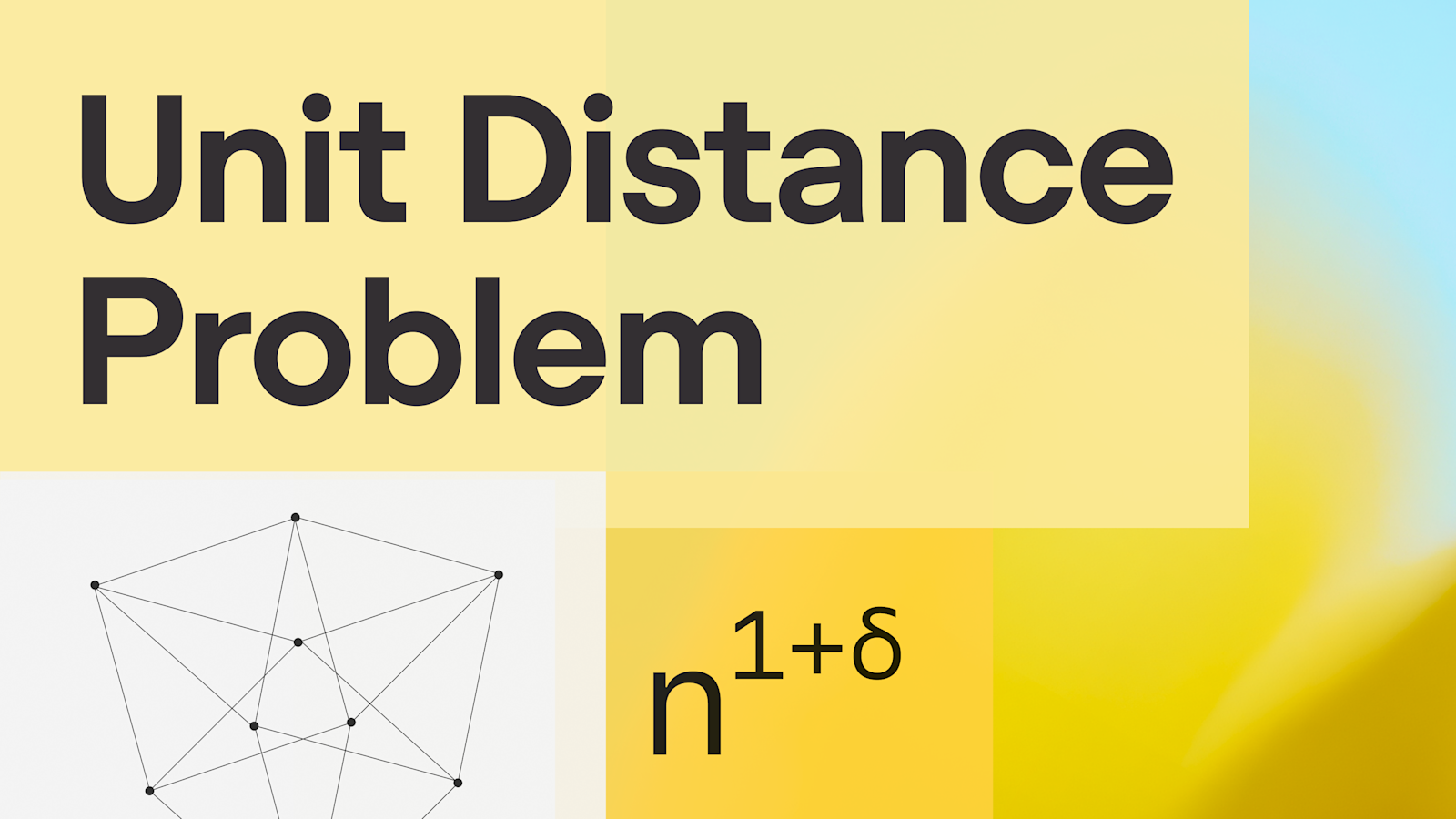
An OpenAI model has disproved a central conjecture in discrete geometry
An OpenAI model solved the 80-year-old unit distance problem, disproving a major conjecture in discrete geometry and marking a milestone in AI-driven mathematics.
The Unbelievable Scale of AI’s Pirated-Books Problem
Meta pirated millions of books to train its AI. Search through them here.

No. 011: Sum-product conjecture disproof, AI-generated authorship fraud, OMB grant-cost rules - The Hallway Track
The Hallway Track No. 011 - How AI is affecting the practice of science
No. 020: Astra solves ten open math problems, AI agents fail at open-ended research, peer review under strain - The Hallway Track
The Hallway Track No. 020 - How AI is affecting the practice of science
Is there something it is like to be an AI?
Posted on Wednesday 2 Jul 2025. 1,593 words, 6 links. By Matt Webb.

VibeMathed - Math Problems Solved by AI
A community-curated record of math problems no human had solved before, proved or disproved with AI in the loop - with checkable sources and verification labels.
Mathematicians are grappling with the possibility that AI might eclipse them
I talked to 20 mathematicians about rapid AI progress in their field.