Collection
Social media (unsorted)

Updated 3d
Will probably be sorted into separate collections
Collection
Updated 3d
Will probably be sorted into separate collections
Adults in Great Britain now spending more time on mobiles than watching TV
Daily average for watching all types of screen is now almost 7.5 hours, annual survey for IPA finds
The Attention Economy and the Collapse of Cognitive Autonomy
Check out the first in a series on social media from Denny Center Student Fellow Rai Hasen Masoud (F'27) to learn more about the attention economy and it's impacts on our democracy.
Who Makes Money From Social Media?
Investigate platforms' revenue redistribution schemes.
People Across the Globe Increasingly Say Social Media Is Harming Democracy
Most think social media leads to manipulation and division, but they also say it informs people and gives them a voice in politics.
Sharing of misinformation is habitual, not just lazy or biased
Why do people share misinformation on social media? In this research ( N = 2,476), we show that the structure of online sharing built into social platforms is more important than individual deficits in critical reasoning and partisan bias—commonly cited drivers of misinformation. Due to the reward-based learning systems on social media, users form habits of sharing information that attracts others' attention. Once habits form, information sharing is automatically activated by cues on the platform without users considering response outcomes such as spreading misinformation. As a result of user habits, 30 to 40% of the false news shared in our research was due to the 15% most habitual news sharers. Suggesting that sharing of false news is part of a broader response pattern established by social media platforms, habitual users also shared information that challenged their own political beliefs. Finally, we show that sharing of false news is not an inevitable consequence of user habits: Social media sites could be restructured to build habits to share accurate information.

How Social Media Rewards Misinformation
A majority of false stories are spread by a small number of frequent users, suggests a new study co-authored by Yale SOM’s Gizem Ceylan. But they can be taught to change their ways.

The Real Lie About Online Video Runs Deeper Than Facebook’s False Metrics
Everyone bought into the fable that users actually wanted more video.
【沖縄県知事選挙】SNS「X」の投稿の約9割は県外から 選挙戦への影響も | 沖縄のニュース|RBC 琉球放送 (1ページ)
9月13日に投開票される沖縄県知事選挙について、8月の1か月間にSNS「X」で発信された「沖縄県知事選」を含む投稿の9割近くが、県外からの発信とみられることが分かりました。RBCは、SNS分析ツール「ソーシャルイン… (1ページ)
Meta's $17 Billion Settlement is a Bad Deal for Teens and All Social
Meta’s settlement with 52 state attorneys general is a bad deal for all internet users, and especially for teens. In this post, we go through the Settlement’s provisions in detail.
Meta Just Paid Nearly $17 Billion To Make Sure It Gets To Write The Kid Safety Rules For Every Other Social Media Platform
By now you’ve almost certainly heard the news that Meta has settled with 52 state and local Attorneys General who had sued the company in some form or another over child safety on Meta’…

20 shared papers
Hall JA Ten myths about the effect of social media use on well-being J. Med. Internet Res. • Dissing AS et al. Smartphone interactions and mental well-being in young adults: A longitudinal study based on objective high-resolution smartphone data Scand. J. Public Health • Beyens I et al. The effect of social media on well-being differs from adolescent to adolescent Sci. Rep. • Valkenburg PM Social media use and well-being: What we know and what we need to know Curr. Opin. Psychol. • Panova T et al. Is smartphone addiction really an addiction? J. Behav. Addict. • Heffer T et al. The longitudinal association between social-media use and depressive symptoms among adolescents and young adults: An empirical reply to Twenge et al. (2018) Clin. Psychol. Sci. • Stavrova O et al. Does using social media jeopardize well-being? The importance of separating within- from between-person effects Soc. Psychol. Personal. Sci. • Lawrence D et al. Reciprocal relationships between trajectories of loneliness and screen media use during adolescence J. Child Fam. Stud. • Cunningham S et al. Social media and depression symptoms: A meta-analysis Res. Child Adolesc. Psychopathol. • Hall JA et al. Experimentally manipulating social media abstinence: results of a four-week diary study Media Psychol. • Panayiotou M et al. Time spent on social media among the least influential factors in adolescent mental health: preliminary results from a panel network analysis Nat. Ment. Health • Johannes N et al. Objective, subjective, and accurate reporting of social media use: No evidence that daily social media use correlates with personality traits, motivational states, or well-being Technol. Mind Behav. • Johannes N et al. No effect of different types of media on well-being Sci. Rep. • Meier A et al. Computer-mediated communication, social media, and mental health: A conceptual and empirical meta-review Communic. Res. • Bruce LD et al. Loneliness in the United States: A 2018 national panel survey of demographic, structural, cognitive, and behavioral characteristics Am. J. Health Promot. • Schemer C et al. The impact of Internet and social media use on well-being: A longitudinal analysis of adolescents across nine years J. Comput. Mediat. Commun. • Hall JA et al. Two tests of social displacement through social media use Inf. Commun. Soc. • Hampton KN Social media and change in psychological distress over time: The role of social causation J. Comput. Mediat. Commun. • Steinsbekk S et al. The new social landscape: Relationships among social media use, social skills, and offline friendships from age 10-18 years Comput. Human Behav. • Odgers CL The great rewiring: is social media really behind an epidemic of teenage mental illness? Nature

総務省がグーグルやXなど5社に勧告 情プラ法に基づく報告に不備:朝日新聞
総務省は24日、米グーグルなど5社に対し、インターネット上の誹謗(ひぼう)中傷への対策を定めた「情報流通プラットフォーム対処法」(情プラ法)にもとづく是正勧告をした。悪質な投稿への対応状況などを公表…

The "Majority Illusion" in Social Networks
Individual’s decisions, from what product to buy to whether to engage in risky behavior, often depend on the choices, behaviors, or states of other people. People, however, rarely have global knowledge of the states of others, but must estimate them from the local observations of their social contacts. Network structure can significantly distort individual’s local observations. Under some conditions, a state that is globally rare in a network may be dramatically over-represented in the local neighborhoods of many individuals. This effect, which we call the “majority illusion,” leads individuals to systematically overestimate the prevalence of that state, which may accelerate the spread of social contagions. We develop a statistical model that quantifies this effect and validate it with measurements in synthetic and real-world networks. We show that the illusion is exacerbated in networks with a heterogeneous degree distribution and disassortative structure.
KFF Tracking Poll on Health Information and Trust: Use of Social Media and AI For Health Information and Advice | KFF
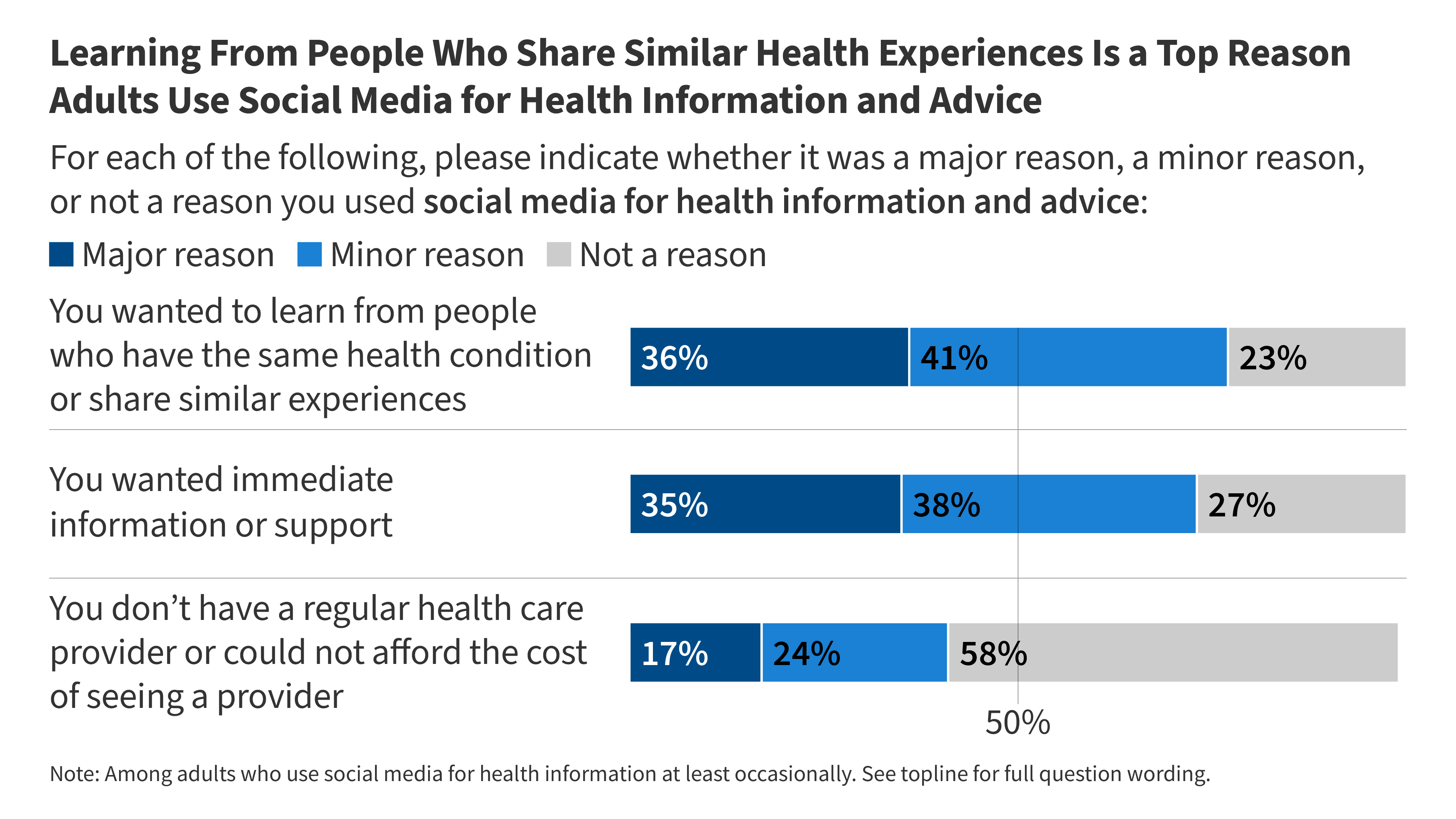
This poll finds that about 3 in 10 adults turn to social media for health information and advice at least monthly. Community connection and the need for immediate answers are the top reasons why people are turning to these tools. Slim majorities of those who use social media for health are confident they can tell what is true, and relatively few take steps to check the information they receive.
The Feed Is Fake
That “viral” song, movie, influencer, and celebrity drama you scrolled by recently was likely the result of a stealth marketing campaign.
OSF
Shifts in U.S. Social Media Use, 2020–2024: Decline, Fragmentation, and Enduring Polarization
Using nationally representative data from the 2020 and 2024 American National Election Studies (ANES), this paper describes how U.S. social media use has shifted across platforms, demographics, and politics. Overall platform reach declined, driven by growth in the share of Americans — especially the youngest and oldest cohorts — who report using no social media. Visiting and posting activity on Twitter/X and Facebook have fallen by nearly 50% since 2020, with the decline on Twitter/X driven primarily by reduced participation among Democratic users. While Facebook, YouTube, and Twitter/X lost ground, TikTok and Reddit grew modestly, consistent with a more fragmented digital public sphere. Platform audiences aged and became slightly more educated and racially diverse. Politically, most platforms shifted toward Republican users while remaining, on balance, Democratic-leaning. Twitter/X experienced the largest change: among posters, the partisan balance swung over 70 percentage points from Democrats to Republicans. Across platforms, political posting remains closely tied to affective polarization, as the most partisan respondents are also the most active. As casual users disengage while polarized partisans remain vocal, online discourse becomes narrower and more ideologically extreme.
So the people launching a new Twitter under the name Twitter launched their thing so I signed up. Turns out they have an AI scanning tweets for "truth" and it currently has no idea what it's doing. Posted something innocuous about Star Wars Zero Company and it essentially blocked it from all feeds.
Coordinated Inauthentic Behavior

A collection of reading and resources around patterns of operations online intended to disrupt networks, scam users, and otherwise affect the health of society and social media Should focus on theory and practice but not tools

Uncovering Coordinated Networks on Social Media: Methods and Case Studies
A General Method to Find Highly Coordinating Communities in Social Media through Inferred Interaction Links

Exposing Cross-Platform Coordinated Inauthentic Activity in the Run-Up to the 2024 U.S. Election
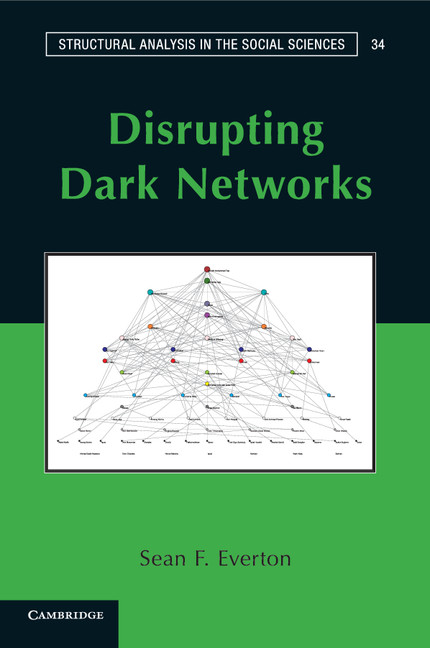
Disrupting Dark Networks
Ecosystem or Echo-System? Exploring Content Sharing across Alternative Media Domains

↳ Slopaganda: The Inauthentic YouTube Network Selling Secession to Albertans — Canadian Digital Media Research Network
