Uncovering Coordinated Networks on Social Media: Methods and Case Studies
Coordinated campaigns are used to influence and manipulate social media platforms and their users, a critical challenge to the free exchange of information online. Here we introduce a general, unsupervised network-based methodology to uncover groups of accounts that are likely coordinated. The proposed method constructs coordination networks based on arbitrary behavioral traces shared among accounts. We present five case studies of influence campaigns, four of which in the diverse contexts of U.S. elections, Hong Kong protests, the Syrian civil war, and cryptocurrency manipulation. In each of these cases, we detect networks of coordinated Twitter accounts by examining their identities, images, hashtag sequences, retweets, or temporal patterns. The proposed approach proves to be broadly applicable to uncover different kinds of coordination across information warfare scenarios.

A General Method to Find Highly Coordinating Communities in Social Media through Inferred Interaction Links
Political misinformation, astroturfing and organised trolling are online malicious behaviours with significant real-world effects. Many previous approaches examining these phenomena have focused on broad campaigns rather than the small groups responsible for instigating or sustaining them. To reveal latent (i.e., hidden) networks of cooperating accounts, we propose a novel temporal window approach that relies on account interactions and metadata alone. It detects groups of accounts engaging in various behaviours that, in concert, come to execute different goal-based strategies, a number of which we describe. The approach relies upon a pipeline that extracts relevant elements from social media posts, infers connections between accounts based on criteria matching the coordination strategies to build an undirected weighted network of accounts, which is then mined for communities exhibiting high levels of evidence of coordination using a novel community extraction method. We address the temporal aspect of the data by using a windowing mechanism, which may be suitable for near real-time application. We further highlight consistent coordination with a sliding frame across multiple windows and application of a decay factor. Our approach is compared with other recent similar processing approaches and community detection methods and is validated against two relevant datasets with ground truth data, using content, temporal, and network analyses, as well as with the design, training and application of three one-class classifiers built using the ground truth; its utility is furthermore demonstrated in two case studies of contentious online discussions.

Exposing Cross-Platform Coordinated Inauthentic Activity in the Run-Up to the 2024 U.S. Election
Coordinated information operations remain a persistent challenge on social media, despite platform efforts to curb them. While previous research has primarily f
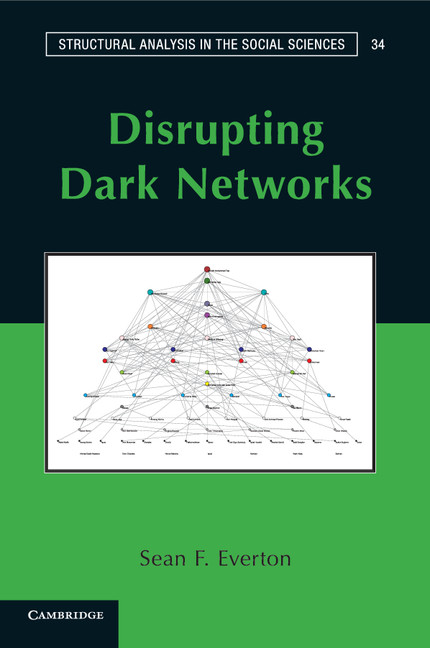
Disrupting Dark Networks
Disrupting Dark Networks focuses on how social network analysis can be used to craft strategies to track, destabilize and disrupt covert and illegal networks. The book begins with an overview of the key terms and assumptions of social network analysis and various counterinsurgency strategies. The next several chapters introduce readers to algorithms and metrics commonly used by social network analysts. They provide worked examples from four different social network analysis software packages (UCINET, NetDraw, Pajek and ORA) using standard network data sets as well as data from an actual terrorist network that serves as a running example throughout the book. The book concludes by considering the ethics of and various ways that social network analysis can inform counterinsurgency strategizing. By contextualizing these methods in a larger counterinsurgency framework, this book offers scholars and analysts an array of approaches for disrupting dark networks.

Ecosystem or Echo-System? Exploring Content Sharing across Alternative Media Domains
Kate Starbird,Ahmer Arif,Tom Wilson,Katherine Van Koevering,Katya Yefimova,Daniel Scarnecchia
↳ Slopaganda: The Inauthentic YouTube Network Selling Secession to Albertans — Canadian Digital Media Research Network
Key takeaways | To explore the data yourself | Context & incident assessment | Concluding remarks

Moderating With Humans, For Humans - Trust Issues
Content Sharing within the Alternative Media Echo-System: The Case of the White Helmets
In June 2017 our lab began a research project looking at online conversations about the Syria Civil Defence (aka the “White Helmets”). Over…

First Evidence That Social Bots Play a Major Role in Spreading Fake News
Automated accounts are being programmed to spread fake news, according to the first systematic study of the way online misinformation spreads