Exposing Cross-Platform Coordinated Inauthentic Activity in the Run-Up to the 2024 U.S. Election
Coordinated information operations remain a persistent challenge on social media, despite platform efforts to curb them. While previous research has primarily f
Uncovering Coordinated Networks on Social Media: Methods and Case Studies
Coordinated campaigns are used to influence and manipulate social media platforms and their users, a critical challenge to the free exchange of information online. Here we introduce a general, unsupervised network-based methodology to uncover groups of accounts that are likely coordinated. The proposed method constructs coordination networks based on arbitrary behavioral traces shared among accounts. We present five case studies of influence campaigns, four of which in the diverse contexts of U.S. elections, Hong Kong protests, the Syrian civil war, and cryptocurrency manipulation. In each of these cases, we detect networks of coordinated Twitter accounts by examining their identities, images, hashtag sequences, retweets, or temporal patterns. The proposed approach proves to be broadly applicable to uncover different kinds of coordination across information warfare scenarios.

Legally Cognizable Manipulation
Swaths of personal and nonpersonal information collected online about Internet users are increasingly being used in sophisticated ways for online political mani
Trust: Foundation of Human Knowledge yet online Platforms won't allow | David Karger | TEDxMIT Salon
Meta CIB / ATP Dashboard
A comprehensive intelligence platform analysing 214 coordinated inauthentic behaviour and adversarial threat operations identified by Meta across 70 countries, spanning April 2018 to Q4 2025.
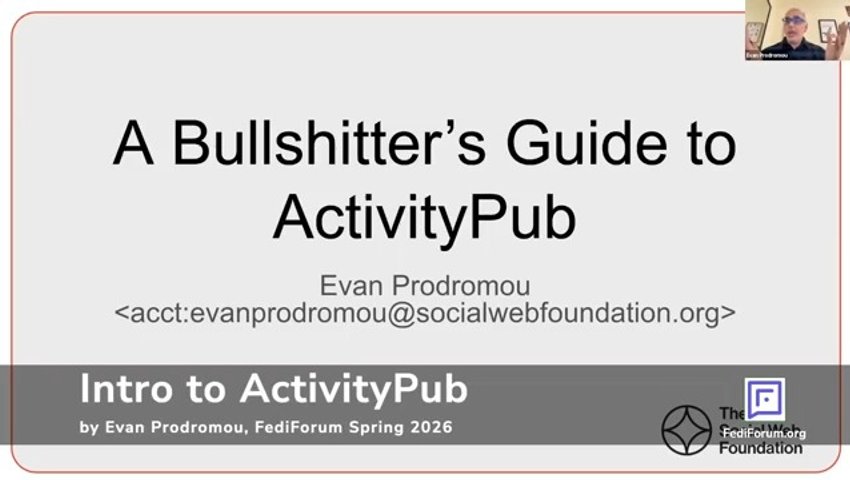
FediForum Talk: How To Bullshit Your Way Through a Conversation about ActivityPub
By Evan Prodromou, Social Web Foundation and editor of the ActivityPub standard. One of the best bluffers in the field of distributed social networks gives you just enough knowledge about ActivityP...
Frontiers | Cyber-mobbing, technology-facilitated abuse and online violence
This article collection will explore the pressing issues of cyber-mobbing, technology-facilitated abuse and online violence, including online abuse, stalking...
Digital Social Norm Enforcement: Online Firestorms in Social Media
Actors of public interest today have to fear the adverse impact that stems from social media platforms. Any controversial behavior may promptly trigger temporal, but potentially devastating storms of emotional and aggressive outrage, so called online firestorms. Popular targets of online firestorms are companies, politicians, celebrities, media, academics and many more. This article introduces social norm theory to understand online aggression in a social-political online setting, challenging the popular assumption that online anonymity is one of the principle factors that promotes aggression. We underpin this social norm view by analyzing a major social media platform concerned with public affairs over a period of three years entailing 532,197 comments on 1,612 online petitions. Results show that in the context of online firestorms, non-anonymous individuals are more aggressive compared to anonymous individuals. This effect is reinforced if selective incentives are present and if aggressors are intrinsically motivated.
Operation Shamrock | Educate - Mobilize - Disrupt Cyber Scams
Operation Shamrock exists to educate about, mobilize against, and disrupt the scam industry. Transnational organized crime syndicates use scams, fraud, and psychological manipulation to steal hundreds of billions of dollars, household by household.

Morally Motivated Networked Harassment as Normative Reinforcement
While online harassment is recognized as a significant problem, most scholarship focuses on descriptions of harassment and its effects. We lack explanations of why people engage in online harassment beyond simple bias or dislike. This article puts forth an explanatory model where networked harassment on social media functions as a mechanism to enforce social order. Drawing from examples of networked harassment taken from qualitative interviews with people who have experienced harassment ( n = 28) and Trust & Safety workers at social platforms ( n = 9), the article builds on Brady, Crockett, and Bavel’s model of moral contagion to explore how moral outrage is used to justify networked harassment on social media. In morally motivated networked harassment, a member of a social network or online community accuses a target of violating their network’s norms, triggering moral outrage. Network members send harassing messages to the target, reinforcing their adherence to the norm and signaling network membership. Frequently, harassment results in the accused self-censoring and thus regulates speech on social media. Neither platforms nor legal regulations protect against this form of harassment. This model explains why people participate in networked harassment and suggests possible interventions to decrease its prevalence.

How Online Mobs Act Like Flocks Of Birds
A growing body of research suggests human behavior on social media is strikingly similar to collective behavior in nature.

(PDF) Canal: Scaling Social Network-Based Sybil Tolerance Schemes
PDF | There has been a flurry of research on leveraging social networks to defend against multiple identity, or Sybil, attacks. A series of recent works... | Find, read and cite all the research you need on ResearchGate

But anyway, papers since you asked: - DOI:10.1371 Digital Social Norm Enforcement: Online Firestorms in Social Media - Deliberation and Identity Rules: The Effect of Anonymity, Pseudonyms and Real-Name Requirements on the Cognitive Complexity of Online News Comments doi.org/10.1177/0032321719891385
Many people are talking about decentralized social media protocols like #ActivityPub and #ATProto and all the amazing things one can do with them. But do you actually know how they work? We thought we'd do something about this. Come to #FediForum next week if you are curious and like to find […]
Original post on mastodon.social
mastodon.socialColombia's Petro accuses Israeli cyberfirm BlackCore of election interference

Las denuncias de sesgo contra plataformas digitales se multiplican en las elecciones de Brasil

Exposure to social bots amplifies perceptual biases and regulation propensity

個人セキュリティ脅威動向レポート2026 上半期 ~ 個人利用者に被害をもたらす「詐欺」と「AIのリスク」~

個人セキュリティ脅威動向レポート2026年上半期を公開 | トレンドマイクロ

Russia Aims to Inject Chaos Into Elections, U.S. Intelligence Finds