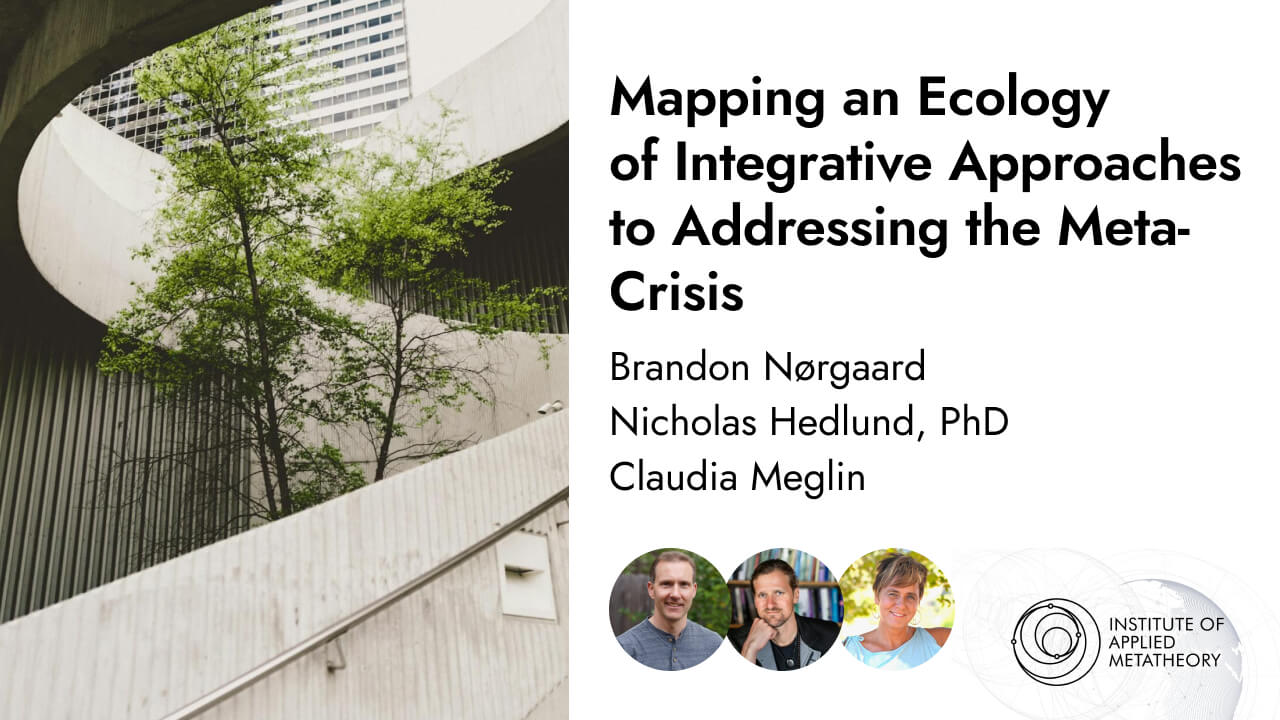
Mapping an Ecology of Integrative Approaches to Addressing the Metacrisis
Dear friends, The Institute of Applied Metatheory (IAM) is pleased to announce the release of a new white paper that charts the landscape of leading-edge responses to the global metacrisis. In “Mapping an Ecology of Integrative Approaches to Addressing the Metacrisis”, IAM scholars Brandon Norgaard, Nicholas Hedlund, PhD, and Claudia Meglin provide a sweeping (albeit

Metaventory — the meta-science community
A comprehensive community of the people building meta-science and the tools they make — psychology and economics first, growing science-wide.


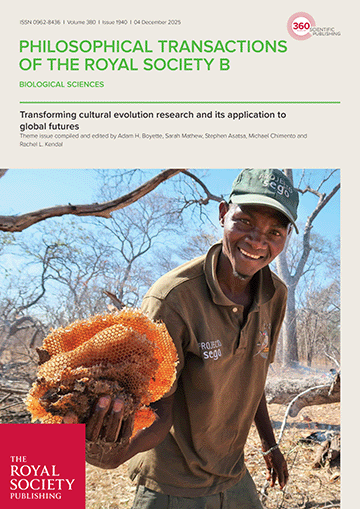
From information free-riding to information sharing: how have humans solved the cooperative dilemma at the heart of cumulative cultural evolution?
Abstract. Cumulative cultural evolution, where populations accumulate ever-improving knowledge, technologies and social customs, is arguably a unique featu

The hidden ‘rules of the game’ that dictate how we navigate the world | Psyche Videos
How free are we really, if human behaviour embodies the complex, intertwined webs of society and history?


Differences Between Tight and Loose Cultures: A 33-Nation Study
The differences across cultures in the enforcement of conformity may reflect their specific histories. , With data from 33 nations, we illustrate the differences between cultures that are tight (have many strong norms and a low tolerance of deviant behavior) versus loose (have weak social norms and a high tolerance of deviant behavior). Tightness-looseness is part of a complex, loosely integrated multilevel system that comprises distal ecological and historical threats (e.g., high population density, resource scarcity, a history of territorial conflict, and disease and environmental threats), broad versus narrow socialization in societal institutions (e.g., autocracy, media regulations), the strength of everyday recurring situations, and micro-level psychological affordances (e.g., prevention self-guides, high regulatory strength, need for structure). This research advances knowledge that can foster cross-cultural understanding in a world of increasing global interdependence and has implications for modeling cultural change.
Discovering and transmitting abstract knowledge over generations
The complexity of human culture depends on people's ability to discover and transmit abstract knowledge. Studying this ability is crucial to understanding humans' distinctive place among species, but current experimental paradigms focus on the cultural transmission of specific, concrete facts rather than generalizable abstract knowledge. In this paper, we develop a crafting game paradigm to study how people discover abstract knowledge and transmit it via language. We compared individuals playing this game for 40 rounds to chains of four participants playing for 10 rounds each and passing messages to each other sequentially. The individuals performed significantly better over rounds, but the chains did not. Through simulations with language model agents and a follow-up experiment, we find substantial variation in the helpfulness of participants' messages, which may explain the lack of consistent improvement in chains. The ability to learn selectively from the good messages may be essential for improvement over generations.
A Vision of Metascience
How does the culture of science change and improve? Many people have identified shortcomings in core social processes of science, such as peer review, how grants are awarded, how people are selected to become scientists, and so on. Yet despite often compelling criticisms, strong barriers inhibit widespread change in such social processes. The result is near stasis, and apathy about the prospects for improvement. People sometimes start new research institutions intended to do things differently; unfortunately such institutions are often changed more by the existing ecosystem than they change it. In this essay we sketch a vision of how the social processes of science may be rapidly improved. In this vision, metascience plays a key role: it deepens our understanding of which social processes best support discovery; that understanding can then help drive change. We introduce the notion of a metascience entrepreneur, a person seeking to achieve a scalable improvement in the social processes of science. We argue that: (1) metascience is an imaginative design practice, exploring an enormous design space for social processes; (2) that exploration aims to find new social processes which unlock latent potential for discovery; (3) decentralized change must be possible, so outsiders with superior ideas can't be blocked by established power centers; (4) ideally, change would align with what is best for science and for humanity, not merely what is fashionable, politically popular, or media-friendly; (5) the net result would be a far more structurally diverse set of environments for doing science; and (6) this would enable crucial types of work difficult or impossible within existing environments. For this vision to succeed metascience must develop and intertwine three elements: an imaginative design practice, an entrepreneurial discipline, and a research field. Overall, it is a vision in which metascience is an engine of improvement for the social processes and ultimately the culture of science.

Opinion | Meta Is Dying. It’s About Time.
Meta has commenced a long, slow slide into irrelevance.

Opinion | Meta Is Dying. It’s About Time.
Meta has commenced a long, slow slide into irrelevance.

A Grand Unified Theory of Cultural Stagnation
Listen to your favorite podcasts online, in your browser. Discover the world's most powerful podcast player.