Collection
When an AI system produces a scientific result, someone still has to decide whether it holds up, and three of this week's items answer that in different ways. In mathematics, nine researchers including Timothy Gowers and Edward Witten have formed an advisory group at the Institute for Advanced Study to help OpenAI decide how to release a batch of machine-produced results it has not yet published, which comes down to setting the terms on which those. Full edition: hallway.aris.pub/no/027/
The AI Discourse in Academia is Toxic. It Doesn’t have to be.
You are allowed to have a nuanced opinion about AI

ScientistTwo: Pioneering the Human Knowledge Frontier with Autonomous AI
Scientific discovery is defined by the ability to identify the boundaries of existing knowledge and venture into unexplored territory. The ultimate vision for AI in science is problem-driven autonomous research: given a fundamental challenge by a human expert, the AI independently navigates the scientific landscape, uncovers theoretical and empirical bottlenecks, and systematically expands the frontier of knowledge. In this paper, we introduce ScientistTwo, a fully autonomous multi-agent framework designed to realize this vision. Specifically, ScientistTwo takes an initial problem as input, establishes state-of-the-art baselines, formulates novel hypotheses, and coordinates specialized agents to orchestrate an end-to-end discovery cycle without human intervention. Moreover, the framework rigorously conducts experiments using diverse datasets and metrics, refines methodologies through automated ablation studies, and validates research findings via a closed-loop simulated peer-review rebuttal engine. To evaluate ScientistTwo's capabilities against the highest standards of human scientific achievement, we benchmark it across papers accepted at top-tier conferences such as ICLR, ICML, and NeurIPS. As a result, ScientistTwo autonomously generates expert-level, publishable papers and fully verified, executable codebases. Its solutions consistently outperform human state-of-the-art models, and achieve higher average review ratings than human-authored papers under automated AI review agents. These results show that ScientistTwo is not merely an assistive tool but an autonomous scientific pioneer capable of pushing the frontiers of human discovery. Project website: https://scientist-two.github.io/

Claude discovers a novel enzyme system
In early results from our new life sciences research lab, Claude agents found an enzyme system whose function is still unknown.

AgenticLS @ NeurIPS 2026 — Agentic AI for Biological Discovery
AgenticLS: Agentic AI for Biological Discovery — Toward Closed-Loop Life-Science Intelligence. A NeurIPS 2026 workshop in Sydney, December 11, 2026.
Edison Scientific Assembles Millennium Problems for Biology | Samuel G. Rodriques posted on the topic | LinkedIn
In light of the progress in mathematics, we at Edison Scientific and FutureHouse have assembled a set of Millennium Problems for Biology. They are chosen to be very hard to solve but very easy to validate in a simple laboratory environment. Any of these, if solved, would mark a major advance in biotechnology, and most of them would contribute materially towards curing disease. These are, in some sense, the “last reasonable eval” for AI in biology. This was work primarily by Michaela Hinks and myself, with contributions from many others. Short descriptions below. The full descriptions of the problems with acceptance criteria are at millenniumproblems.bio. Share more if you have ideas. If they meet our criteria, we’ll add them to our list (with attribution and permission). A few notes on exclusion/inclusion criteria: -We placed a major emphasis on ease of validation, so challenges like “solve aging” are omitted. These should all be validatable in a standard wet lab in a short period of time (days, maybe a week or two.) -We placed a major emphasis on ensuring grading would be as objective as possible, so many great basic science mysteries are also omitted, because it would be very challenging to tell when the mystery was “solved.” (E.g., “uncover the function of the Vault protein,” or “explain how the Oxytricha genome works.”) -We placed a major emphasis on ensuring the problems would be understandable to anyone with a basic biology background, so some highly technical but very important challenges were also omitted. Finally, we anticipate that some problems may require edits in response to community feedback. If you think we got them wrong, please send the feedback, and we will collate and update. Thanks to Adam Marblestone, Michael Baym, Erika DeBenedictis, and Tony Kulesa for reviews. | 52 comments on LinkedIn
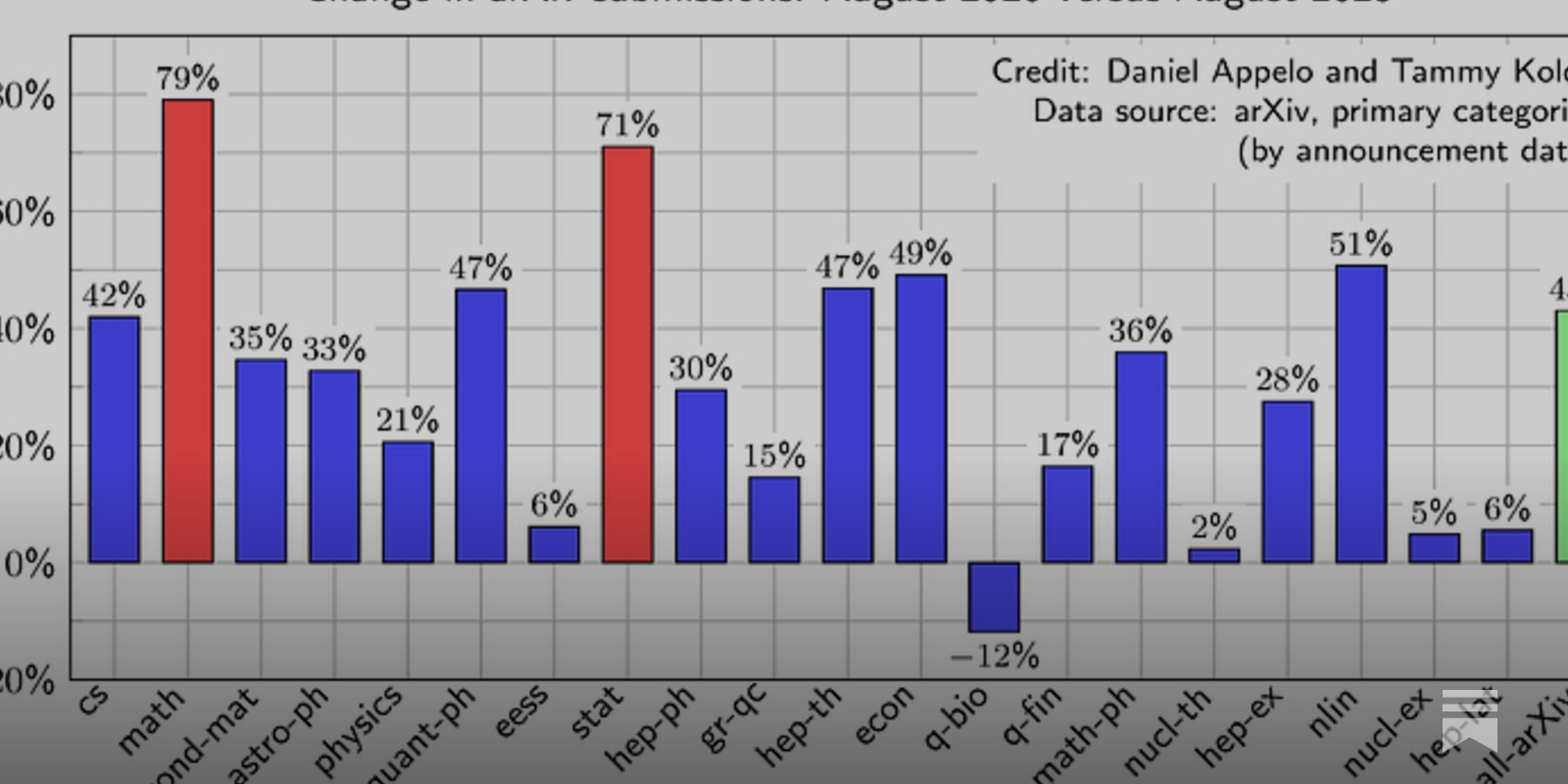
A Breakdown of arXiv Submissions in Mathematics
Guest post with Daniel Appelo (Virginia Tech)

Announcing the Advisory Group on Mathematics and Artificial Intelligence
[This is a guest post by the Advisory Group on Mathematics and Artificial Intelligence. This blog post was initially written in a different file format and converted using AI. — T.] We would …