No. 027: AGMAI advisory group, Millennium Problems for biology, autonomous research pipelines - The Hallway Track
The Hallway Track No. 027 - How AI is affecting the practice of science
No. 027: AGMAI advisory group, Millennium Problems for biology, autonomous research pipelines - The Hallway Track
The Hallway Track No. 027 - How AI is affecting the practice of science
Advisory Group on Mathematics and Artificial Intelligence
OpenAI is working with an independent Advisory Group on Mathematics and Artificial Intelligence to guide the review and communication of emerging AI results.
No. 029: OpenAI math manuscripts, inquiry narrowing, virtual biology initiative - The Hallway Track
The Hallway Track No. 029 - How AI is affecting the practice of science
OpenScience.ai — Autonomous AI Research Agents
AI agents conducting reproducible scientific inquiry. Full provenance, executable notebooks, peer validation.

No. 020: Astra solves ten open math problems, AI agents fail at open-ended research, peer review under strain - The Hallway Track
The Hallway Track No. 020 - How AI is affecting the practice of science
No. 028: arXiv rate limit, AI paper mills, Google FluSight - The Hallway Track
The Hallway Track No. 028 - How AI is affecting the practice of science
OpenScience | Open-source AI co-scientist for research
OpenScience is the open-source AI co-scientist. Free models included or connect any model from any provider, including Claude, GPT, Gemini and more.
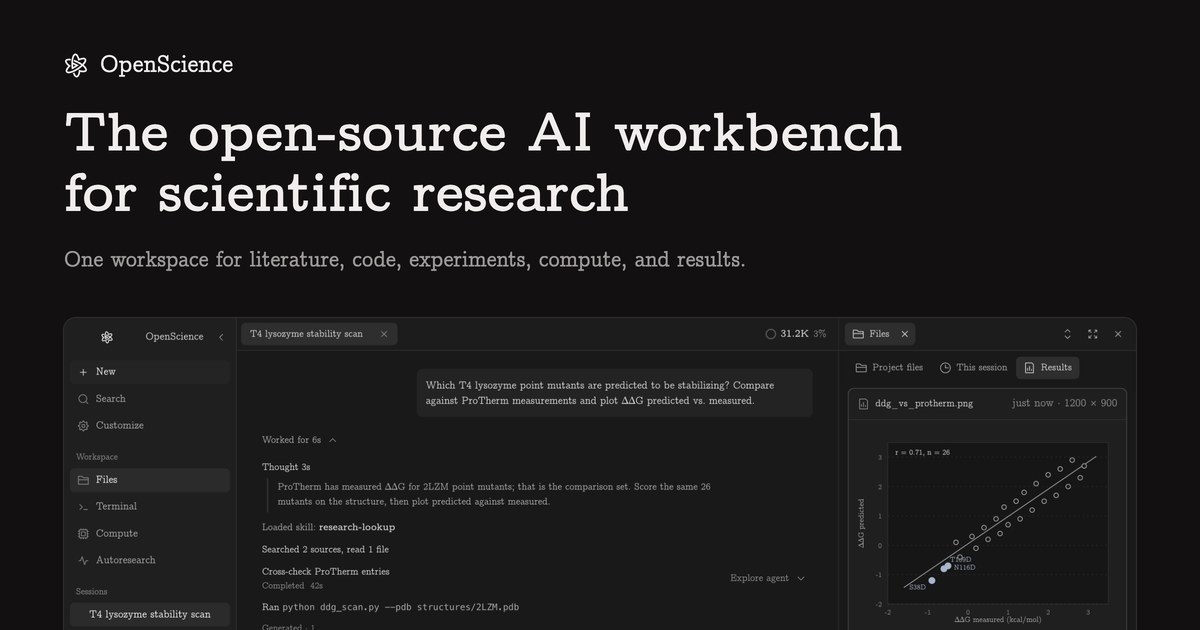
We're releasing Terminal-Bench-Science: a benchmark for evaluating AI agents on research workflows across scientific domains. 🚀 An ongoing community effort out of Stanford University & Laude… | Steven Dillmann | 13 comments
We're releasing Terminal-Bench-Science: a benchmark for evaluating AI agents on research workflows across scientific domains. 🚀 An ongoing community effort out of Stanford University & Laude Institute, built by the team behind Terminal-Bench together with scientific domain experts at research institutions worldwide. 🧪 ⚛️ 🌍 ➕ ⚙️ Terminal-Bench-Science 0.1 has 70 tasks across the life, physical, earth, mathematical, and engineering sciences. Each one is contributed by a researcher porting their own workflows into challenging agentic tasks, on problems they actually care about. 🧠 Anthropic's Opus 5 dominates most scientific domains with an overall pass rate of ~30%, except the mathematical sciences, where Fable 5 and OpenAI's GPT-5.6 Sol take the lead. SpaceXAI's Grok 4.6 is one of the best models for engineering tasks, Z.ai's GLM 5.3 is the best open model, and Kimi (Moonshot AI)'s Kimi K3 is the only model beyond Opus 5 that lands on both cost and token efficiency Pareto frontiers. 🏆 All leaderboard results are live here: https://lnkd.in/gYh99UfU 💻 You can find all tasks on our Github: https://lnkd.in/gejKmXpj Special thanks to our amazing reviewer team Allen Hart, Ivan Bercovich, Joe Janssen, Jiaming H., Steffen Bollmann, Sergey Aganezov, Ben Blaiszik, Karl Krauth, Aaron Feller, Ben Blaiszik, Yiqi Liu, Han Hou, Robert Joseph G., Robert Zhang; our AI research advisors Ryan Marten, Alex Shaw, Lin Shi, Ben Feuer, Mike Merrill, Gian Segato, Jenia Jitsev, Bodhisattwa Majumder, Peter Clark, Thomas Wolf, Braden Hancock, Andy Konwinski, Alex Dimakis; and especially to our co-leads Sanmi Koyejo and Ludwig Schmidt. | 13 comments on LinkedIn

Accelerating scientific discovery with ChatGPT for Academic Researchers
OpenAI is giving 100,000 academic researchers free access to ChatGPT's most advanced AI models to accelerate scientific research, collaboration, and discovery.
OpenAI’s latest math breakthroughs commit research misconduct, experts say
OpenAI released 10 AI-generated results over the weekend. Some mathematicians are unhappy with their approach
No. 013: Provenance vocabulary, Wikipedia contamination, OpenAI rare-disease diagnoses, ARA paper format - The Hallway Track
The Hallway Track No. 013 - How AI is affecting the practice of science
No. 008: AI co-mathematician, compiler-verified protocols, open infrastructure bets - The Hallway Track
The Hallway Track No. 008 - How AI is affecting the practice of science
No. 011: Sum-product conjecture disproof, AI-generated authorship fraud, OMB grant-cost rules - The Hallway Track
The Hallway Track No. 011 - How AI is affecting the practice of science
No. 014: Science's AI productivity paradox, Sakana clears peer review, AI proof search on open Erdős problems - The Hallway Track
The Hallway Track No. 014 - How AI is affecting the practice of science
No. 005: GPT-Rosalind, AI verification gap, Agent4Science - The Hallway Track
The Hallway Track No. 005 - How AI is affecting the practice of science
AI has supercharged scientists—but may have shrunk science
Analysis of 41 million papers finds that although AI expands individual impact, it narrows collective scientific exploration
Collection

Updated 7d
When an AI system produces a scientific result, someone still has to decide whether it holds up, and three of this week's items answer that in different ways. In mathematics, nine researchers including Timothy Gowers and Edward Witten have formed an advisory group at the Institute for Advanced Study to help OpenAI decide how to release a batch of machine-produced results it has not yet published, which comes down to setting the terms on which those. Full edition: hallway.aris.pub/no/027/