Collection
my-to-read

Updated 4mo
Collection
Updated 4mo
My AI Adoption Journey
My experience adopting any meaningful tool is that I've necessarily gone through three phases: (1) a period of inefficiency (2) a period of adequacy, then finally (3) a period of workflow and life-altering discovery.
The AI Engineering Report 2026: The AI Acceleration Whiplash - Ten Takeaways
What two years of telemetry data from 22,000 developers reveals about AI's real impact on developer productivity, code quality, and business risk in 2026.

Todepond dot com


‘It’s not progress, and we can stop it’: journalist Karen Hao on big tech, protest and the preventable AI future
The US reporter and bestselling author was one of the first journalists to get inside OpenAI – and was alarmed at what she found. Six years on, she tells Carole Cadwalladr, a coalition of resistance is growing to oppose the new Silicon Valley ascendancy

We May Be Entering A Second Axial Age
The transition from small hunter-gatherer societies into complex civilizations gave rise to the first Axial Age. Today, the planetary polycrisis of climate chaos, mass migration, increasing warfare and transformative AI represents a rupture of comparable magnitude.

Using AI to write better code more slowly
A lot of people seem convinced that the point of AI coding is to write low-quality code as fast as possible. Spew out barely-passable slop, open massive PRs, and merge them unvetted. Ship it! But t…

Blogroll – Manu
I believe we should all blog more and connect more with strangers. There's not much I can do as an individual. I can offer to be your first reader, …
Piri – Manu
Let's start from the basics: can you introduce yourself? Hey, I'm Piri. I'm a software designer, engineer, and artist of sorts. I build Kinopio, and …
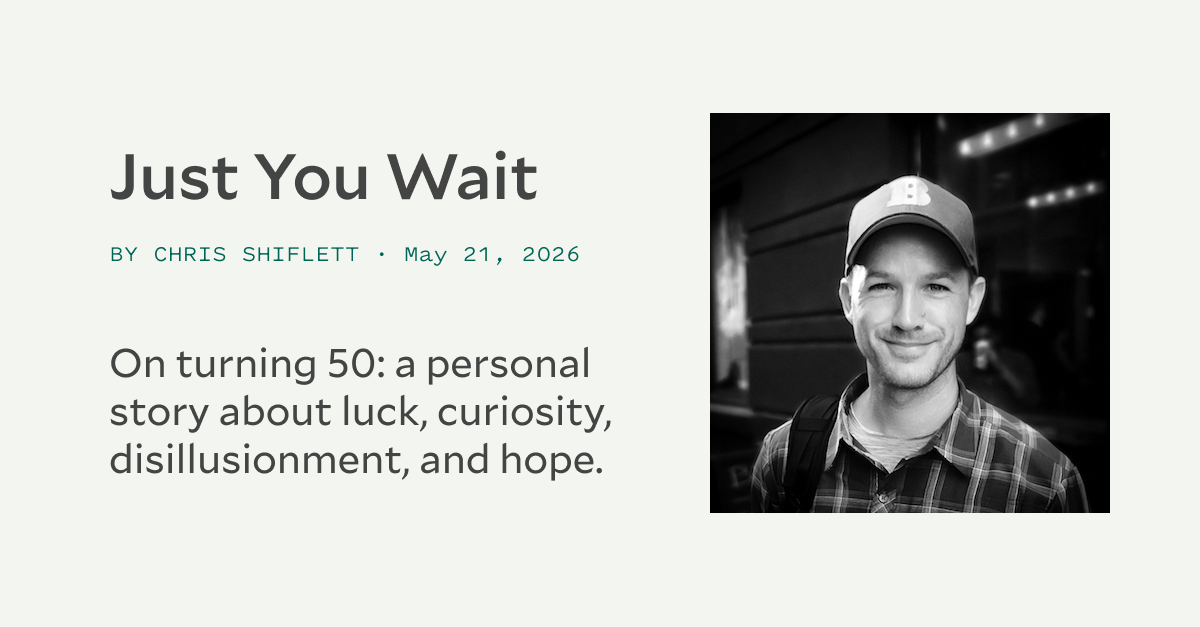
Just You Wait, by Chris Shiflett
On turning 50: a personal story about luck, curiosity, disillusionment, and hope.
ligo.at: decentralized links page
Get your own decentralized and personalizable links page for all your social profiles. Build on top of AT Protocol.
CompactLTJ: Space & Time Efficient Leapfrog Triejoin on Graph Databases
Leapfrog Triejoin (LTJ) is arguably the most practical and popular worst-case-optimal (wco) algorithm for solving basic graph patterns in graph databases. Its main drawback is that it needs the database triples (subject, predicate, object) represented as paths in a trie, for each of the six orders of subject, predicate, and object. The resulting blowup in space makes most systems disregard LTJ or implement it only partially, which makes their corresponding algorithms non-wco. In this paper we show that, by using compact data structures, it is possible to build an index that at the same time matches the query time performance of the fastest classic wco index, and uses a fraction of the space of non-wco indices (which are much slower). Concretely, we make use of compact tree representations to store functional tries using one bit per trie edge, instead of one pointer, and further reduce the space by storing partial tries. Our most compact variant uses 5–6 times less space than classic wco implementations and 2–3 times less than classic non-wco systems. At solving queries, it is on par with the fastest classic wco system, and 30–40 times faster than non-wco systems. We further incorporate improved query resolution strategies into CompactLTJ variants, which makes it considerably faster than classic wco systems as well, on queries that do not output too many results. Finally, we show how CompactLTJ can incorporate dynamism without altering its performance, even under very demanding update regimes. We leave a public fully-functional implementation of CompactLTJ that can be directly used by practitioners.

How I'm able to take notes in mathematics lectures using LaTeX and Vim
A while back I answered a question on Quora: Can people actually keep up with note-taking in Mathematics lectures with LaTeX. There, I explained my workflow of taking lecture notes in LaTeX using Vim and how I draw figures in Inkscape. However, a lot has…
Fresh 2.3: Zero JS by default, View Transitions, and Temporal support | Deno
Fresh 2.3 ships true zero-JS pages, View Transitions, CSP nonce support, IP filtering, and Temporal API support in islands.
Personal Journal Club

Papers papers papers
Cognitive Architectures for Language Agents

Thinking—Fast, Slow, and Artificial: How AI is Reshaping Human Reasoning and the Rise of Cognitive Surrender
Warnings for pattern matching
Retrieval-Augmented Code Generation: A Survey with Focus on Repository-Level Approaches
Lost in the Middle: How Language Models Use Long Contexts
TDOP Pratt