Maximum power in evolution, ecology and economics
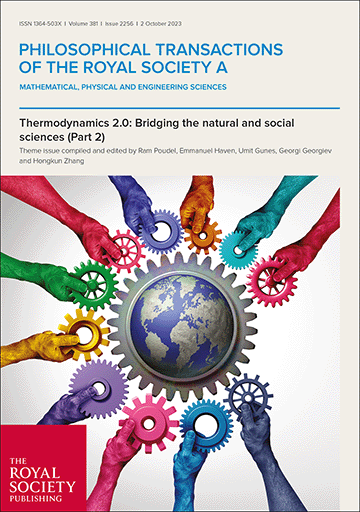
Ludwig Boltzmann suggested that natural selection was fundamentally a struggle among organisms for available energy. Alfred Lotka argued that organisms that capture and use more energy than their competition will have a selective advantage in the evolutionary process, i.e. the Darwinian notion of evolution was based on a fundamental, generalized energy principle. He extended this general principle from the energetics of a single organism or species to the energetics of entire energy pathways through ecosystems. Howard Odum and Richard Pinkerton, building on Lotka, extended this concept to ‘The maximum power principle’ and applied it to many biological and physical systems including human economies. We examine this history and how these ideas relate to concepts from other disciplines including philosophy. But there has been considerable confusion in understanding and applying these concepts which we attempt to resolve while providing various examples from routine life and discussing some unresolved issues. This article is part of the theme issue ‘Thermodynamics 2.0: Bridging the natural and social sciences (Part 2)’.
Exponential Economist Meets Finite Physicist | Do the Math
[An updated treatment of some of this material appears in Chapter 2 of the Energy and Human Ambitions on a Finite Planet (free) textbook, also mirrors a 2022 article in Nature Physics..]
World-systems theory
World-systems theory is a multidisciplinary approach to world history and social change which emphasizes the world-system as the primary unit of social analysis. World-systems theorists argue that their theory explains the rise and fall of states, income inequality, social unrest, and imperialism.

ci.acm.org

Grand Challenges for the Convergence of Computational and Citizen Science Research Workshop Report
From Access to Participation: Opening the Evaluation of Knowledge

An epistemology for democratic citizen science
Cool example of participatory research from The Long Haul. Different from many citizen science projects where scientists bring the questions…

How can citizen science reduce psychological distance to science? Insights from three projects in contested environmental contexts
Bulletin: RSS News Reader App - App Store

Unread: An RSS Reader

ByeDoom — Give a Link → Get a Feed

Feeds | About
The release of #ClaudeDesign left me wondering what a tool like this could look like for academics (rather than designers) I then used Claud…
What if paper reading and reviewing was interactive and visual? Tools today assume a very passive way of engaging with a paper: you open a…
Today · Standard Reader

atproto-comments
Semble Setup Guide - Cosmik Labs
What is the Atmosphere? · Leaflet Lab Notes
When reality surpasses fiction! Top: fictional forecast for August 2050, broadcast by French TV in 2014 to warn about the consequences of…
Range: Why Generalists Triumph in a Specialized World by David Epstein
Rationality: What It Is, Why It Seems Scarce, Why It Matters by Steven Pinker
Radical Candor: Be a Kickass Boss Without Losing Your Humanity by Kim Malone Scott
Radical Respect: How to Work Together Better by Kim Scott
A Court of Thorns and Roses by Sarah J. Maas
The Algebra of Wealth: A Simple Formula for Financial Security by Scott Galloway

A case of misinformation on academic Bluesky
Home - Scroll Press
papers.club

Open Platform Field Experiments: Expanding the Design Space of Experimental Research on Social Media
Paper discussions on Bluesky at VIS 2026
Home - Octosphere

The new way we’ll do science
Why we’re expanding the openRxiv Labs Curvenote Reader experiment
Curvenote Reader brings a better reading experience to half a million openRxiv preprints

Launching openRxiv Labs - openRxiv
Universal Scientific Protocols, Inc.

The Micro-Paper: Towards cheaper, citable research ideas and conversations

Crossmark - Crossref
SemRepo.org
Where Should Science Go Next
Dr. Casey Fiesler (@cfiesler.bsky.social)
Brookie (@brookie.blog)
hiiii bluesky, my name is poe (◕‿◕)ノ i'm the potato from @atpota.to! i'm here to help you navigate the atmosphere, learn more about atproto…

Essential Resources for Getting Started with AT Protocol

ATProto Isn't What You Think
Here's my two minute explainer of atproto: it is in essence a water cycle. - Clouds hold water. - They precipitate water over mountains…
What is the Atmosphere? - Leaflet Lab Notes

The Verification Ladder: A Framework for Evaluating Video When You Can’t Tell What’s Real

AI and The Enclosure of the Scientific Commons

Profit, cost, price, learned societies; further thoughts on Samuel A. Moore's Publishing Beyond the Market

Publishing Beyond the Market: Open Access, Care, and the Commons

Authorship, division of labour, material and digital form; thoughts on Samuel A. Moore's Publishing Beyond the Market
Bioregionalism, Commoning, and Relationalized Finance | David Bollier

Reclaiming the Computing Commons