New_ Public Invests in Local Online Spaces as Digital Civic Infrastru…
archived 11 Apr 2025 17:34:52 UTC

Computational Public Space
Chapters — Intro, Communal computing, This presentation, Physicality — Globalization, Centrally-planned, Isolating, Private property, Surveillance, Consumption, Hidden — Summary, Outline
Computational Public Space
New_ Public Invests in Local Online Spaces as Digital Civic Infrastru…
archived 11 Apr 2025 17:34:52 UTC
New_ Public
We are researchers, engineers, designers, and community leaders working together to create digital public spaces where people can thrive and connect.

Creating a Flourishing Digital Public Space for Your Local Area | Notion
A how-to guide for admins and moderators of inclusive, uplifting, and public-spirited local Facebook groups, Discord servers, subreddits, and more...

Building Digital Public Spaces for Good
A Conversation with Eli Pariser, Co-Founder and Co-Director of New_ Public

Local Digital Spaces Are Essential Civic Infrastructure (SSIR)
With traditional community spaces underfunded and neglected, investing in the health of our online gathering places has become essential. <meta property=

Digital Spaces Directory | New_ Public
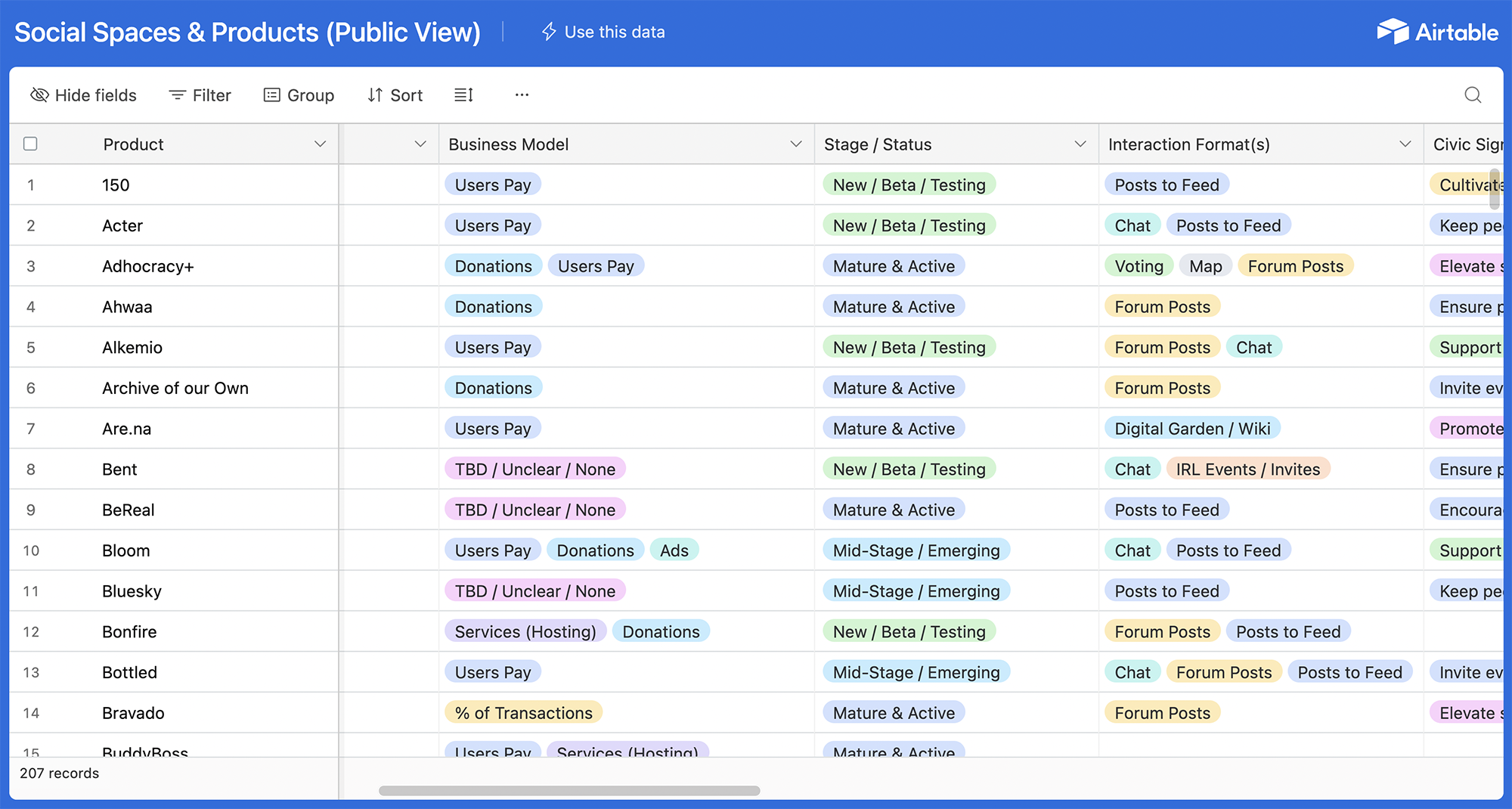
As the social media landscape changes and a new wave of digital spaces emerges, this Directory is meant to be a resource for our field — a jumping-off-point for further exploration and research for anyone who’s interested in studying, building, stewarding, or simply using digital social platforms. We hope this will inspire creative exploration, spark new collaborations, and highlight important progress.
Trails and public spaces — Rafael M. Batista
A reply to Kenny Peng and colleagues on designing social media around trails — and why the campground or the piazza may be the better analogy.


Screen As Room: An Architectural Perspective on User Interfaces — Christoph Locher · Interaction Designer
With the use of video games as social spaces being observed for several years and the increased focus put on virtual social spaces due to the scarceness of physical social spaces in the last months, the concept of “spatial interfaces” is once again at the center of discussions. I want to add an alternative perspective to this, looking at the properties of physical spaces as metaphors, rather than models, for interfaces and exploring seven of them in more detail.
Screen As Room: An Architectural Perspective on User Interfaces — Christoph Locher · Interaction Designer
With the use of video games as social spaces being observed for several years and the increased focus put on virtual social spaces due to the scarceness of physical social spaces in the last months, the concept of “spatial interfaces” is once again at the center of discussions. I want to add an alternative perspective to this, looking at the properties of physical spaces as metaphors, rather than models, for interfaces and exploring seven of them in more detail.
ATmosphere technology to support organizing and activism
There has been some good writing by Mosh, Erlend, and Meri about this topic worth pulling in. Permissioned spaces coming to atproto will also unlock a lot of important affordances for crafting protected spaces for organizers. For example, permissioned spaces on semble would turn into community-run search engines. My hope is that atproto is the missing infrastructural piece that enables us to really shape digital spaces around the specific needs organizers and their communities rather the...

Architecture and the Internet: Designing places in cyberspace
Cyberspace, as the information space is called, has become accessible in the past decade through the World Wide Web. And although it can only be experienced through the mediation of computers, it is quickly becoming an alternative stage for everyday economic, cultural, and other human activities. As such, there is a potential and a need to design it according to place–like principles. Making places for human inhabitation is, of course, what architects, landscape architects, and town planners have been doing in physical space for thousands of years. It is curious, therefore, that Cyberspace designers have not capitalized on the theories, experiences, and practices that have been guiding physical place–making. While most 3D environments closely mimic physical spaces, they are, by and large, devoid of the essential characteristics that differentiate a ‘place’ from mere ‘space.’ And only rarely are they sensitive to, and take advantage of, the peculiarities of Cyberspace. We believe that this state of affairs is temporary, characteristic of early adoption stages of new technologies. As the Web matures, and as it assumes more fully its role as a destination rather than as means of communication, there will be a growing need to design it according to place–making principles. By looking at physical architecture as a case study and metaphor for organizing space into meaningful places, this paper explores the possibility of organizing Cyberspace into spatial settings that not only afford social interaction, but, like physical places, also embody and express cultural values. At the same time, because Cyberspace lacks materiality, is free from physical constraints, and because it can only be ‘inhabited’ by proxy, these ‘places’ may not necessarily resemble their physical counterparts.
Collection

Updated 8d
Physical or digital, things to do with public spaces
Digital Placemaking

What does it mean to make a digital space into a place?
Ambient Co-presence

Spatial Communication in Level Design
www.lri.fr

Urp: a luminous-tangible workbench for urban planning and design
The Death of DeviantArt and the art-site shaped hole haunting the Internet - Multi-hyphenate

Building Digital Public Parks with Deepti Doshi