
Is AI Creating a Culture of Avoidance?
As chatbots and AI companions emerge as communication tools of choice for humans, a new and unsettling dynamic is taking shape. Tools that can smooth over difficult communication between friends and coworkers—reducing misunderstandings, hurt feelings, or social discomfort—also have a downside. Left unchecked, they may erode human intuition and sabotage empathy.

The case against efficiency: friction in social media
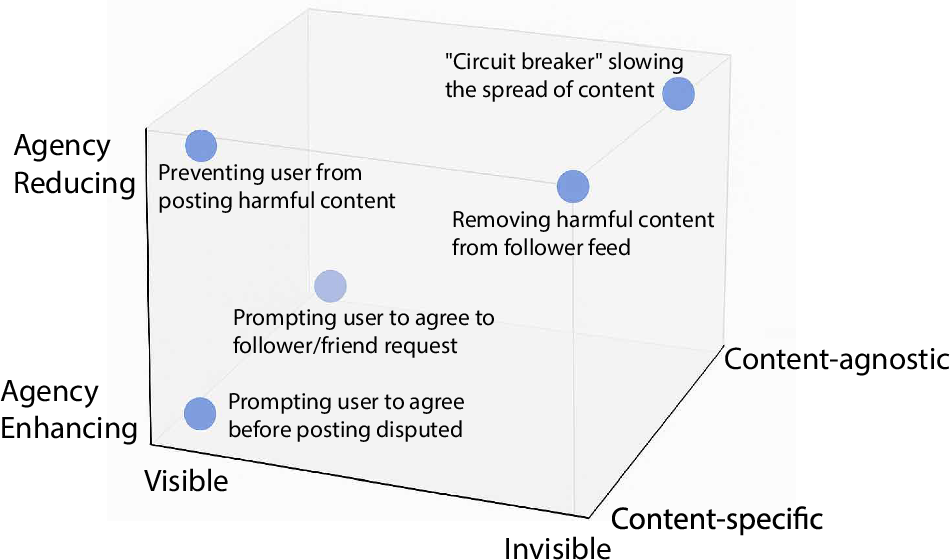
Social media platforms frequently prioritize efficiency to maximize ad revenue and user engagement, often sacrificing deliberation, trust, and reflective, purposeful cognitive engagement in the process. This manuscript examines the potential of friction—design choices that intentionally slow user interactions—as an alternate approach. We present a case against efficiency as the dominant paradigm on social media and advocate for a complex systems approach to understanding and analyzing friction. Drawing from interdisciplinary literature, real-world examples, and industry experiments, we highlight the potential for friction to mitigate issues like polarization, disinformation, and toxic content without resorting to censorship. We propose a state space representation of friction to establish a multidimensional framework and language for analyzing the diverse forms and functions through which friction can be implemented. Additionally, we propose several experimental designs to examine the impact of friction on system dynamics, user behavior, and information ecosystems, each designed with complex systems solutions and perspectives in mind. Our case against efficiency underscores the critical role of friction in shaping digital spaces, challenging the relentless pursuit of efficiency and exploring the potential of thoughtful slowing.
What's the point of a note-taking app?
The true purpose of a note-taking app is to facilitate deep learning through three interconnected processes—externalizing ideas, internalizing them into new insights, and resurfacing them over time—and good design should minimize accidental friction while preserving the productive friction that enables genuine understanding.

Agentic Coding is a Trap | Lars Faye
Remaining vigilant about cognitive debt and atrophy.
The case for friction in AI-mediated information seeking and learning
Introduction. This paper challenges the assumption that frictionless AI-mediated information seeking represents progress. We argue that AI systems eliminating productive friction, such as uncertainty, exploration, and reflective processes, undermine intellectual virtues essential for critical thinking in an AI-saturated information environment. Method. This conceptual article employs a theory synthesis approach, drawing on library information science (LIS) theories of information behaviour, experience, and literacy, virtue epistemology, and human–computer interaction (HCI) friction design literature. Analysis. We map intellectual virtues such as curiosity, thoroughness, and intellectual humility onto the Association of College and Research Libraries (ACRL) Framework for Information Literacy for Higher Education, building on and extending previous analyses. We connect dimensions of virtuous search to AI system design principles and align friction types with specific intellectual virtues. Results. We propose three design principles for human-centred AI systems (representation, affordance, and facilitation) and develop a typology that maps friction interventions to intellectual virtues, providing concrete examples for each. Conclusion. Productive friction should be understood as a feature supporting intellectual development, not a barrier to efficiency. The design choices made today will determine whether AI serves as intellectual scaffolding or cognitive crutch.
We Chose Frictionless. It Left Us Empty.
On what my parents understood about creating relationships that we have forgotten — and why the inconvenience is the whole point.

The Shape of Friction · Matthias Ott
Web design engineer, UX designer, teacher, and speaker – helping teams build websites and digital products with a focus on CSS, accessibility, and performance.

Design Frictions for Mindful Interactions | Proceedings of the 2016 CHI Conference Extended Abstracts on Human Factors in Computing Systems
Welcome to the preview of the new ACM Digital Library. ACM will formally transition to Open Access on January 1, 2026.

Collection

Updated 22d
"remove friction" is how you get slop

KJ Charles
There's an infuriating AI article in the Society of Authors magazine. "Bec Evans searches for principles that could guide authors' use of generative AI." A bunch of authors who all say they wouldn't use it to write but will to 'research', 'remove friction', 'fact check and propose rewrites'.
friction is good

how friction and struggle help grow, learn, create, develop.
The case against efficiency: friction in social media

Writing by Hand is Good for your Brain - Here's how to do it

AI Coding will Prevent Expertise | Lars Faye
Cognitive Surrender

AI Dry July: Aborted

Japanese web design: weird, but it works. Here's why
