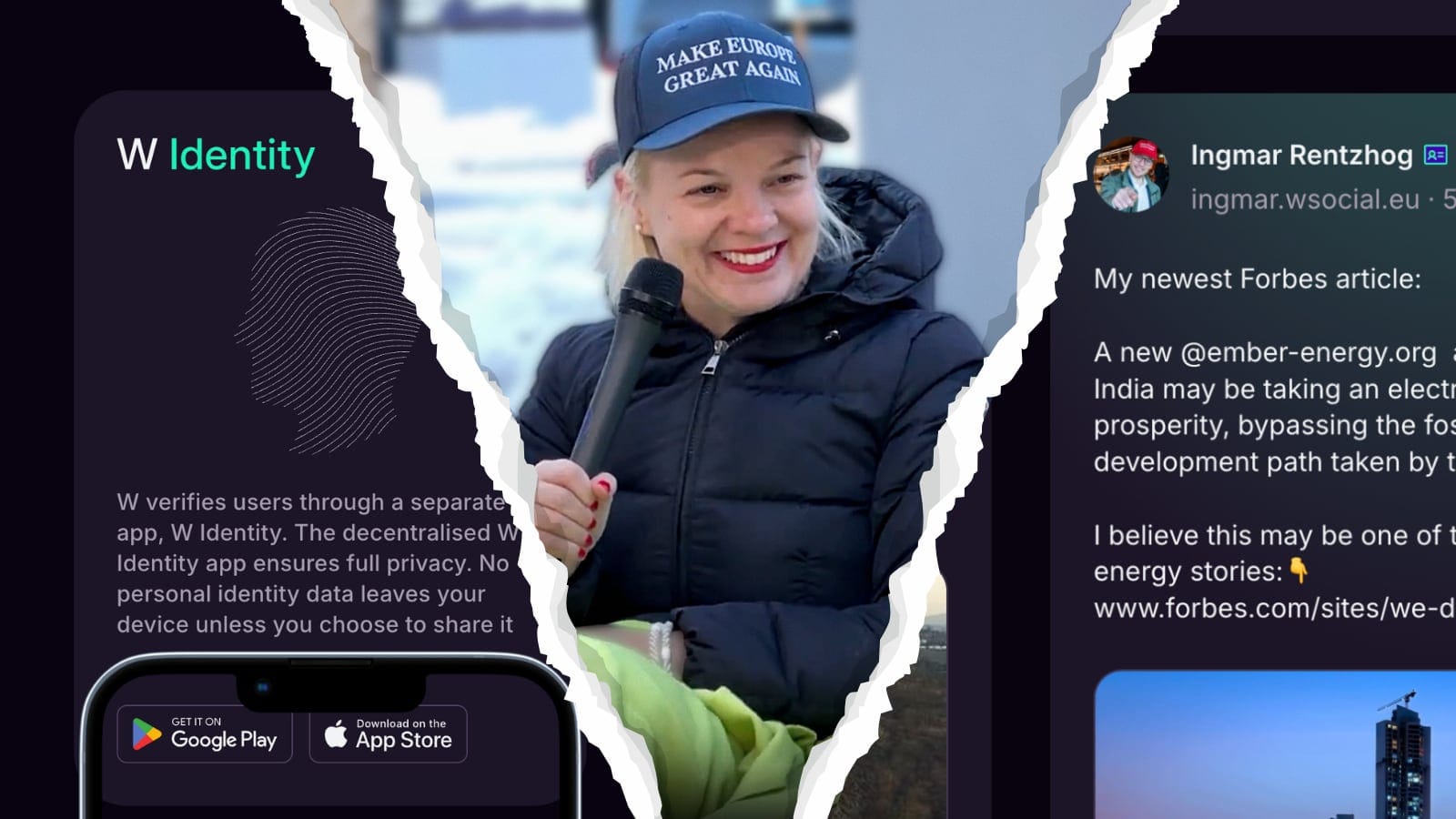
W Social: Hello World!
Hello World! 🙂 This category is for discussing W Social, a new member on the AT-protocol federation. Launched in conjunction with the World Economic Forum in Davos on January 19, 2026, the project has sparked a lot of praise, interest, rumors and slander. In fact, our social media monitoring console registered 1 billion post views (across all the main social media) for posts mentioning #wsocial within the first week. As I write this, W Social is not yet open for business. There i...

Social media is a gnarly coordination problem we need to decompose - a warm space
How Online Mobs Act Like Flocks Of Birds
A growing body of research suggests human behavior on social media is strikingly similar to collective behavior in nature.

The Weird, Fragmented World of Social Media After Twitter - The Atlan…
archived 7 Aug 2023 02:41:57 UTC

Two tests of social displacement through social media use
The present manuscript presents two tests of the hypothesis that social media use decreases social interaction, leading to decreased well-being. Study 1 used the Longitudinal Study of American Yout...

No Sense of Place: The Impact of Electronic Media on Social Behavior
Electronic media present us with a collage of experiences from everyplace. We eat dinner at home while watching starving children thousands of miles away reach out to us for food. From our easy chairs, we stare at blindfolded hostages, and coolly
Impact of the COVID-19 pandemic on social media
Social media became an important platform for interaction during the COVID-19 pandemic, coinciding with the onset of social distancing. According to a study conducted by Facebook's analytics department, messaging rates rose by over 50% during this period. Individuals confined to their homes utilized social media not only to maintain social connections but also as a source of entertainment to alleviate boredom. Concerns arose regarding the overreliance on social media for primary social interactions, particularly given the constraints imposed by the pandemic.
Consequences of Information Feed Integration on User Engagement and Contribution: A Natural Experiment in an Online Knowledge-Sharing Community
Many online communities that rely on effortful, voluntary content contributions offer additional content curation tools to facilitate social interactions and encourage user contributions. Any platform that offers two or more heterogeneous content types (e.g., expert knowledge and social posts) faces a choice about the presentation format: whether to display the content types separately or in an integrated information feed. We leverage a natural experiment on Zhihu, a Q&A platform that offers a social-interaction-oriented functionality called Ideas. Zhihu initially presented answers (expert knowledge content) and ideas (social posts) in two different information feeds, but the platform integrated ideas into the same information feed as answers in June 2019. We find that information feed integration significantly decreased user engagement with and contribution of both ideas and answers. We hypothesize that users decreased their engagement because the juxtaposition of incongruous types of content increased mindset switching and cognitive strain. This hypothesis is supported by an additional laboratory experiment. We also present evidence showing that contributions decreased both because of the decrease in engagement (weaker social recognition incentives) and because integration heightened concerns that posting ideas would dilute the contributor’s professional image. Our findings have important theoretical and practical implications for any platform that hosts heterogeneous content. History: Xiaoquan (Michael) Zhang served as the senior editor and Yili (Kevin) Hong served as associate editor for this article. Funding: Z. Cao acknowledges this research was funded by National Natural Science Foundation of China [Grants 72201238, 72192823]. G. Li acknowledges this research was funded by National Natural Science Foundation of China [Grant 72102047] and Shanghai Pujiang Program [Grant 21PJC006]. Supplemental Material: The e-companion is available at https://doi.org/10.1287/isre.2022.0043.
W Don't Have Time (@wdonthavetime.selfhosted.social)
"Trust community, not wealth" Holding power accountable on the open social web. https://woosh.link/wdonthavetime.selfhosted.social
The Untold Story About W Social: Unconventional Beginnings, Strategic Pitches and Conflicting Signals
A deep dive into the origin story of W Social, an analysis of the strategic arguments they have been using to appeal to government officials, media companies and advertisers... and the discussion of conflicting signals they have been sending

The Untold Story About W Social: Unconventional Beginnings, Strategic Pitches and Conflicting Signals
A deep dive into the origin story of W Social, an analysis of the strategic arguments they have been using to appeal to government officials, media companies and advertisers... and the discussion of conflicting signals they have been sending

W Don't Have Time
@wdonthavetime.selfhosted.social
"Trust community, not wealth" Holding power accountable on the open social web. woosh.link/wdonthavetime.selfhosted.soci…
Some thoughts on #WSocial, how they have been responding to criticism and why I believe they are showing the limits of free speech absolutism. I agree with @echna.bsky.social that "W Social seems to be on an X speedrun - without ever having been like Twitter." 🔗: aseachange.com/@elena/statuses/01M0SDV98GRDW…
Elena Rossini on GoToSocial ⁂ (@elena@aseachange.com)
aseachange.comSocial media is no longer social. Most of it is passive viewing of videos and pictures from people we've never met. But we're still studying social media like it's 2010. We've entered the post-social media era — and research needs to catch up. osf.io/preprints/socarxiv/6nue7_v1 preprint w/ Richard Rogers
Social media algorithms don't allow us to understand or control what we see online and why... until now! Top scholars @jonathanstray.com and @noupside.bsky.social are sharing @mysky.social, a tool that allows users to adjust their feed’s priorities and explains why certain posts appear over others.
🎛️📲 Meet the algorithm you can actually control and understand
newpublic.substack.comBee 🐝 (@sweetbee.vip)
Bee 🐝 (@sweetbee.vip)