Gradients of intimacy and creating shelter: An interview with Erin Kissane
How might we use nature as an inspiration for creating online communities?

Gradients of intimacy and creating shelter: An interview with Erin Kissane
How might we use nature as an inspiration for creating online communities?
Stewardship of global collective behavior
Collective behavior provides a framework for understanding how the actions and properties of groups emerge from the way individuals generate and share information. In humans, information flows were initially shaped by natural selection yet are increasingly structured by emerging communication technologies. Our larger, more complex social networks now transfer high-fidelity information over vast distances at low cost. The digital age and the rise of social media have accelerated changes to our social systems, with poorly understood functional consequences. This gap in our knowledge represents a principal challenge to scientific progress, democracy, and actions to address global crises. We argue that the study of collective behavior must rise to a “crisis discipline” just as medicine, conservation, and climate science have, with a focus on providing actionable insight to policymakers and regulators for the stewardship of social systems.

ICPA - ICPA 2026
Welcome to the 2026 International Conference on Perception and Action (ICPA). This year, we meet in Omaha, Nebraska, bringing the international ecological psychology community together in a setting that reflects a growing culture of research and innovation.ICPA brings together scholars from around the world who study perception and action as inseparable, mutually constraining processes grounded in organism–environment relations. The program features work spanning affordances, perceptual learning, coordination and control, development, social interaction, ecological design, and methodological innovation.The conference is designed to support sustained dialogue across theoretical, empirical, and applied perspectives—welcoming diverse viewpoints and participants from across institutions, disciplines, and countries. We invite you to join us for a week of scientific exchange and community building as we continue to advance ecological approaches to understanding behavior in real-world contexts.
The Atmosphere . Building the open social web
Networked Cooperative Ecosystems
Research TeamAndi Argast (Researcher), Nick Houde (Researcher), Dana Salama, (Researcher & Designer), Samuel Young (Network Mapping), Rithikha Rajamohan (Research Lead).
Building A Prosocial Media Ecosystem | NOEMA
There’s never been a better time to make social media what it always should have been: a tool to strengthen rather than strip-mine the social fabric.

Systems of Global Governance in the Era of Human-Machine Convergence
Technology is increasingly shaping our social structures and is becoming a driving force in altering human biology. Besides, human activities already proved to have a significant impact on the Earth system which in turn generates complex feedback loops between social and ecological systems. Furthermore, since our species evolved relatively fast from small groups of hunter-gatherers to large and technology-intensive urban agglomerations, it is not a surprise that the major institutions of human society are no longer fit to cope with the present complexity. In this note we draw foundational parallelisms between neurophysiological systems and ICT-enabled social systems, discussing how frameworks rooted in biology and physics could provide heuristic value in the design of evolutionary systems relevant to politics and economics. In this regard we highlight how the governance of emerging technology (i.e. nanotechnology, biotechnology, information technology, and cognitive science), and the one of climate change both presently confront us with a number of connected challenges. In particular: historically high level of inequality; the co-existence of growing multipolar cultural systems in an unprecedentedly connected world; the unlikely reaching of the institutional agreements required to deviate abnormal trajectories of development. We argue that wise general solutions to such interrelated issues should embed the deep understanding of how to elicit mutual incentives in the socio-economic subsystems of Earth system in order to jointly concur to a global utility function (e.g. avoiding the reach of planetary boundaries and widespread social unrest). We leave some open questions on how techno-social systems can effectively learn and adapt with respect to our understanding of geopolitical complexity.

Bioregionalism, Commoning, and Relationalized Finance | David Bollier
Have you noticed how the term “bioregional” is becoming a new eco-buzzword and greenwashing term? At the same time, many ordinary people are genuinely excited about the idea of bioregionalism as a constructive way to focus activism and socioeconomic innovation. Bioregionalism offers a practical, politically accessible space for addressing climate change, social inequality, the eclipse of democracy, out-of-control oligarchs, and capitalist growth.
Richard McElreath 🐈⬛ (@rmcelreath.bsky.social)
Anthropologist - Bayesian modeling - science reform - cat and cooking content too - Director @ MPI for evolutionary anthropology https://www.eva.mpg.de/ecology/staff/richard-mcelreath/

An ecological perspective to master the complexities of the digital economy
Economic and social interactions are shifting to digital platforms which grow into vast ecosystems where user engagement creates value for members while ecosystem orchestrators harvest massive revenue. The digital ecosystem business model succeeds by adeptly navigating fast-changing environments, including new technologies and volatile demands, through dynamic innovation in a decentralized decision-making setting. This renders digital platform ecosystems complex adaptive systems. Recognizing that natural ecosystems are a prime example of complex adaptive systems, we propose a systematic hierarchical framework for describing and understanding digital ecosystems, rooted in ecology and evolution. Our framework compares digital ecosystems hosted by societies to natural ecosystems embedded in biomes, products to species, and technologies and elements of business strategy to the genetic makeup of a species. As digital platforms face heightened scrutiny about their socio-economic power and societal value, our approach contributes to the development of deeper understanding and sustainable governance of the digital economy.
Bridging Social Movements and the New Social Web (working draft) - Variable Context with @CaptainCalliope.blue
On connecting movements, media, and new protocol ecosystems to rebuild the civic, cultural, and technical foundations of a freer, more self-determining society.
Defining “Participatory Ecosystem” — Grow the Pie, N...
A blog on social software, collaboration, trust, security, privacy, and internet tools by Christopher Allen. Defining “Participatory Ecosystem” — Grow t...
We Need To Rewild The Internet
The internet has become an extractive and fragile monoculture. But we can revitalize it using lessons learned by ecologists.

Relational values of nature: leverage points for nature policy in Europe
Relational values reflect the qualities of the relationships between humans and nature, such as care, social bonding, place attachment and spiritual meanings. In this perspective article, we argue ...

What if we thought about digital spaces like an ecologist? We’d consider the incredible communities that come together over the interwebs – yes, even through social media – in a totally different way. substack.com/home/post/p-192761679
Collection

Updated 1mo
Interconnected, relational, emergent. Socially networked media rooted in ecological relationalities.
Prosocial Media
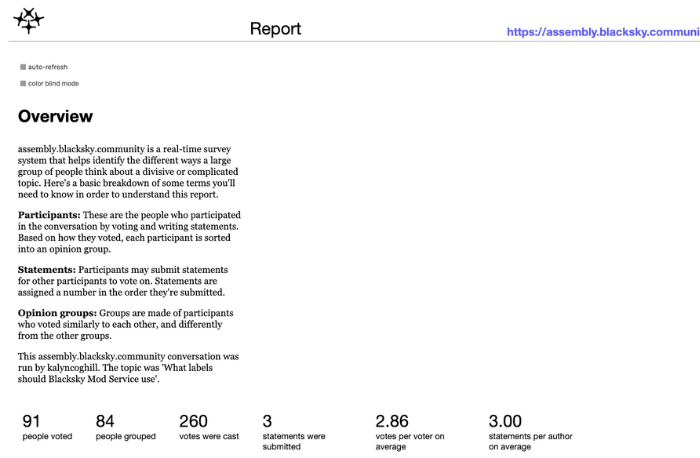
What Happens When You Have a Choice? : A Breakdown of The People's Assembly and Blacksky's Vision for Democratic Tooling

Introducing Discussions - a new way to have conversations on Blacksky 🗣️ Now you can create a dynamic poll right from the post composer in…

Sparkable
What Does Constructive Mean?

MySky Social | Jonathan Stray | Substack
Prosocial Media
