Why Being Wrong Can Be Right: Magical Warfare Technologies and the Persistence of False Beliefs
Across human societies, one sees many examples of deeply rooted and widely held beliefs that are almost certainly untrue. Examples include beliefs about witchcraft, magic, ordeals, and superstitions. Why are such incorrect beliefs so prevalent and how do they persist? We consider this question through an examination of superstitions and magic associated with conflict in the Eastern Democratic Republic of the Congo. Focusing on superstitions related to bullet-proofing, we provide theory and case-study evidence showing how these incorrect beliefs persist. Although harmful at the individual-level, we show that they generate Pareto efficient outcomes that have group-level benefits.
Believing what we do not believe: Acquiescence to superstitious beliefs and other powerful intuitions.
A Year of Magical Thinking
Elite impunity has fueled the fantasy that catastrophes are for other people.

Design Spells · Design details that feel like magic
Discover micro-interactions, easter eggs, and other seemingly extra design details that infuse life, personality, and fun back into the web.

Resource recs on AI catastrophic risk
If nothing magic is happening in the human brain, things could get weird

Against theory-motivated experimentation: Can random experimental choice lead to better theories?
Scientists must choose which among many experiments to perform. We study the epistemic success of experimental choice strategies proposed by philosophers of science or executed by scientists themselves. We develop a multi-agent model of the scientific process that jointly formalizes its core aspects: active experimentation, theorizing, and social learning. We find that agents who choose new experiments at random develop the most informative and predictive theories of the world. The agents aiming to confirm, falsify theories, or resolve theoretical disagreements end up with an illusion of epistemic success: they develop promising accounts for the data they collected, while misrepresenting the ground truth that they intended to learn about. Agents experimenting in these theory-motivated ways acquire less diverse or less representative samples from the ground truth that also turn out to be easier to account for. Random data collection, on the other hand, combines virtues of diverse and representative sampling from a target scientific domain which enables cumulative development of the successful theoretical accounts of it. We suggest that randomization, already a gold standard within experiments, is also beneficial at the level of experiments themselves.

The Perfect Mirror
An experiment with AI spiritual direction almost convinces Matthew Milliner that it works—until the real world breaks the spell.

Against Economics
Mainstream economists nowadays might not be particularly good at predicting financial crashes, facilitating general prosperity, or coming up with models for preventing climate change, but when it comes to establishing themselves in positions of intellectual authority, unaffected by such failings, their success is unparalleled. One would have to look at the history of religions to find anything like it. To this day, economics continues to be taught not as a story of arguments—not, like any other social science, as a welter of often warring theoretical perspectives—but rather as something more like physics, the gradual realization of universal, unimpeachable mathematical truths.

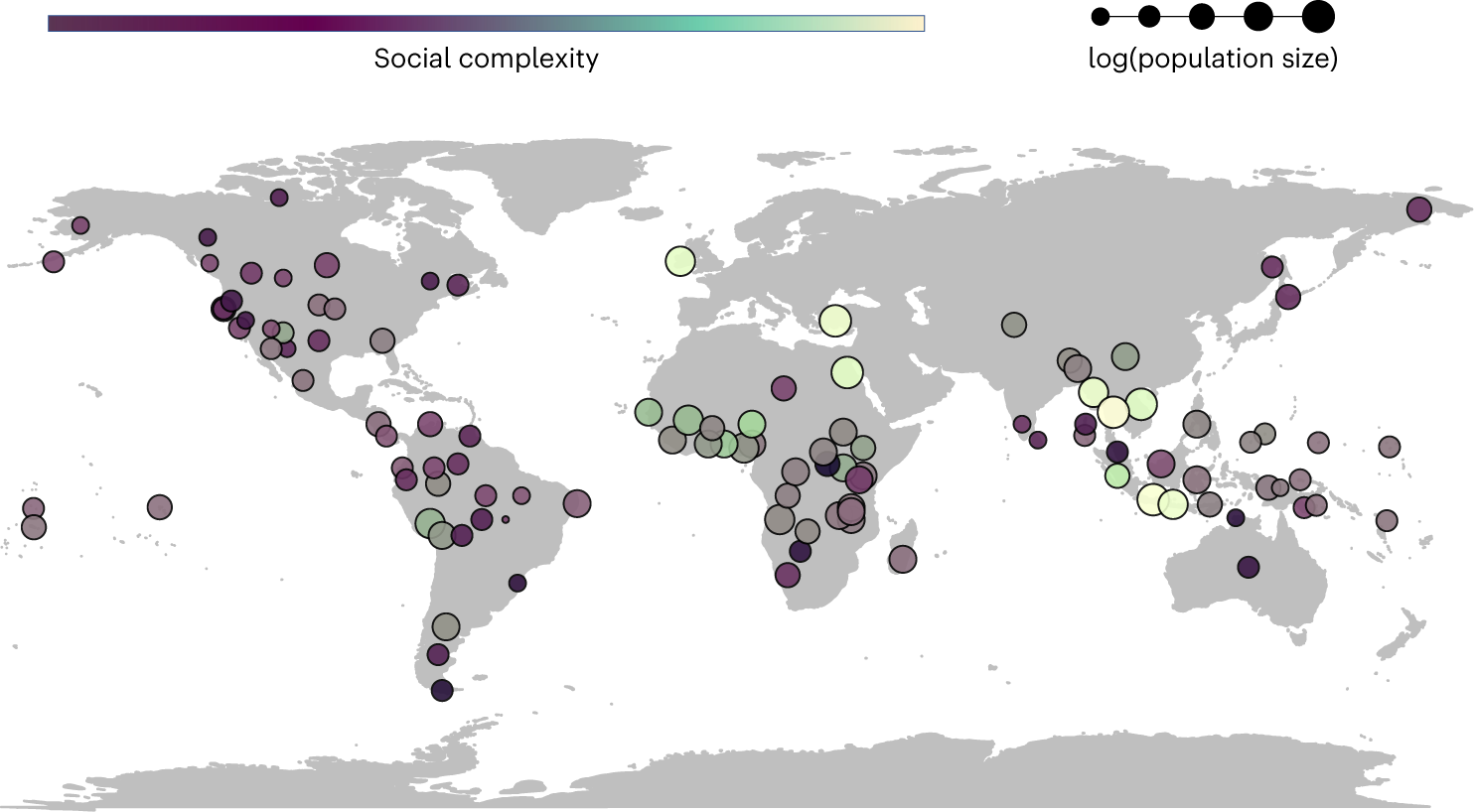
Supernatural explanations across 114 societies are more common for natural than social phenomena
Humans across the globe use supernatural beliefs to explain the world around them. This article explores whether cultural groups invoke the supernatural more to explain natural phenomena (for example, storms, disease outbreaks) or social phenomena (for example, murder, warfare). Quantitative analysis of ethnographic text across 114 geographically and culturally diverse societies found that supernatural explanations are more prevalent for natural than for social phenomena, consistent with theories that ground the origin of religious belief in a human tendency to perceive intent and agency in the natural world. Despite the dominance of supernatural explanations of natural phenomena, supernatural explanations of social phenomena were especially prevalent in urbanized societies with more socially complex and anonymous groups. Our results show how people use supernatural beliefs as explanatory tools in non-industrial societies, and how these applications vary across small-scale communities versus large and urbanized groups.

Conscious and Nonconscious Components of Superstitious Beliefs in Judgment and Decision Making
Abstract. Despite the large impact that superstitious beliefs have on the marketplace, we currently know very little about their implications for consumer


Experiments — ux-phi
Playable versions of canonical experiments in philosophy: the Socratic-questionnaire thought experiments — the trolley problem, Gettier cases, the side-effect effect, Mary the colour scientist.
I Fed the People Building the Metaverse
On AI, male ego, and other reasons I no longer believe technology is magic

Entanglement Builds Space-Time. Now “Magic” Gives It Gravity. | Quanta Magazine
In holographic theories, physicists may have traced the pliability of space-time to its quantum roots: a measure of quantumness known as “magic.”

The Ascendancy of the Scientific Dictatorship: An Examination of Epistemic Autocracy, from the 19th to the 21st Century
A. In the past, the elite manipulated the population through a more mystical belief system. In particular, there was the institution of Sun worship (typified by deities such as Osiris and Set). However, as antiquity gave way to modern history, this system of control began to lose its effectiveness. During the sixteenth century, the ruling class managed to co-opt a relatively new methodology of truth discernment...science. Over the years, they would contaminate this institution with their own virulent strains of thought...metaphysical naturalism, radical empiricism, Malthusianism, Darwinism, behaviorism, radical environmentalism, etc. Many of these paradigms were derivative of their own occult doctrines, thinly veiled to appear as objective science. All of these concepts correlate in some way and, at some point, coalesce. Together, they are gradually paving the way for the re-introduction of the hidden god of the Ancient Mysteries.

AI as Social Technology: Astor Lecture by Professor Henry Farrell

Bayesian Inference of Social Norms as Shared Constraints on Behavior

What people learn from punishment: A cognitive model

Spurious normativity enhances learning of compliance and enforcement behavior in artificial agents

Deference, Dissent, and Dispute Resolution: An Experimental Intervention Using Mass Media to Change Norms and Behavior in Rwanda

How Does Media Influence Social Norms? Experimental Evidence on the Role of Common Knowledge